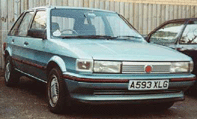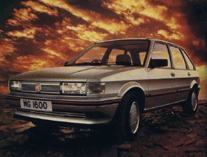
The MG Maestro 1600 was first fitted with a 1598cc R-series OHC engine. The configuration differed from the engines fitted to Austin Maestros because instead of the standard single SU carburettor the MG Maestro 1600 was fitted with two twin-choke Weber DCNF carburettors. This helped to increase the power from a standard 86BHP to 103BHP.
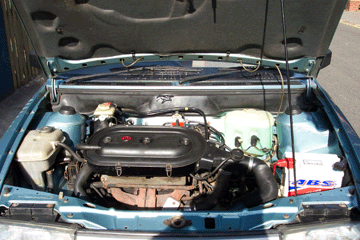
Originally Twin SU carburettors were considered as traditionally fitted to most previous MG cars, but this set-up failed to produce the 100BHP and 100lb/ft torque that Austin Rover had set as targets for the MG Maestro. The Weber DCNF carburettors helped to achieve the target because they effectively provide each cylinder with its own carburettor. Removal of the air filter housing reveals the "four trumpet"-effect. This set-up gives a distinctly sporty tone under acceleration and can be easily tuned and modified to increase power significantly. Top speed of an MG Maestro 1600 is around 112mph and the 0-60 time is just 9.6 seconds. This is significantly quicker than both the MG Metro 1300 launched the previous year and the MGB that had ceased production in 1980. In fact the performance was on a par with the MG Metro Turbo or Ford's Escort XR3.

All MG Maestro 1600s were fitted with solid-state digital instrumentation, trip computer and voice synthesizer. These features were linked to each other and to many sensors around the car. Even now, the MG Maestro 1600's dash seems way ahead of its time. In 1983 it was a revelation. Other cars such as the Fiat Tipo DGT and the Vauxhall Astra GTE were fitted with digital dashes, but none of them had the features fitted to the MG Maestro 1600.
The instrumentation was shared with the Austin Maestro 1.6 Vanden Plas. The MG has red stripes around the instruments, whereas the Vanden Plas has blue stripes. The layout of the instruments is the same on the digital dash as the 1.6HLS but all instruments (Speedo, tachometer, fuel gauge and engine temperature gauge) are LED displays. The Speedo features three large green digits, rather like a digital clock. Each digit is about 2cm high. The other instruments are made of small LEDs that illuminate as the revs, fuel reading and engine temperature increase.
The speedo has a convert button that changes the reading from MPH to Km/h. This was said to be useful when travelling abroad. When this button is pressed the trip computer readings also change. So for example if the unit is displaying the instantaneous fuel consumption, it will change this reading from miles per gallon into litres per 100km.
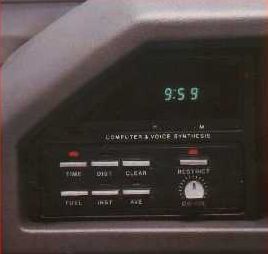
The trip computer that takes the place of the ashtray (which is relocated to a space in front of the gearlever) has six buttons which alter the reading in the digital clock display and trigger a voice message if the voice unit is on and not on restrict. The buttons work as follows:
| TIME | press once for time, then hold for date. |
| TRIP DISTANCE | trip distance reading in either miles or kilometres. |
| CLEAR | clears trip distance and the fuel readings |
| AVERAGE FUEL CONSUMPTION | displays fuel consumption since driver last pressed clear. |
| INSTANTANEOUS FUEL CONSUMPTION | displays current fuel consumption. |
| FUEL USED | displays fuel used since driver last pressed clear. |
| RESTRICT | reduces the announcements so that only warnings are heard. |
The three fuel readings rely on information sent by the fuel-flow transducer. This component can be seen positioned just to the left of the ignition coil on the bulkhead. The unit measures the rate that the fuel is flowing into the engine allowing the trip computer to calculate fuel used and in conjunction with the speedometer, the two fuel consumption readings. It is extremely important to regularly replace the fuel filter which is located in the fuel line just in front of the fuel-flow transducer. If the fuel filter is not replaced every 24,000 miles impurities in the fuel will damage the fuel-flow transducer and the trip computer will issue inaccurate readings. It is well worth replacing the fuel filter often because it keeps the engine clean and only costs £5. Fuel filters are still available from MG Rover dealers. (Fuel-flow transducers cost £187+VAT and are no longer available.)
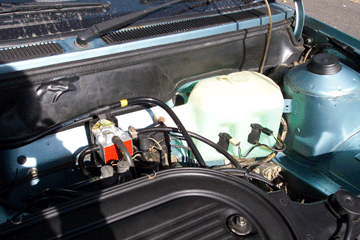
As mentioned earlier, when the restrict button is not pressed, the voice synthesizer announces the feature as you pressed the button on the trip computer. The voice synthesizer also announces other information, including seat belt reminders and warnings of low fuel. The voice synthesizer has a 36-word vocabulary that is used to announce the messages. A volume control on the unit could be used to adjust the volume or switch off the voice altogether. The voice can be left on with the restrict button pressed, this enables only the warnings to be heard.
The voice unit turns off the radio transmission before announcements and issues the messages through the driver's dash mounted speaker. The voice in the unit belongs to actress Nicolette MacKenzie who starred in TV Series such as General Hospital during the eighties. The Italian-spec MG Maestro 1600s were fitted with a male voice rather than the female voice of UK spec cars!
As well as the performance-tuned engine and digital instrumentation, the MG Maestro 1600 has many cosmetic differences from the Austin Maestro including:
Some of the standard features that were fitted to the Austin Maestro Vanden Plas were omitted from the MG Maestro 1600, but they could be fitted as optional extras. These included: tinted glass, electric front windows, tilt/slide sunroof and four-speaker stereo radio/cassette player (in place of the mono radio). Black or metallic paint could also be specified as an optional extra. The metallic paint was popular, particularly in the Silverleaf that was shown in the original Austin Rover brochures and Zircon Blue of which a large number have survived. Black paint wasn't as popular, perhaps because customers were unwilling to pay to have a solid colour. Black has always been an unusual colour on MG Maestros and this continued with the MG Maestro Turbo as only 49 black MG Maestro Turbos were built.
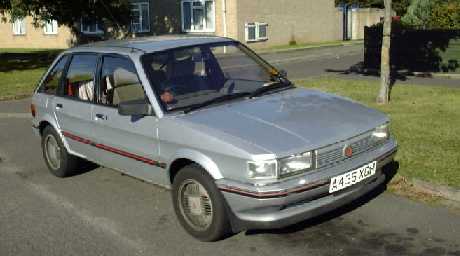
In April 1984, when the MG Montego was launched, all 1.6 litre Maestros received the S-series engine that was used in the new Montego. This new engine was essentially the same as the R-series that it replaced and it had the same displacement of 1598cc and produced the same power output. In the Austin Maestro the air filter housing was moved and became cylindrical rather than a flat, oval shape that it had been in the R-series Austin Maestros. The OHC engine was now belt driven instead of chain driven and there were a number of other small modifications made. In the MG Maestro 1600, the large oval air filter remained, as did the two Weber DCNFs. The main difference on the S-series MG Maestro 1600 was the addition of the carburettor cooling fan that was installed to help eradicate the hot-starting problems that some owners had reported. The MG Maestro Turbo and MG Montego Turbo have a carburettor cooling fan located in the same place, just behind the offside headlight.
Just 2700 MG Maestro 1600s were produced with the S-series engine between April and September 1984. Nowadays S-series MG Maestro 1600s are extremely rare and it is now unusual to see one, even at MG shows.