
Finding Time Last month, a camera was found I thought was lost. Last week I found a suit. Today, it occurred to me, What comes back reminds us of our fortune. I have lost more than a suit, So I open my heart to my life, THE DAFFODIL PRINCIPLE
Several times my daughter had telephoned to say, "Mother, you must come see the daffodils before they are over." I wanted to go, but it was a two-hour drive from Laguna to Lake Arrowhead.
"I will come next Tuesday," I promised, a little reluctantly, on her third call. Next Tuesday dawned cold and rainy. Still, I had promised, and so I drove there. When I finally walked into Carolyn's house and hugged and greeted my grandchildren, I said, "Forget the daffodils, Carolyn! The road is invisible in the clouds and fog, and there is nothing in the world except you and these children that I want to see bad enough to drive another inch!"
My daughter smiled calmly and said," We drive in this all the time, Mother."
"Well, you won't get me back on the road until it clears, and then I'm heading for home!" I assured her.
"I was hoping you'd take me over to the garage to pick up my car.
"How far will we have to drive?"
"Just a few blocks," Carolyn said. "I'll drive. I'm used to this."
After several minutes, I had to ask, "Where are we going? This isn't the way to the garage!"
"We're going to my garage the long way," Carolyn smiled, "by way of the daffodils."
"Carolyn," I said sternly, "please turn around."
"It's all right, Mother, I promise. You will never forgive yourself if you miss this experience."
After about twenty minutes, we turned onto a small gravel road and I saw a small church. On the far side of the church, I saw a hand-lettered sign that read, "Daffodil Garden".
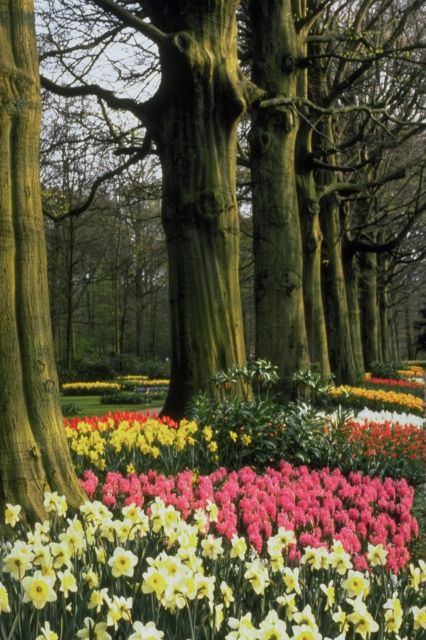
We got out of the car and each took a child's hand, and I followed Carolyn down the path. Then, we turned a corner of the path, and I looked up and gasped. Before me lay the most glorious sight. It looked as though someone had taken a great vat of gold and poured it down over the mountain peak and slopes. The flowers were planted in majestic, swirling patterns - great ribbons and swaths of deep orange, white, lemon yellow, salmon pink, saffron, and butter yellow. Each different-colored variety was planted as a group so that it swirled and flowed like its own river with its own unique hue. There were five acres of flowers.
"But who has done this?" I asked Carolyn.
"It's just one woman," Carolyn answered. "She lives on the property. That's her home." Carolyn pointed to a well-kept A-frame house that looked small and modest in the midst of all that glory. We walked up to the house. On the patio, we saw a poster. "Answers to the Questions I Know You Are Asking" was the headline.
The first answer was a simple one. "50,000 bulbs," it read.
The second answer was, "one at a time, by one woman. Two hands, two feet, and very little brain."
The third answer was, "Began in 1958."
There it was. The Daffodil Principle. For me, that moment was a life-changing experience. I thought of this woman whom I had never met, who, more than thirty-five years before, had begun - one bulb at a time - to bring her vision of beauty and joy to an obscure mountain top.
Just planting one bulb at a time, year after year, this unknown woman had forever changed the world in which she lived. She had created something of ineffable magnificence, beauty, and inspiration.
The principle her daffodil garden taught is one of the greatest principles of celebration. That is, learning to move toward our goals and desires one step at a time - often just one baby-step at a time - and learning to love the doing, learning to use the accumulation of time. When we multiply tiny pieces of time with small increments of daily effort, we too will find we can accomplish magnificent things. We can change the world.
"It makes me sad in a way," I admitted to Carolyn. "What might I have accomplished if I had thought of a wonderful goal thirty-five years ago and had worked away at it 'one bulb at a time' through all those years. Just think what I might have been able to achieve!"
My daughter summed up the message of the day in her direct way. "Start tomorrow," she said.
Lessons from Geese
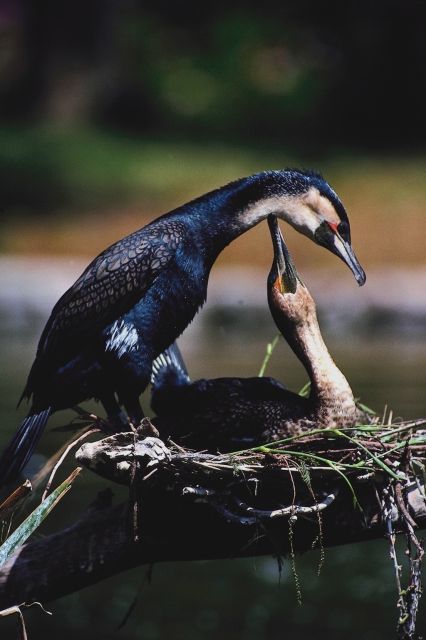
Fact 1: As each goose flaps its wings it creates an "uplift" for the birds that follow. By flying in a "V" formation, the whole flock adds 71% greater flying range than if each bird flew alone.
Lesson 1: People who share a common direction and sense of community can get where they are going quicker and easier because they are traveling on the thrust of one another.
Fact 2: When a goose falls out of formation, it suddenly feels the drag and resistance of flying alone.It quickly moves back into formation to take advantage of the lifting power of the bird in front of it.
Lesson 2: If we have as much common sense as a goose,we stay in formation with those headed where we want to go.
Fact 3: When the lead goose tires, it rotates back into the formation and another goose flies to the point position.
Lesson 3: It pays to take turns doing the hard tasks and sharing leadership. As with geese, people are interdependent on each others' skills, capabilities, and unique arrangements of gifts, talents, or resources.
Fact 4: Geese flying in formation honk to encourage those up front to keep up their speed.
Lesson 4: We need to make sure our honking is encouraging. In groups where there is encouragement, the production is much greater. The power of encouragement (to stand by one's heart or core values and encourage the heart and core of others) is the quality of honking we seek.
Fact 5: When a goose gets sick, wounded, or shot down, two geese drop out of formation and follow it down to help protect it. They stay with it until it dies or is able to fly again. Then, they launch out with another formation or catch up with the flock.
Lesson 5: If we have as much sense as geese,we will stand by each other in difficult times as well as when we are strong.
That's What Friends Do
Jack tossed the papers on my desk - his eyebrows knit into a straight line as he glared at me.
"What's wrong?" I asked.
He jabbed a finger at the proposal. "Next time you want to change anything, ask me first," he said, turning on his heels and leaving me stewing in anger.
How dare he treat me like that, I thought. I had changed one long sentence, and corrected grammar, something I thought I was paid to do.
It's not that I hadn't been warned. Other women who had worked my job before me called Jack names I couldn't repeat. One coworker took me aside the first day. "He's personally responsible for two different secretaries leaving the firm," she whispered.
As the weeks went by, I grew to despise Jack. His actions made me question much that I believed in, such as turning the other cheek and loving your enemies. Jack quickly slapped a verbal insult on any cheek turned his way. I prayed about the situation, but to be honest, I wanted to put Jack in his place, not love him.
One day another of his episodes left me in tears. I stormed into his office, prepared to lose my job if needed, but not before I let the man know how I felt. I opened the door and Jack glanced up. "What?" he asked abruptly.
Suddenly I knew what I had to do. After all, he deserved it.
I sat across from him and said calmly, "Jack, the way you've been treating me is wrong. I've never had anyone speak to me that way. As a professional, it's wrong, and I can't allow it to continue."
Jack snickered nervously and leaned back in his chair. I closed my eyes briefly. God help me, I prayed.
"I want to make you a promise. I will be a friend," I said. "I will treat you as you deserve to be treated, with respect and kindness. You deserve that. Everybody does." I slipped out of the chair and closed the door behind me.
Jack avoided me the rest of the week. Proposals, specs, and letters appeared on my desk while I was at lunch, and my corrected versions were not seen again. I brought cookies to the office one day and left a batch on his desk. Another day I left a note. "Hope your day is going great," it read.
Over the next few weeks, Jack reappeared. He was reserved, but there were no other episodes. Coworkers cornered me in the break room. "Guess you got to Jack," they said. "You must have told him off good."
I shook my head. "Jack and I are becoming friends," I said in faith. I refused to talk about him. Every time I saw Jack in the hall, I smiled at him. After all, that's what friends do.
One year after our "talk," I discovered I had breast cancer. I was thirty-two, the mother of three beautiful young children, and scared. The cancer had metastasized to my lymph nodes and the statistics were not great for long-term survival. After my surgery, friends and loved ones visited and tried to find the right words. No one knew what to say, and many said the wrong things. Others wept, and I tried to encourage them. I clung to hope myself.
One day, Jack stood awkwardly in the doorway of my small, darkened hospital room. I waved him in with a smile. He walked over to my bed and without a word placed a bundle beside me. Inside the package lay several bulbs.
"Tulips," he said.
I grinned, not understanding.
He shuffled his feet, then cleared his throat. "If you plant them when you get home, they'll come up next spring. I just wanted you to know that I think you'll be there to see them when they come up."
Tears clouded my eyes and I reached out my hand. "Thank you," I whispered.
Jack grasped my hand and gruffly replied, "You're welcome. You can't see it now, but next spring you'll see the colors I picked out for you. I think you'll like them." He turned and left without another word.
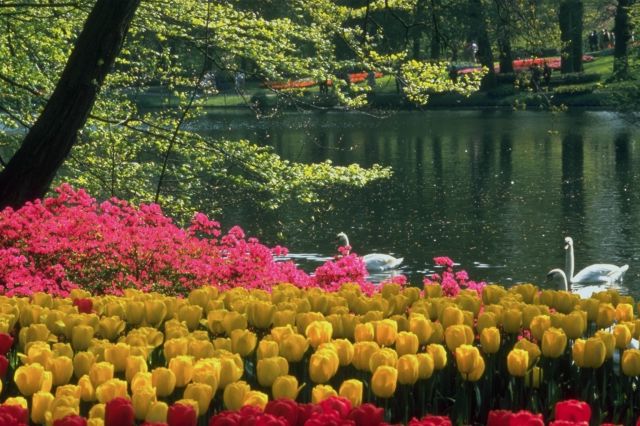
For ten years, I have watched those red-and-white striped tulips push their way through the soil every spring.
In a moment when I prayed for just the right word, a man with very few words said all the right things.
by Chris Weaver
I remember having been disappointed with myself,
Losing such a nice item.
When it was found it, I realized,
My life had proceeded on normally without it.
But what felt especially good in finding it,
Were memories stirred seeing images stored in that camera.
It was a high end Italian job I bought in Florence,
Thought left behind in a hotel closet.
Low and behold, it turned up at the cleaners.
I had gotten along just fine without it.
But the suit, when I wear it, reminds me of Italy,
Of adventurous and happy times.
Nothing is lost.
What goes its own way, goes for the better understanding of the gods.
Even though there is sadness in losing something special,
We survive and move forward.
Even if it is a little harder.
Even if it is a lot harder.
What will be will be.
But mostly,
We are surprised.
Because so often, we fill our lives full of things,
We don’t really need,
Like a suit or a camera.
I have lost more than a camera with special pictures on it.
I know what it is to lose things,
That cannot be replaced.
But even the very difficult losses have served in some way,
To teach me, make me better,
Help me appreciate everything to come my way.
Whatever it brings to me,
Even if it brings loss.
Knowing if I keep on going,
Keep living and losing,
I will become more.
Finding.
by Jaroldeen Asplund Edwards
by Dr. Robert McNeish
We are willing to accept their help and give our help to others.
by T. Suzanne Eller
After all, that's what friends do.
