
Images of the PastOur candlelit evening walk through the Eldora CemeterySomeone from the back of the group spoke up and said, "good evening Mr. Lundy." An elderly man, dressed in a very fine suit, raised his lowered head, looked at the crowd and said, "good evening ladies and gentleman." Mr. Lundy? Mr. Edward Lundy? How could this possibly be? Behind the man who said that his name is Edward Lundy stands a gravestone, bearing the name Edward H. Lundy and also inscribed in the stone were the dates July 3, 1871 - October 17, 1958. The group of people standing around the grave of Edward Lundy didn't appear to be frightened, only intrigued. We stood in silence and listened intently as Mr. Lundy told us that he had been a businessman of rare discernment and keen acumen, always looking to the interests of the community in general while advancing his own. He told us of what it was like to live in Hardin County during the 1900's. He also told us of his first wife who was buried to his left and of his second wife who was buried to his right, and he told us of his children who grew to be fine upstanding citizens, and that they were buried behind he and his wives. It was remarkable to say the least, to have this man standing before us, talking about the history of Hardin County. In the background, a few hundred feet away, there was heard the sound of someone playing a violin. Next to Mr. Lundy was a lantern to light his face so that we could see him. We (my Mother and I) and about 20 other people had been shuttled by a little tram into the depths of the cemetery where we followed our hosts and the paths marked by candle light. Mr. Lundy returned to his resting place and we walked a small distance where we came upon a man singing a beautiful hymn. His name was Charles McKeen Duran. Mr. Duran had a rare and lovely voice and his dog Romeo was standing, still standing by his side, even in death. Behind him was his gravestone and that of his wife and family. Inscribed in his stone were the dates November 26, 1842 - June 1, 1934. Mr. Duran told us of his father, a minister in Vermont, who moved his family by a small horse drawn buggy to Iowa when he was just a baby. Mr. Duran was one of the organizers of the Hardin County Bank. It was a pleasure to meet Mr. Duran and Romeo, who Mr. Duran told us was his best friend. We moved onto Samuel R. Edginton (1827-1888) and Lois Beal Edginton (September 18, 1832 - April 14, 1912) who told us that they had purchased the 2nd lot sold in Eldora for $40.25 in 1853. Lois had given the town its name, "Eldora". Mr. Edginton had been a Lieutenant Colonel in the Civil War. They seemed like such a happy couple. Life sure was hard on them during those days, but now they can rest together in eternity. By now it was very dark in the cemetery. Our only light was from the candles lighting the path and the lanterns which lit the faces of those who had come back to tell us who they were. Our guide told us of a woman buried in the cemetery who had been born on the spot that she now rested. She had also been married in that same house that once stood there, and she died in that very same house. She had donated her land and the house to the cemetery, which is where she still is today. She must have loved that spot very much! The graceful sound of the violin had drifted into the distance and now we could hear the soft melancholy tune coming from a flute. We crossed the cemetery, following the dark path and soon we met Sheldon Greenleaf Winchester (July 17, 1830 - October 14, 1889) and Mahala Ellsworth Winchester (January 25, 1833 - January 27, 1927). Mr. Greenleaf had left his home in Ohio with only $8.00 in his pocket at the age of 16. He heard the calling of the West, and struck out alone to find his fortune. Mrs. Winchester was one of the first teachers of the Eldora school system and daughter of the prominent Daniel Ellsworth. Sheldon and Mahala were very much in love and shared with us their hardships as well as their accomplishments. They lost three children at young ages to diseases that today are common place and easily treated.
|
Then there was Enoch Eastman (April 15, 1810 - January 9, 1886) who was the Lt. Governor of the State of Iowa at one time. He also was the attorney who prosecuted the Reform School Superintendent, accepting no fee. He said, "my satisfaction was in seeing the radical reform in management that made the School a humane institution and not a prison. That School, now called the Eldora Training School, still stands and still houses boys under the age of 18 who have had, well let's just say that they have had some trouble with the law. But thanks to Enoch, they are treated humanely and fairly while incarcerated. Enoch surely is at peace in his beautiful surroundings. Our guide pointed out a small marker that was the resting place of a runaway slave girl. Not much was known about her except that she had run away from somewhere and she was found in someone's barn very ill and died a few days later. Whoever found her was kind and made sure that she had a safe haven to rest in. We also had the pleasure of meeting Mr. Paul T. Davison (March 16, 1895 - May 30, 1970). He was the first custodian of the Pine Creek State Park, which is now called Pine Lake State Park. He was instrumental in the building of what we know at that park as the Upper Lake and the bath house which still stands in it's original place. He is resting approximately half a mile from the Lake that he loved so much. Mr. Rex Bateson was the next distinguished resident of the cemetery that we were privileged to meet. He was a prominent attorney and told us of his untimely death in 1963 in Mexico. He suffered a heart attack while vacationing with his wife. It took quite some time to get all the proper papers filed before his body was released for burial in Eldora. His coffin is lined with lead and he is encased in glass. Do you suppose they were afraid he'd get out? Well he fooled them, because he did get out for a time on Friday, July 27, 2001. Just long enough to visit with a group of about 20 people before he returned to his glass encased and lead lined bed.
|
We continued on just a bit further where the little tram was waiting for us. We boarded the tram and were transported from the serene resting places of many people who had braved an oftentimes unforgiving territory. People who had the fortitude and generosity to leave us the part of the world that we now call home. We arrived safely and were greeted by friendly folks who don't yet have a headstone with their name and dates of birth and death on it and were served homemade ice cream and cookies.
|
This production was put on by the Hardin County Historical Society. There was obviously a lot of planning and research involved in what we enjoyed the other night. It was a wonderful experience and I will look forward to attending again when they put another one on. On our program, which is where I got the facts for this article there is an Old Russian proverb; "We live as long as we are remembered."
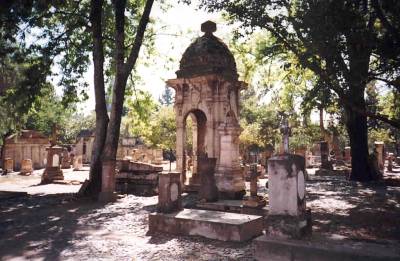
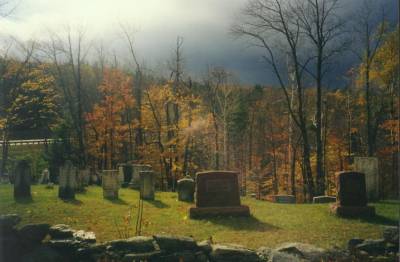
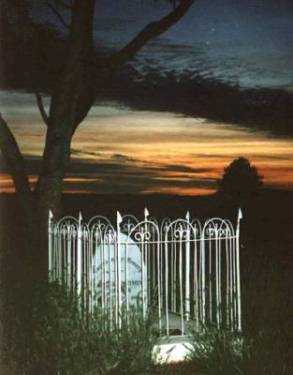
By Ann Lindaman July, 2001 The first picture is a cemetery in Guadalajara, Mexico The next one is a cemetery somewhere in Vermont, USA And the last picture is a gravesite near Cloncurry, Queensland, Australia back to my homepage |
