DIFFERENTIALS
Where are differential gears?
The differential gears are located in the center of the front and rear axels depending on which type of drive train your car has. In a FWD car it is in the front and in a RWD car it is in the rear, respectively. AWD cars are special though, there are 3 differentials; one on the front axel, one the back axel, and one in between the two axels in the middle of the drive shaft. The additional differential is there so that the front and rear tires can move at different speeds.

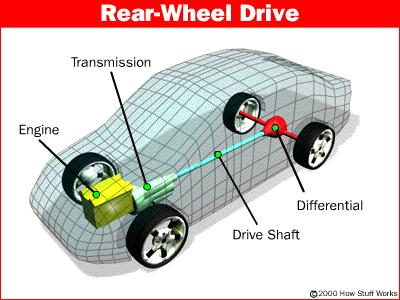
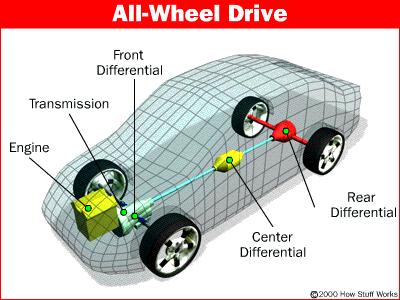
The differential gears are placed between half shafts on each axel. By dividing the axel it will allow the car's wheels to turn at the different speeds it needs to.
Why Do We Need Differential Gears?
While driving your wheels spin at different rates especially when turning. In a turn, your outer wheels will move across a greater distance then the inner wheels. The outer wheels must also travel this greater distance in the same amount of time it takes for the inner wheels to travel the shorter distance. That means the outer wheels must be able to spin faster then the inner wheels.
The problem is that the driving wheels - wheels being driven by the engine - must be connected to each other so that when the engine turns the axel both wheels will turn. They must also be able to turn at different rates meaning they must be disconnect in some way. If they were not able to move at different speeds and the axel directly connected both wheels it would be almost impossible to turn. A tire would have to spin or slip. This slip or spin would cause a lot of strain on the axel and could end up ruining the car. A differential makes it possible for your wheels to be connected to your engine while being able to spin at different speeds.
As for the non-driving wheels, they do not need differentials for they spin indendently from everything else.
What Happens In a Regular Differential?
- The drive shaft turns a crown wheel.
- The crown wheel rotates, rotating the planet pinions. However, the planet pinions are not spining they are revolving.
- The planet pinions turn the sun gears.
- The sun gears spin and turn the axels, which turns the tires.
The crown wheel turns both wheels at the same rate. But when the car turns the planet pinions start to spin in the opposite directions. This allows the tires on the outside of the turn and get ahead of the inside tires. The differential makes the turn sharper, smoother, and quicker.
Above Image: ©2002 Microsoft Corporation. All rights reserved.
Problems
Differentials will allow tires to spin at different speeds but one of the bigest problems comes when a tire slips, such as on ice. A car will not move because the supplied torque is given to the spinning tire. That means the other tire on the ground will not be able to push the car. Now-a-days there is a solution. A Limited-Slip Differential(or LSD) will solve this.
A LSD has a mechanism within the gears that will lock at a certain point. There is a set of clutches and a spring between the pinion gears. When the tires are spinning evenly the spring and clutch are off the pinion gears. When a tire is spinning at a different speed the springs push out on the clutchs against the pinions forcing them to spin together. Note: This occurs even when turning. Depending on the springs and clutches there is a way to get past the locking ability by push through it (such as when turning and the tires are firm on the ground). When a tire is slipping on ice the clutches will locks the gears inside the differential suppling torque to both tires. This will allow you do manuver over the ice.

Another kind of differential used mostly in AWD vehicles is called a Viscous Coupling Differential. This differential will transfer torque from one set of tires to the other set of tires.
This differential has two power output shafts, two sets of discs, and a large sealed cylinder of thick liquid surrounding the discs. When one set of tires are off the ground and spinning faster then the other set of tires, their corresponding discs spin faster as well. When the thick fluid spins with the faster moving discs, it takes the other set of discs with it. This is transfering of torque to the gripping tires.
One might ask about turning and how this differential effects it. While turning the front and rear tires might spin at different speeds, but not at a big enough rate to cause any effects in this differential.
Differentials in many 4WD vehicles are also special. They are called Locking Differentials. That means they can lock there wheels together so they spin at the same speed, done so from an interior switch. This helps when offroading and rock climbing. This makes it impossible to turn though.
Return to Main Page
Copyright © 2002 ppddaiddddyy's site
All Rights Reserved.
Images: Thanks to www.HowStuffWorks.com


