
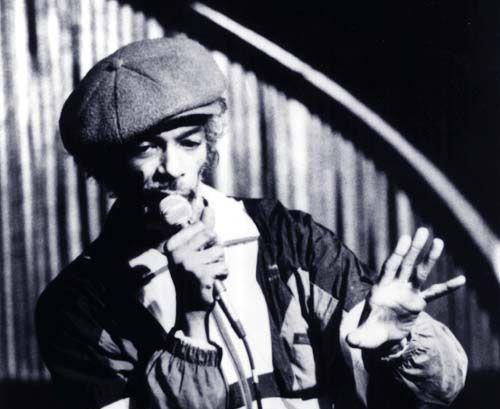


A full-on spoken word album, complete with dated references and arguably immature missteps.
Billed as "a new black poet" on the album cover, you can bet that this album is quite a period piece. In that respect, it's a fascinating time capsule. A perfect account of a small slice of Black amerikkkan ideology in the late 1960's and and early 1970's. The word 'revolution' is used liberally, but it's not just a glamor word; he really means it. There's a lot of poignant commentary going on here, but alas, it's a spoken word album. Gil shouts, cusses and grunts his way through fourteen articulate, unique and outspoken poems over the top of congas and nothing else. One piece in particular is quite puzzling: "The Subject Was Faggots" doesn't really make clear whether or not Gil really feels this way or is making a satire of people who are homophobic. In any case, it's an complete failure. There is no singing or proper songs on this album, so as poignant and quotable as it is at times, it is not a good representation or introduction to the world of GSH.
~Austin


Colorful and touching rebirth of an artist.
One of the most personal albums ever recorded, the title is not just an eye-catcher. It is an accurate representation of the album's vision (not to mention, a wonderful song). While he was still stuck with studio musicians for this album, Gil's got the cream of the crop: Ron Carter's impeccable timing and sympathy on bass; Bernard Purdie's impregnable, yet still funky rhythms; and most importantly, Brian Jackson's steady and beautifully melodic pianos. Jackson would become an integral part of the GSH sound in the near future, but for the this album, he's simply a great compliment. While "The Revolution Will Not Be Televised" with the full band backing is certainly the album's most well known piece (and probably it's most revolutionary; it is arguably the first rap 'song' ever recorded), "Home is Where the Hatred Is" is its most enduring. A chilling first hand account of addiction, it suggests sobering similarities to the concepts of home as later offered by Robert Smith on "Homesick" and Ben Gibbard on his lone solo outing (how's that for far-reaching influence?). Revived a few years later by Esther Phillips (a worthy rendition), and then several years later by Gil himself, it is an often stunning piece of realism, disguised as a catchy and resonating pop song. And that's the weird thing about this album: it doesn't really have a funky soul slant like you may have expected. It's far more vocal pop, with slightly funky overtones in the rhythm section. And, in stark contrast to his preceding album, it is a surprisingly calm, decidedly melancholy affair. Indeed, Gil is more Curtis Mayfield than David Ruffin when it comes to his singing style (except in baritone). Many of the songs here are so resonant and articulate, they would perhaps have been a highlight on a lesser album; but instead, they just blend in with the unique and revolution-suggesting atmosphere found here. It is a profound, naive work by an artist who truly believes (or rather, believed at the time anyway) that music could (or would) save the world. Powerful stuff. On some days, I would have no trouble calling it Gil's definitive statement.
~Austin
A paraphrase of the first two albums.
This album would be Gil's last proper one for Flying Dutchman and it serves as a meeting ground between his first two albums. The first half of the album (a/k/a side one of the record) is all proper songs and they are all more of the message filled (but not preachy), meditative vocal-styled tracks that appeared on Pieces of a Man. Although, of the five songs found here, there aren't any revelations, they are still of the highest quality. "Did You Hear What They Said?" is a rather chilling Vietnam protest that accounts the reality in the aftermath of a soldier's death. The second half (a/k/a side two of the record) is entirely spoken word pieces. It feels like Gil has stepped up his spoken word game, as he sounds less angry while simultaneously making more precise and damaging attacks on his targets. "Ain't No New Thing" in particular is quite vicious (and accurate). Overall, while the album does feel a little stagnant and underwhelming (which I have always felt was on account of the sequencing), the material is still quite good; and some of it points the direction to the great things forthcoming.
~Austin
BLUEBIRD FIRST EDITION...
In 2001, the RCA boutique label Bluebird Jazz remastered and expanded Free Will to great success. The remastering on the proper songs is outstanding, correcting the original's muddy sound. There are two alternate takes included: the title track, which receives a much jazzier rendition and "Speed Kills" which stays fairly true to the released version, except only Gil is heard on vocals. Because the spoken word side of the album was more or less done in one take, there is a nearly complete alternate version of the second side of the album. This deluxe edition doesn't enhance the album, but it will make longtime fans come to a more full appreciation of it.

Reiteration of Gil's Flying Dutchman albums.
Upon his departure from the Flying Dutchman label, Gil issued this best of set that does a pretty good job of summing up his output for the label. It pretty much covers all the essentials, but as I am big anti-compilation person, I would say go for the proper albums. Although, this collection does pop up a little more frequently (due to its subsequent reissue on RCA proper) than the albums. So, it may serve as a good introduction and place holder until you can track down the albums.
~Austin



A brilliant spiritual realization.
A fascinating and focused song cycle that stands as one of the most personal and poignant albums ever made. The entire record concentrates on lamented memories, introspective searching and personal revelations. The small jazzy group that works with Gil here is a perfect complimentary piece and makes the already intimate reflections contained in the album's lyrics magnified. Brian Jackson's acoustic and electric piano work throughout the album is spot-on and a wonderful co-star for Gil's newly sympathetic tone. Despite the spoken word track that addresses Watergate ("H2Ogate Blues"), the rest of the album's content is utterly timeless. Whether addressing relationships ("Peace Go With You, Brother", "A Very Precious Time" and "Your Daddy Loves You") or social issues ("The Bottle" and "A Song For Bobby Smith"), the record can be heard in any context or time frame and still resonate. A masterpiece. One of the best pieces of cover art I've ever seen as well.
~Austin
RUMAL-GIA EDITION...
In 1998, the album was remastered and expanded. The bonus tracks are mostly live recordings, but one alternate take of "A Song For Bobby Smith" from 1978 is quite possibly an improvement over the original. There's a great live recording of "Winter In America" which wouldn't get a proper studio rendition until Gil's next album. The final track is a monster 10+ minute performance of "The Bottle" that is rousing, but without losing the bite of the tune's core. The sound is full and intimate, leaving me with the opinion that it is the definitive rendition of the record.
Basically the same direction, except with a bigger budget.
Trivia time: this was the first album ever released on Arista Records. And, with an expanded budget, Gil and Brian Jackson were able to hire a full-time band. The chemistry between these musicians is amazing. They are able to make some of the material on this album —which is otherwise standard issue GSH— quite exciting. There is much more of a focus on the funk and the groove in these songs and the polyrhythmic exercises they work into are quite invigorating (especially on "The Liberation Song" and "Guerilla"). Another interesting aspect is that, despite an electric bass player (Danny Bowens), there are no guitars in the new band. All of the melodies are handled by vocals, pianos and horns. The band uses this somewhat unique lineup to meld the music into a sort of afro-informed vocal jazz sound. Brian Jackson's role is even more prevalent than before, sometimes taking on solo vocal duties. There is one solo spoken word piece ("Pardon Our Analysis") that is a somewhat sequel to the last album's "H2Ogate Blues." Overall, it's quite a unique brand of 70's soul that doesn't really sound like anything else from the time. This would just be the starting point for a long time of high quality work from GSH and Brian.
~Austin
RUMAL-GIA EDITION...
In 1998, the album was remastered and expanded. The remastering is again ably handled Malcolm Cecil. There's only two added tracks; one a solo spoken piece that revives and makes a medley of some of Gil's most well-known poems, the other a solo vocal and electric piano rendition of "Winter In America" performed by Gil and it is easily the best thing to come out of the GSH remaster campaign.
More of the same.
Not that there's anything wrong with this album, it's just too similar to the last one, which had better songs and execution. The fact that this album followed Midnight Band by a matter of months should be a good clue-in to its rushed sound. Brian Jackson is at his most prevalent on this album, taking lead vocals on roughly half the tracks. The musical backings are just as interesting as before, some of the songs are just carried out a little longer than necessary. I've warmed up to it a lot more over the years, but it definitely doesn't live up to the bar that was set previously.
~Austin
RUMAL-GIA EDITION...
A few superb live tracks (including a monster rendition of "Johannesburg" and a great "Save the Children") and an early hip hop track from the 80's protesting apartheid, which sounds out of place next to the rest of the album, but is nice completion piece.
Half live/half studio. All great.
A great move to capture The Midnight Band live on this album. Not all the songs are live recordings; a few slots were used on the album to air some new studio recordings and they are all more interesting (and better) than the previous albums jammy tendencies. The jamming is saved for the live recordings and, in that context, whether premiering new songs ("17th Street" and "Trane") or revisualizing old ones as extended epics ("The Bottle" and "Home is Where the Hatred Is"), everything sounds in sync and as tight as ever. The funk is definitely played up on this album. Because of that and the album's inclusion of some older songs, coupled with the stellar performances, this could be viewed as a fine introductory piece to Gil's later period. As it stands, it's another reiteration of Gil's consistency.
~Austin
RUMAL-GIA EDITION...
Remastered in 2000, but because it was originally a double album on vinyl, no bonus materials were included, besides new liner notes by Gil (which all of the Rumal-Gia reissues include).
A revamp and contemporization of the classic GSH sound.
This album marks a fairly drastic change in Gil's music. The content and message is still there, but The Midnight Band's polyrhythmic attack is abandoned in favor of Gil and Brian conducting studio musicians towards a more rhythmically concise base with much more of a focus on keyboards and guitars. Sure, it may sound like a dumbing down, but I actually view it as an improvement. The sound here is much closer to Gil's R&B peers of the time, but even in that category, he sticks out immensely because of his complete disregard for disco. The songs are fine-tuned to perfection and this was the first GSH album that didn't have at least one spoken word piece. Overall, it's a very soothing and polished record that has undoubtedly been very influential on the R&B genre since its release, especially on folks in the 90's. It's one of my favorite records of all time.
~Austin
If it ain't broke, don't fix it.
Musicians used to do this all the time: tour all year and write songs on the road and then bang them out for a new studio record about a year after their previous album. And Gil and Brian were arguably the best at it. If not, they were certainly the most consistent. Sure, this album, musically, sounds dead-on similar to the last one, but the songs are so good, it doesn't matter. By this point, Gil and Brian were like the Lennon-McCartney of R&B, churning out song after song of catchy resonance. From pop songs ("Madison Avenue" and "Show Bizness") to social commentaries ("Angola, Louisiana" and "Angel Dust" to the introspective feel good ballads that we'ce to expect ("A Prayer For Everybody/To Be Free"). Perhaps just a notch below Bridges, but still miles ahead of its peers.
~Austin
Collection of Gil's spoken word pieces.
This album collects all of Gil's spoken word pieces that appeared on all of his previous Arista albums (plus "H2Ogate Blues"), along with a few previously unheard pieces. It's all pretty good and focuses a lot on 1970's politics, but fans of Gil's singing will be disappointed. However, it's a treasure trove for fans of his spoken work, as the original issue of this album is difficult to find, to say the least.
~Austin
RUMAL-GIA EDITION...
Remastered in 2000. The reissued edition features one bonus track; a single from 1990 protesting the United States' ridiculous money-dumping into its space program titled "Space Shuttle." It's not a complete success, as it blends an almost Happy Mondays sounding keyboard dance track with Gil's spoken verses, but its inclusion is appreciated for completion of your collection. Despite all of the previous reissues in the Rumal-Gia series mentioning that all of Gil's Arista albums would eventually be remastered and reissued, the series stopped with this album, leaving the rest of Gil's catalogue (from Bridges on) out of print as of this writing. I have been able to track down official CD issues of the rest of his late 70's and early 80's catalogue, through Japanese-issued CDs, but they were exceedingly difficult to obtain (and not too cheap when I did).
Still ain't broke.
Completing a series of records that could be viewed as somewhat of a trilogy, 1980 is just another home run. The sound is evolving here a little to a more contemporary sound, complete with dated (but not detrimental) slap basslines. The material is just as strong as ever though, with Gil and Brian jamming out another eight songs that are catchy beyond belief. The epic title track is one of the duo's best songs ever, while "Alien (Hold On To Your Dreams)" has remained a live staple since its inception. This would be Brian Jackson's last album with Gil and it is a fine parting note to go out on. His presence was certainly missed in the following years. Arguably the best of Gil's Arista catalogue.
~Austin
The Gil and Malcolm Cecil show.
Malcolm Cecil's billing is upped to co-producer (though he had been involved since Secrets), suggesting that, in Brian Jackson's departure, Gil turned to Malcolm Cecil to fill that void. While the album isn't a complete washout, there is definitely a step down in quality here. The backing tracks are, for the most part, unchanged (though maybe a little too slick), but lyrically and thematically, the album is somewhat unfocused. There's a few tracks that are directed properly and they are complete triumphs. But some things feel, for the first time in years, like filler (I still have trouble sitting through "Combinations" and "A Legend In His Own Mind"). Perhaps a slight step down, but there's redeeming moments, like the revisiting of "Your Daddy Loves", which is given a completely new arrangement and is a complete victory. Still, it is a telling sign that he had to go back into his catalogue of old material to make a winner. This is the first album to feature Gil's working band The Amnesia Express.
~Austin
A reassuring and more sure-footed affair.
This album starts out with Gil's first venture into reggae "Storm Music", suggesting that the album is going to be a big change of pace. But, instead, it's back to business as usual after the song. And it's not like the song is a crappy half-attempt at the style, either. It's a rather convincing, resonating tune. From there, the backings and songs are back to what we have come to accept as the signature GSH sound from this period. In fact, things are executed in such a by-the-books fashion that you may not even notice there's two spoken word poems contained on the second half. Indeed, diligent listeners will notice that Gil sounds quite reinvigorated here, whether through the spoken word with musical accompaniment tracks ("Morning Thoughts", the sort of cover "Inner City Blues/The Siege of New Orleans" and the epic anti-Reagan rant "'B' Movie") or the reiteration of his love of jazz ("Is That Jazz?"), he truly sounds inspired here most of the time. A strong later effort.
~Austin
A strange, uneven farewell.
This album starts off with one of the most cliched-sounding songs Gil ever did with the over-the-top slapbass and intrusive horn charts of "Fast Lane" (and isn't there a terrible guitar solo in there somewhere too?). It's an overproduced song that sets the table for the uneven mess to follow. There are some good —even great— songs here, but it's by no accident that this is Gil's shortest album. With an album that strains to reach 35 minutes, time should not be wasted on throwaway filler like the aforementioned "Fast Lane." Not to mention the shameless rehashes of old songs: "Blue Collar sounds a lot like "Three Miles Down" while "Explanations" may remind you of "Late Last Night" thematically and "Show Bizness" melodically. There's a couple more reggae experiments here and one is completely brilliant ("No Exit") while the other is standard, but still decent ("Ready Or Not"). Overall, it's disappointing that he basically retired from recording after this album because it's just not up to par and it would've been nice to have a great album to say good bye with. But, it's still got some alright stuff that fans will find of interest.
~Austin
A decent overview of Gil's Arista work.
Although this collection does inexplicably contain a few pieces from Gil's Flying Ditchman albums, it focuses on his hits from his Arista albums. Being that some of those records have become increasingly scarce in recent years, this serves as a decent introduction to the period. It did contain one new track, an updated anti-Reagan rant, the decidedly dated and cheesy "Re-Ron."
~Austin
A fantastic overview of Gil's Arista work.
An expansive two CD collection that gives a more accurate portrayal of Gil's Arista years. Although, by this point, the albums are probably easier to find on vinyl than this collection is. And, with such a sprawling and generous running time, you might question whether or not it would just make more sense to get the proper albums. I would say, yes, hold out for the albums, but then again, it is kind of a cool collection, just because of its exceeding rarity. However, when it came down to it, I traded mine in because it was rather superfluous.
~Austin

Gil and the later incarnation of the Amnesia Express hit the road in Europe.
A two disc collection of European live in concert recordings, it's a bit too much sheen for my taste (and hearing "Save the Children" smooth jazzified is more than a little disappointing). The extended performances that worked on It's Your World work against this album's favor because the band simply isn't as good. The 20+ minute rendition of "Angel Dust" is just confusing. The persistent audience sing-a-longs, overly glossy performance by the band and canned crowd noise make this sound uncomfortably close to a lounge act. The songs on disc one all sound like the same performance, but to make this album even more confusing, disc two seems to be pulled from several different performances. None of the actual dates or cities of performance are listed either.
~Austin
Same stuff, still not very good.
A single disc synopsis of Tales of Gil Scott-Heron. More poor annotation and information, perhaps to get people like me to buy the same material twice. Probably better to avoid these later live releases.
~Austin
An unforeseen, yet beautiful and epic comeback.
After over a decade of battling addiction for the second time in his life, Gil made this comeback album of all new material. And while his voice has diminished away into a rough, nearly Tom Waits howl and some of the production aspects of the backing tracks have now become dated, it is perhaps Gil's most personal and inspired work since Winter In America, two decades previous. He has rarely sounded as important as he does on "Message to the Messengers", a brilliant spoken piece where Gil has recognized his influence in the hip hop world and sees the misguided steps that the younger generation has taken and his commentary on the issue is eye-openingly poignant (and still relevant, over a decade later). The center piece is "The Other Side", a nearly 20 minute long epic that updates "Home is Where the Hatred Is" and sounds like it was recorded live during the concerts documented on Tales of Gil Scott-Heron. The band isn't really fantastic (and that guitar solo is very cliched), but Gil's straining voice full of despair and fear is enough to make it quite possibly his most affecting piece ever. Brian Jackson has even stopped by to add his sure-handed touch to the piano on a few tracks. The focus on the spoken word tracks is an interesting move and the results are always quite good (the great 'military/monetary' dynamic of "Work For Peace" is a definite highlight). Overall, it's a bittersweet temporary victory, because as reinvigorated as Gil sounded here, he just as quickly disappeared from the public eye yet again and has remained musically silent ever since.
~Austin
