
|
A study in Renaissance culture - the arts and politics |
Written by Irving Stone
Starring
Charlton
Heston as Michelangelo
Rex Harrison
as
Julius
II
Diane Cilento
as
the Contessina de Medici
Harry Andrews
as
Donato
Bramante
Tomas Milian
as
Raphael
Santi
Adolfo
Celi as Giovanni de Medici
Alberto
Lupo as the Duke of Urbino
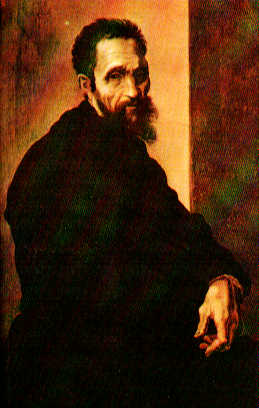 |
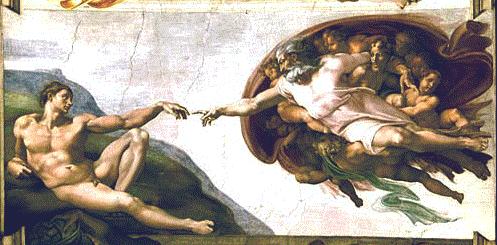 |
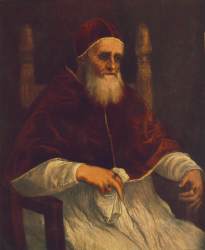 |
|
(1475-1564) |
(1508-1512) |
(1443-1513) |
Intertwining of two great Renaissance figures'
lives and conflict (between Pope Julius II
and the artist-sculptor, Michelangelo) leads
to the painting of the Sistine chapel in Rome
in this huge spectacle, a meticulous production,
loosely based on the Irving Stone novel.
Nominated for 5 Academy Awards
including
Best Color Cinematography
The Agony and the Ecstasy by Irving Stone
This film presents a reasonably accurate portrayal of the intricate and often
violent politicsof Renaissance Italy. Pope Julius was often considered a better
warrior than religious leader. The movie shows the pope's role as secular leader
of the Papal States as well as for the Christian Church in Western Europe. In
the film, one of the cardinals justifies Julius's role as a warrior by stating that
the pope must fight his secular enemies to maintain an independent Church free
fromthe control of European princes. This is and has been a subject for debate.When you view and discuss this film, keep in mind the role of the papacy in
medieval and Renaissance Europe and the growing protests against the political
aims and the materialistic ambitions of the popes.The movie accurately portrays how Michelangelo worked on the ceiling.
Fresco is theprocess of painting on damp, freshly laid plaster so that the paint
is bonded to the wall. For many years, it was felt that Michelangelo used muted
colors for his design. A recent cleaning and restoration project on the Sistine
Chapel ceiling has shown the colors to be bright and rich. The film shows fresco
colors as they were revealed recently, which is interesting, since the film was
made 20 years before the restoration project.Note the scene between Michelangelo and Raphael when they discuss the
role of the artist and his patron. The necessity of patronage and securing
commissions from wealthy clients began during this time period. It has
continued to plague the artist, to a certain extent, up until the present.Identifications and Vocabulary: Define these terms from our pre-film discussion
they they will give you a better understanding of the film. The WEB sites at the end of
this page will help you to complete this part of the film activity.Michelangelo Buonarroti:
Julius II:
Donato Bramante:
Raphael de Santi:
de `Medici (family):
Fresco:
Cardinal:
Papal States:
St. Peter's Basilica:
Simony:
Indulgences:
1) Why didn't Michelangelo want to paint the Sistine Chapel?
2) What was Michelangelo’s reaction to the commission, the request by Julius, to
paint the ceiling of the chapel?
3) a. Why does Michelangelo destroy his early work on the painting and run off to the
stone quarry at Carrara?
b. What does this tell you about characteristics of a Renaissance artist?
4) a. What criticisms does Michelangelo hear when Julius' Cardinal aides respond to
the partially finished work?
b. How does Michelangelo respond to them?
c. Why does Julius later tell Michelangelo "you make a better priest than I do"?
How can this be?
5) a. How were the Renaissance artists restricted by their need for a patron and
funding?
b. What reminder does Raphael Santi give to Michelangelo about artists and
their relationship with their patrons?
6) How did Julius raise money for his wars and for the completion of the Sistine
Chapel? How would this practice contribute to the decline of the prestige of
the papacy?
7) Julius II commissioned Michelangelo to paint the ceiling of the Sistine Chapel.
Michelangelo went way over schedule and budget. What were the problems?a. Did Michelangelo simply underestimate the time required?
b. Did he underestimate the cost or availability of the supplies he needed?
c. Did he think the effort through, not considering logistical complexities?
d. Did he underestimate the labor he would need to assist him?
e. Did Julius II ask for many revisions (e.g., Noah’s nakedness already covered,
about to be covered, almost uncovered. . .)?
8) Describe 3 challenges that faced Michelangelo as he painted the Sistine Chapel.
a.
b.
c.
9) How did the people react to the painting when it was first unveiled?
WEB Sites pertinent to the characters in and story of the film
The Agony and the EcstasyMichelangelo: His Life and His Art A biographical study (with works) of the life of
MichelangeloMichelangelo 02 A strong biographical study of Michelangelo
Michelangelo 03 From the EuroWeb Gallery, a biographical study (with works) of
MichelangeloJulius II 01 From the Catholic Encyclopedia's popes
Julius II 02 From InfoPlease.com, a biographical study of Julius II
Julius II 03 A paper done on the life and importance of Julius II as a pope
Donato Bramante 01 Renaissance study of Bramante's architectural works
Donato Bramante 02 From Giorgio Vasari, a study of Bramante
Donato Bramante 03 From InfoPlease.com, a biographical study of Bramante
Raffaello Sanzio (Raphael) 01 A biographical and artistic study of Raphael
Rafaello Sanzio (Raphael) 02 Uffizi collection and survey of Raphael's works
Rafaello Sanzio (Raphael) 03 Biography and works of Raphael
Sistine Chapel -- The Ceiling Cleaned A new look at the Cleaned-up Sistine Chapel and what
it has revealed to the art world; includes a study on how the clean-up was done.Fresco 01 What is a Fresco?
Fresco 02 Understanding the Fresco style of painting, and examples from the Renaissance
St. Peter's Basilica The construction and history of St. Peter's, the center of the Roman
Catholic world.
|
to Home |
 |
 |
|
