
|
|
 |
(author) |
Starring
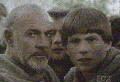
Sean
Connery as
William of Baskerville
Christian
Slateras
Adso of Melk
F.
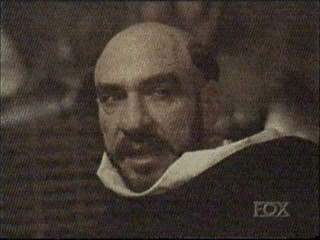
Murray Abraham as Bernardo Gui
Helmut
Qualtinger as Remigio de Varangine
Michel
Lonsdale as the Abbott
William
Hickey as Ubertino de Casale
Elya
Baskin as Severinus
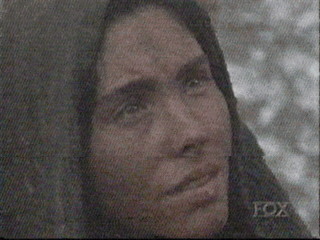
Valentine
Vargas as The Girl
Michael
Habcheck
as Berenger
Volker
Prechtelas Malachia
Feodor
Chaliapin, Jr. as Jorge de Burgos
Ron
Perlman as Salvatore
 |
 |
 |
 |
|
& Adso of Melk |
|
Inquisitor in Toulouse (from 1307-1323) |
|
Name of the Rose is a movie about a differences between the two kinds of monks.
William of Baskerville is portrayed as a "modern man", a scholar-monk who seems to
understand all the lessons of the past and is able to see the "big picture", unlike the
others of his age.The story takes place in the year 1327, as William of Baskerville and his young
novice, Adso of Melk, arrive at an unnamed northern Italian monastery, which
happens to contain the greatest library in Christendom. Baskerville, the visiting
monk, who is of the Franciscan order, and his novice, arriveat the remote
Benedictine abbey to attend a church debate with other important delegates. It is
through the eyes of this young monk-in-training that the mystery unravels. Adso
becomes witness to the lengths the Roman Catholic Church went to suppress
knowledge in order to maintain the strength of the church and her faithful.Scribes and scholars have come from all across Europe to use the library,
wanting to see its closely-guarded treasures. mysterious intrigues develop among
the monks, and the story turns a series of unexplained murders. A gifted young
illuminator is killed; the next morning a second monkis found dead, standing
head-first in a barrel of pigs' blood. A series of murders occur in the monastery,
and William, who has a reputation as something of an investigator, becomes
involved in trying to discover the causes of death and to find the murderer. There
are many suspects, but like Arthur Conan Doyle's Sherlock Holmes, he tackles the
mystery with all of his sharpened skills of observation.Some historians feel that the control over new knowledge and ancient classical
literature was the key to the church's stability during the Middle Ages. William of
Baskerville uses his logic and reasoning skills to solve the mysterious deaths of
several monks at the abbey. His use of logic gets himinto trouble when he confronts
the superstition and arbitrary powers of the Holy Inquisition.
Questions for the Analysis of the Name of the Rose:
1) In the beginning of the story while William is outside the walls of the abbey, he
observes the peasants fighting over refuse thrown down the hillside from the
abbey. He makes the comment, "And there's another generous donation of the
church to the poor." What is his meaning?2) Ironically, the theme of the story seems to be that the hunger for knowledge and
truth is dangerous, divisive, and ultimately illusory. How does William's yearning
for books reflect the changing times times in 14th Europe?3) William is an English Franciscan and a student of Roger Bacon. The early
beginnings of experimental science took place among English Franciscans;
William himself demonstrates a deductive ability reminiscent of Sherlock Holmes.
Compare and contrast the characters of William of Baskerville andBernardo Gui.
How do they represent the two divergent ways of logic/reason and the
superstition/fear in the late middle ages?4) Bernardo Gui: The medieval inquisition had been created during the reign of
Pope Gregory IX (1227- 1241). Its main technique was to extract confessions.
Bernard describes the techniques used in interrogations. Bernardo Gui was a
real life character. What can you find out about the actual historicalcharacter?
(There are several web sites that deal with Gui's role in the inquisition)5) What methods were employed by the Holy Inquisition in dealing with those
accused of heresy, witchcraft, and other similar crimes against the church? Is
the film accurate in this portrayal of the Inquisitioning techniques? Explain
thoroughly.Why did William of Baskerville choose to separate himself from the Inquisition?
6) Two great conflicts appear in the story: first, the Pope and the Holy Roman
Emperor are fighting for pre-eminence; and second, the Pope and the
Franciscans are battling over the question of poverty."Should the Church
possess earthly riches and play a role in temporal politics; or should it work
among the poor and outcast, emulating (as the Franciscans argue) the poverty
of Christ?" Explain the positions of each of these two monastic orders on this
question.7) How do the customs, beliefs, and practices of the Franciscan and Benedictine
orders differ? How were they similar? Create a chart showing this comparison.8) William of Baskerville asked the head librarian of the abbey, "What's the
matter with laughter?" Analyze the contradiction that exists in the words of the
librarian when he says, "Laughter is evil," andyet he reads Aristotle's works.
What are the librarian's words before he dies?9) There were numerous heretical groups attacking the established order of church
and society. Some are puritanical and scorn the wealth and pomp of the papacy;
others stir up rebellion against the rich and are rumored to be grossly immoral.
Members of these sects become bandits and outlaws when they arepersecuted.
The monastery shelters many men who have been on the losing side of these
disputes with the Pope; some are Franciscans, but others have murkier
backgrounds. Describe the "heresies" of three different groups from the medieval
period.
|
to Home |
 |
 |
|
