
|
A Study in Medieval Culture and Politics |
Written by James Goldman
Starring
Peter O'Toole
as
Henry II
Katharine Hepburn
as
Eleanor
Timothy Dalton
as
Phillip II
Anthony Hawkins
as
Richard I
John Castle
as
Geoffrey
Nigel Terry
as
John
Jane Merrow
as
Princess Alais
Nigel Stock
as
William Marshall
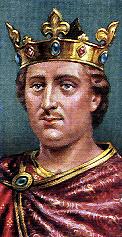 |
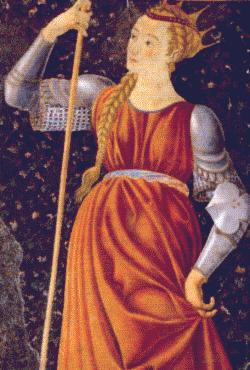 |
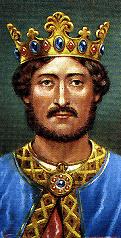 |
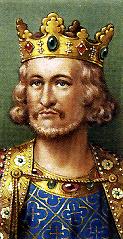 |
|
the Lion (1133-1154-1189) |
of Aquitaine (1122-1204) |
the Lion-hearted (1157-1189-1999) |
Lackland (1165-1199-1216) |
Lion
in Winter is a very witty character study of Henry II and Eleanor of Aquitaine
and
their
sons, Richard, Geoffrey, and John (and their family secrets). It
makes use of a
very
clever dialogue, and is a film that should be viewed several times to gain
a "full"
comprehension
of its multiple philosophical meanings. Lion in Winter provides a
view
of
12th century society, politics, and the influence (or lack of influence)
of the church.
Nominated for 7 Academy Awards
Won
3 Academy Awards, Including:
Best
Actress
(Katharine
Hepburn)
Best
Screen Play
Lion
in Winter by
James Goldman
(An
Historical Study)
The events in this film take place in the late 12th century. The main characters
are: Henry II (King of England), Eleanor of Aquitaine (Henry's wife), Richard, Geoffrey
and John (surviving sons of Henry and Eleanor),Philip II (the young King of France),
and Princess Alais (his sister). It is Christmas, 1183, the height of the Middle Ages.
This film is about a family conference called by Henry II, who hopes to settle the
issue of who his successor as king of England will be. Modern psychology has been
used to interpret what might have happened in the past; and, although this
conference portrays a fictitious event, such meetings did actually take place.The complex nature of feudal holdings becomes evident, not far into the story.
Eleanor had been married previously to King Louis VII of France, who sought her
dowry of the rich lands of Aquitaine and Poitou. Whenshe did not produce a male
heir, Louis annulled her on the grounds of consanguinity (blood relationship).
Eleanor then married Henry Plantagenet, who became King Henry II of England
three years later. It is important to remember that the king of England was also the
Duke of Normandy and therefore a vassal of the French king.The ambition of the
English kings to gain more French lands and the desire of the French kings to
prevent this was a mojor theme for many years of the Middle Ages. It led to the
Hundred Years War. Marriages were a goodway to gain valuable territory. For
example, with Princess Alais came her dowry of a province called the Vexin,
a land Henry desired for its strategic location near Paris.Note how the film portrays living conditions in the Middle Ages. Unlike the
"olde" time film (like Ivanhoe), Lion in Winter gives the idea that castles were
actually uncomfortable to live in. Castles have been muchromanticized, but the
reality is that they were damp, cold, and primitive places. Not that people lived
long in them in the first place. Dogs freely wander the halls as a reminder that
hunting was an important medieval pastime. Consider the mind set that you have
about king or queen -- Do Henry and Eleanor fit that perception?How does your
perception differ from "reality" as portrayed in Lion in Winter?Note also how the main historical characters are portrayed. Although the
records are sparse, we do know that Henry was a strong king. He was concerned
with making his law the universal or "common" law ofhis land rather than the
fragmented feudal laws of each manor. Eleanor is considered to have been one
of the most powerful women in history. Richard did become king (1189-1199), but
was noted more for his prowess as a warrior than his abilities as a ruler. John
became king after Richard (1199-1216); his rule was disastrous for the English
monarchy. He lost almost all of the English possessions in France. He also was
forced by his nobles in 1215 to sign the Magna Charta, which limited the monarch's
power. Because he was such a bad king, noEnglish prince since then has been
named John!Vocabulary:Use your text and outside sources, including the internet, to find
out about these terms and people listed below. Why were these people "notables"
of their time? What did they stand for? What didthey accomplish? See WEB
Sites at the end of the study guide . . .annulment:
(to hold) a court:
crusade:
dowry:
vassal:
primogeniture:
excommunication:
Thomas Becket:
Eleanor of Aquitaine:
Henry II (Plantagenet):
Richard I (Plantagenet) 'the Lion-hearted":
John (Plantagenet) "Lackland":
Battle of Bouvines:
Magna Carta:
Robin Hood:
Innocent III:
Philip II (Capet) "Augustus":
Historical Analysis:
1) The Middle Ages, by earlier historians, were referred to as the "dark
ages." Consider the detailed description in A World Lit Only by Fire; what
does William Manchester have to say about the times?
What does Spielvogel (pp. 178-192, 210-228) have to say?
2) Observations from the film: Does the film give any corroborative support or
opposition to the descriptions above? Describe the observations you have made:
3) Modern (revisionist) historians have considered the Middle Ages many things,
but not the "dark ages." As you view this film, try to determine why modern
historiographers do not consider this period a "darkage." Site your
observations:
4) Based upon what you have read in Spielvogel and/or A World Lit Only by Fire,
and observed in Lion in Winter, what general conclusions can you make about
the period referred to as the Middle Agesconsidering quality of life, societal
standards, political nature of the time, and religious attitudes?
5) What was life like for royalty during the Middle Ages? Use the film to cite
examples of the medieval lifestyle, both in every day living, as well as at festive
occasions. Consider clothing, food, living quarters, entertainment, holiday
customs, and power of medieval royalty.
6) What does this film lead you to think of about the life of the lower classes
(serfs/peasants) of the time (in comparison to royalty)?
7) What does Henry mean when he says, “I’ve snapped and plotted all my
life. There’s no other way to be alive, king and fifty all at once.”?
8) Comment on the importance of marriage in the middle ages as a “political tool.”
Why was the marriage of Eleanor to Henry important for England? Important
to France? Why is Henry anxious to keep Alais?
9) Why was Henry so obsessed with planning for his succession? He mentions a
king named "Lear," and we have talked about Charlemagne. What did they do
to cause discord in their dynastic line with regardsto succession? What disasters
did they create?
10) What does this conversation tell you about medieval politics/ international
relations?Henry II: “The Vexin’s mine.”
Philip of France: “By what authority?”
Henry II: “It’s got my troops all over it; that makes it mine.”
11) Why did Henry keep Eleanor imprisoned in Salisbury Tower? Why do you
suppose he didn't just divorce her?
12) Why did Henry and Eleanor's sons plot, cheat, connive, and try to politically
devour each other?
13) Explain what Prince Geoffrey means when he says to his brother John, “If
you’re a prince, there’s hope for every ape in Africa.”
14) Philip II of France became known as "Augustus" – noble, glorious, imposing,
stately, princely. What traits does he display that might merit this title? What
are some of his "less kingly" traits?
15) Eleanor states, "We are the origins of war, not history's forces, nor the
times, nor justice, nor the lack of it, nor causes, nor religions, nor
ideas, nor kinds of government. . . ." Who is the"We" she is talking
about here? How true is this? How does this statement demonstrate the politics
of feudalism?
16) "We are the world in small. A nation is a human thing; it does what
we do for our reasons. Surely, if we are civilized we can put away the
knives. We can make peace. We have it inour hands." What does
Eleanor mean by this comment? Who is the "We" in this statement?17) When Eleanor (of Aquitaine) said to her son Richard, “You’re not an
assassin;” he responds by saying, “Look again.” What does he mean?
What does this tell you about intrafamily competitionfor the crown?
18) What does Eleanor mean when she says, "We're jungle creatures, Henry.
And dark is all around us . . ." Is she referring to the age in which they
are living as a "dark age," or is she referring to something else?
19) In comparing the character of the knight in In the Name of the Father with
the characters in Lion in Winter, in what ways do they differ on the religiosity
of the times?
20) Look up Niccolo Machiavelli who lived during the Renaissance. He wrote a
book about the way a leader should rule called The Prince. Would the tactics
he talks of to be used by his prince be comparable to the tactics you see in Lion
in Winter?
WEB Sites pertinent to the characters in and story of the film,
the Lion in WinterHenry II from Camelot International
Richard I from Camelot International
|
to Home |
 |
 |
|
