
|
|
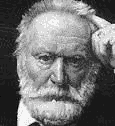
Written by Victor Hugo
Starring
Liam Neeson
as Jean Valjean, convict on the run, mayor of Vigau
Geoffrey Rush
as Javert, policeman who hunts Valjean
Uma Thurman
as Fantine, Valjean is devoted to her
Claire Danes
as Cosette, Fantine's daughter whom Valjean raises
Reine Brynolfsson
as Captain Beauavais
Hans Matheson
as Marius, militant student, love interest with Cosette
Peter Vaughan
as Bishop, befriends Valjea
Mimi Newman
as Cosette (age 8)
 |
 |
|
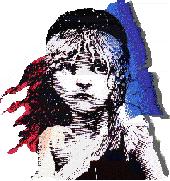 |
In "Les Miserables", the film, based on Victor Hugo's epic story, Jean Valjean is convicted
of stealing a loaf of bread, which causes him to lead a life on the run. Jean falls in love with the beautiful and poverty-stricken Fantine. After her death, Valjean raises her daughter Cosette. As the story unfolds, Cosette falls in love with Marius, a young revolutionary. In the story, Valjean decides to sacrifice his own freedom to save Cosette's love. The movie reaches a climax with a confrontation between Valjean and Javert, the policeman who hunts Jean to the end. On the banks of the Seine, at the height of the July revolution in 1832, the story concludes in a somewhat surprising, yet predictable way.This novel takes place in a France in which the monarchy has been returned to power by
the reactionary forces of Europe that defeated Napoleon in 1815. In the France of the Restoration, the disparity between the wealth of the aristocracy and the desperate poverty of the masses is overwhelming.1) Take one of the following characters who have become archtypes: Jean Valjean, a
man condemned by poverty and classification as a convicted felon but redeemed by
the kindness of one man and his own will; Collete, the child victim of poverty,
Bishop Myriel, the social activist who believes in the essential goodness of man; and
Javert, the petty, regulation bound, and short-sighted bureaucrat who relenlessly and
unreasonably pursues a good man for a violation that should have been forgotten
long ago, and write a full-page character study based upon the character's
personality and actions in the story.2) Explain Jean Valjean's actions as clearly as you can state them:
> Did Jean Valjean do wrong by stealing the loaf of bread? Was there another way to
get what he needed? If you can justify his stealing the loaf of bread, where do you
draw the line between crime which should be punished and crime that can be
excused?> Why did Jean Valjean steal the silver from the Bishop? Is there any way that
this act can be justified?> Why did Jean Valjean steal the coin from Petit Gervais? Do you blame him for
doing it? If you don't blame him for stealing the coin, where do you draw the
line between crime which should be punished and crime that can be excused?3) Do you think that Cossette and Marius knew eachother well enough to really
fall in love? What chances would you give them for long-term happiness
together? How would you react to an ex-convict who had spent many years in
the harshest and roughest prisons, living and working close to you? What if
you had young children?4) "Les Miserables is a leviathan I am about to ship out to sea," said Hugo
before he published his turbulent 5-volume epic story. And truly, what a
leviathan it was -- history, political, and religious theory were just a few of the
many things interwoven into the fabric of this already complex story. Site fully
how of each of these themes are expressed in the film while relating to the
story.5) Why did Jean Valjean spare Javert's life? Describe the character of Javert and
explain: why Javert let Jean Valjean go, why Javert committed suicide, and
what might Javert have done instead.
|
to Home |
 |
 |
|
