
|
|
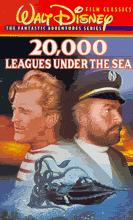
Written by Jules Verne
Starring
Kirk Douglas as Ned Land
James Mason as Captain Nemo
Paul Lukas as Professor Pierre Aronnax
Peter Lorre as Conseil
 |
The story opens in San Francisco of the late 19th century, where terrified
sailors are telling tales of a giant narwhal (one-horned whale) wrecking their
vessels. Professor Arronax, his assistant, Conseil, and a roguish harpoonist
named Ned Land, join an armed expedition to find the narwhal. After their
frigate is sunk, the three men uncover the truth about those strange tales:
the “narwhal” is actually the Nautilus, a giant submarine designed and built
by reclusive genius, Captain Nemo.
1) a. What similarities and/or differences exist between the news media's coverage of
the recent shark attacks and the reports of a monster in thin the story's beginning?b. What physical and behavioral characteristics does the monster share and not share
with marine mammals?2) What does this chapter reveal about trying to find a “monster” (or any object) in the
world ocean?3) What was known about submarines in Verne’s time and how is Verne’s imagination at
work here?4) Is Captain Nemo justified in his belief that the Professor, Ned and Conseil should be
treated as enemies?5) a. What do we learn about Captain Nemo’s intellect, background and philosophy?
b. What do you think is Nemo’s idea of utopia, an ultimate dream world, based on
what we learn aboard his ship?c. What does Verne’s description of the Nautilus tell us and not tell us about the
mind of Nemo?d. How does Verne use existing scientific principles and inventions to “equip”
the Nautilus “beyond all belief”?6) How is Verne’s ability to take new inventions and extend their application for
his stories evident in this chapter?7) a. What nineteenth century attitudes towards animals and hunting are revealed in
the story?b. List the foods eaten aboard the nautilus and classify them according to phylum
and/or class.c. What is a dugong, where does it live, how does it feed and why is it endangered?
How does this study once again point to man’s reckless exploitation of the sea?d. Based upon your observations, do you think Verne is pro-whaling? Why do you
think Verne includes “environmental” issues in this novel?8) How are shipwrecks symbolic of man’s relationship with the sea and what does
this symbolism say about the role of technology to overcome Nature’s power?9) How is the men’s excursion on land like an episode of Survivor’s?
10) a. What does Nemo mean when he says “Are you surprised, Professor, at setting
foot on land…and finding savages there? Where aren’t there savages?”b. What modern-day events support or refute Nemo’s contention that the entire
world is inhabited by savages?11) What can we glean about Nemo’s opinion of himself and his cause from the
portraits of great men that he keeps hung in his cabin?12) What is the legend of Atlantis, how did it get started and how does Verne
support this legend (to such an extent that interest in Atlantis thrived
following publication of his novel)?13) When Nemo says “we may brave the laws of humanity but we can’t withstand
the laws of Nature,” what law of humanity led him to be in this predicament in
the first place?14) Explain the lesson that Verne intends from the following passage: “…this
plague is nothing compared to the scourge that will strike our descendants
once we have exterminated all whales and seals. Then, overpopulated with
cuttlefish, jellyfish and squid, the oceans will become vast centers of
infection, since their waters will no longer contain ‘those cast stomachs
that God has assigned to souring the surface of the seas.’”15) a. Why do you think Verne deliberately keeps the nationality of the attacking
ship a secret?b. Why are the three men so interested in the nationality of the ship?
Return
to HomeTo Film Index



