
|
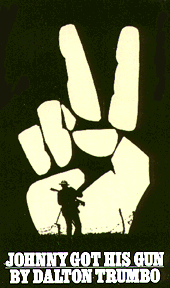
A Study in the Realities of War II |
 |
Starring
Timothy Bottoms
as Joe Bonham
Donald Sutherland
as Jesus Christ
Kathy Fields
as Kareen
Marsha Hunt
as Joe's Mother
Jason Robards
as Joe's Father
Marge Redmond
as the First Nurse
Jodean Russo
as the Second Nurse
Alice Nunn
as the Third Nurse
Diane Varsi
as the Fourth Nurse
Maurice Dallimore
as the British Colonel
Ed Gilbert
as thePriest
Peter Brocco
as the Ancient Prelate
Judy Howard Chaikin
as the Bakery Girl
Kendell Clarke
as the Hospital Offical
Ben Hammer
as the Second Doctor
Robert Easton
as the Third Doctor
Eric
Christmas as Corporal Timlon
 |
 |
 |
|
the Boys |
a Talk With Jesus |
|
: This film is rated R for violence and sexual content.
While this content is not blatant and graphic, it does give the film the R-rating. It is
not a requirement that you view this film, but if you chose to do so, it has much
historical content that can be studied.Johnny Got His Gun is a harrowing classic story of the horrors of war and its
consequences. The story revolves around the tragic life of Joe Bonham, a boy sent
to war with hopes of victory. As in Remarque'sAll Quiet on the Western Front,
Dalton Trumbo tells of a "romantic" war that depresses one with its starkrealities.
Joe is severely wounded in battle, and is unable to see, smell, hear, or taste. He is
completely isolated from the outside world physically, socially, and psychologically.
His isolation drives him into a life of nothing, misery but no pain. Throughout the
story, Joe struggles to retain his humanity. He hasdifficulty trying to tell if he's
sleeping or awake because he can't see or hear. One of the most intriguingparts of
this story is Joe's struggle to keep in his mind what year and time it is.
Dulce et decorum est
Bent double, like old beggars under sacks,
Knock-kneed, coughing like hags, we cursed through sludge,
Till on the haunting flares we turned our backs,
And towards our distant rest began to trudge.
Men marched asleep. Many had lost their boots,
But limped on, blood-shod. All went lame, all blind;
Drunk with fatigue; deaf even to the hoots
Of gas-shells dropping softly behind.Gas! Gas! Quick, boys! -- An ecstasy of fumbling,
Fitting the clumsy helmets just in time,
But someone still was yelling out and stumbling
And flound'ring like a man in fire or lime.
Dim through the misty panes and thick green light,
As under a green sea, I saw him drowning.In all my dreams before my helpless sight
He plunges at me, guttering, choking, drowning.
If in some smothering dreams, you too could pace
Behind the wagon that we flung him in,
And watch the white eyse wilting in his face,
His hanging face, like a devil's sick of sin,
If you could hear, at every jolt, the blood
Come gargling from the froth-corrupted lungs
Bitten as the cud
Of vile, incurable sores on innocent tongues, --
My friend, you would not tell with such high zest
To children ardent for some desperate glory,
The old lie: Dulce est decorum est
Pro patria mori.Wilfred Owen
(English poet, March 18,1893-November 4,1918 -- killed in
action in France crossing the Sambre Canal, just one week
before the Armistice)"Dulce est decorum est pro patria mori"
Horace, Roman poet, 65-8 B.C.
(While Quintus Horastius Flaccus was a student at Athens, he
enlisted in Brutus' and Cassius' army against Octavian and
Mark Antony. When his side was defeated at Phillipi, he
returned to Rome. Dulce est decorum est pro patria
appears in his second book of Epistles .)
Johnny Got His Gun by Dalton Trumbo captures the essence of the post-war
existentialismmovement. As the brutality and thoroughness of war has increased
with new technology, the romantic notion of war has diminished. The cold,
indifferent cruelty of modern warfare has changed ourperception of war. The story
writer asks many questions about war, democracy, the military, themedical doctors
and nursing corps, and established religion.Trumbo portrays the fall from innocence of a young man who goes off to war
with the belief, Dulce et decorum est pro patria mori, and returns from the
battlefield a nameless, limbless, speechless, sightless and hopeless, but thinking
invalid. Set in a time at its most chaotic, "the GreatWar," the story is void of
optimism and overflowing with questions.Both Erich Remarque and Dalton Trumbo must have been familiar with
Owen's life and works, for it is this phrase, Dulce et decorum est pro patria
mori, that becomes the focus of both men's classic works about World War I --
It is sweet and honorable to die for one's country .
1) Relate these famous quotes to the story, Johnny Got His Gun , identifying the
specific place in the novel that each would best fit and why.a. There never was a good war or a bad peace.
-B. Franklin, September 11,1783b. There is many a boy here today who looks on war as all glory, but boys, it
is all hell.
-W.T. Sherman, August 11,1880c. Older men declare war. But it is youth that must fight and die.
-H. Hoover, June 27,19442) How does the stream of consciousness technique that runs throughout the story
affect the tone of the story? Would some other style be as effective?3) In one of the flashbacks, there is a discussion with Johnny and his father about
democracy. Describe this discussion and the concept of democracy that is
developed.4) The author of Johnny Got His Gun viewed religion as the only hope in a
hopeless world. Support or refute this statement using evidence from the story.5) Interspersed with recollections of Joe Bonham's life is a description of his
amazing struggle to remain human. Joe's efforts begin with a search for "time,"
and once time has been found, he begins to "organize" his world. After many
years of struggle to orient himself, he tries to reach out to others by
"communicating" with themWhen at the end of the story it is realized that
Johnny is not a "vegetable" and can communicate, how do those in the room
with him respond? Why?6) "During the day we live in a dream. We also dream at night. The
only difference is that we control the dreams during the daytime,
while the dreams control us at night."Explain the meaning of this statement. Relate to the story.
7) What is the meaning behind Johnny saying that it could have been the lady
next door who killed him?8) In the flashback where Johnny is wounded, he talks of a dead Bavarian and how
they might have been friends. A similar scene occurs in All Quiet on the Western
Front. What does this say about war andthose who fight wars? Relate to the
story.9) Like many war stories, Johnny Got His Gun contrasts the romantic idea of was
versus the realistic view. How is this done? Which characters represent each
point of view, and why do you suppose this is so?. 10) Trumbo was one of the so-called Hollywood Ten, prominent scriptwriters and
directors, who were arrested for contempt of Congress during the McCarthyist
crusade against Communist in the 1950s. In1947 he was sentenced to a jail term
for refusing to testify before the House Un-American ActivitiesCommittee. Along
with others from the 'Hollywood Ten' group of writers and actors, Trumbo refused
to state whether they were, or ever had been, members of the Communist Party.
The Ten were charged with contempt and later convicted. Trumbo was fired by
Metro-Goldwyn-Mayer and imprisoned for a year in 1950.Find out who the Hollywood Ten were and what their fates were during the
McCarthy era. Why were they brought up before the hearings, and how did they
deal with the accusations set against them?11) Consider these statistics for World War I:
|
|
|
|
|
|
|
|
|
|
|
|
|
|
How does this chart change the meaning of the "dry" statistical figure "9,000,000 dead"?[These 9,000,000 recorded here were military casualities. An even larger
number of non-combatants 12,500,000-- died as a result of military action, massacre,
starvation or disease. (from Patrick Bridgwater. "German Poetry and the First World War,"
European Studies, 1 [1971]). All told, 21,000,000 people, combatants and civilians,
perished in the four years of the war.]Based upon the 9,000,000 statistics for combatants, calculate the figures for
21,000,000 people. What does this reveal about the impact of war on a country?
|
to Home |
 |
 |
|
