
|
|
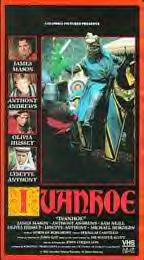
Written by Sir Walter Scott
Starring
Anthony
Andrews as Wilfred of Ivanhoe
James Mason
as
Isaac of York
John Rhys-Davies
as
Front de Boeuf
Julian
Glover as King Richard
Lysette
Anthony as Lady Rowena
Michael
Hordern as Cedric
Olivia
Hussey as Rebecca
Sam Neill
as
Brian de Guilbert
Anthony
Haygarth as Friar Tuck
David Robb
as
Robin Hood
John Hallam
as
Herald
Kevin Stoney
as
Fitzuse
Michael
Gothard as Athelstone
Philip
Locke as Grand Master
Ronald
Pickup as Prince John
Stewart
Bevan as Edward
Stuart
Wilson as De Bracy
 |
The battle of Hastings sets the historical stage for this story. From the 5th10. What was the "Battle of Torquilstone," and why was it
century to 1066 CE, England was mainly inhabited by Angles, Saxons, and
Danes, which weere all Germanic peoples. William, the Duke of Normandy,
had defeated and killed Harold the Bald at the Battle of Hastings in 1066.
The results of this event were far-reaching following William's coronation
as king of England. He confiscated the lands of most of the Saxon nobility
and handed these lands to his Norman supporters. He also made French the
language of the court, which meant that Anglo-Saxon was now the language
of the laboring classes, the slaves (serfs), the outlaws, and those who were
brave enough to oppose the Normans. The Norman rulers also introduced
unfair forest laws, codes of chivalry, and continental customs, such as
curfews and trial by combat.Another important aspect of the historical background to Ivanhoe are the
Holy Wars fought in the Middle East (the Crusades), an attempt to win back
the "Christian" Holy Lands from the Moslems (Saracens). Many pilgrims
followed the Crusades and were killed in battle. It is at this time, the Order
of the Knights Templar was founded (1119 CE), made up mostly of Normans.
But these men soon became rich and power-hungry groups, leading extremely
immoral lives. They also persecuted the Saxons. The relations between the
Saxons and the Normans, even a century and a half after Hastings, was of
bitterness and hatred.Ivanhoe takes place in the second half of the reign of Richard I (1189-1199).
It is the story of King Richard's return to England, and the fight against the
factions loyal to his scheming half-brother, Prince John. Central to this story
is the disinherited Saxon knight Sir Wilfred of Ivanhoe, whose chivalrous
spirit places him against the powerful Templar Sir Brian de Bois-Guilbert.
Discussion Questions
1. a. A mysterious hero who goes by the name "Disinherited Knight"
wins the jousting portion of a tournament. When he is asked to reveal
his identity, the unidentified knight refuses to do so, remains dressed,
including helmet to conceal his identity. How does this compare to the
concept of "patents of nobility," as explained in "A Knight's Tale?"b What were the customary rules of a tournament jousting event?
2. Who is Wilfred of Ivanhoe, and why is he the key to the story? Why
does Cedric disown Ivanhoe?3. Ivanhoe's father orders Rowena to marry Prince Athelstane. Why is
she given no choice in the matter? What does this say about the role of
women in the 12th century? What purposes did marriage serve in the
12th century? How is marriage different today?4. Isaac of York's life is in danger because he is Jewish. Why were
Jews so feared and despised? What was the role of anti-Semitism in
medieval Europe? Is there a comparison between medieval Anti-
Semitism and 20th century Anti-Semitism?5. Who is the real villain of Ivanhoe? Answer in detail.
6. Who is the Black Knight, who has helped Ivanhoe and the Saxons?
What is the mystery (of this character) in the story?7. How does Cedric change during the course of the novel?
8. Why is Ivanhoe the hero of the story? What picture of chivalry
do you get from Ivanhoe?9. a. Why is Richard a popular king among the Saxons as well as Normans?
b. Why does Richard have a troubled reign? Cite three reasons
and explain each as to why they were problems.c. What is Scott'e judgement of Richard's behavior as king?
d. How does history evaluate the reign of Richard?
e. How does history evaluate the reign of John?
important to the story of Richard?11. Are Scott's characters in Ivanhoe realistic? Give reasons
for your answer.
Return
to HomeTo Film Index


