
Marple
Newtown Senior High School
Modern
European History
|
|
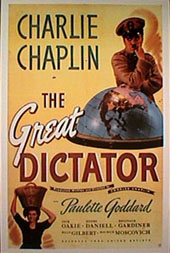
Written and Directed by Charlie Chaplin
Starring
Charlie Chaplin
as
Adenoid Hynkel and a Jewish Barber
Jack Oakie as
Benzino Napaloni
Reginald Gardiner
as
Schultz
Henry Daniell
as
Garbitsch
Billy Gilbert
as
Herring
Grace Hayle as
Madame Napaloni
Carter DeHaven
as
Bacterian Ambassador
Paulette Goddard
as
Hannah
Maurice Moscovitch
as
Mr. Jaeckel
Emma Dunn as
Mrs. Jaeckel
Bernard Gorcey
as
Mr. Mann
Paul Weigel as
Mr. Agar
 |
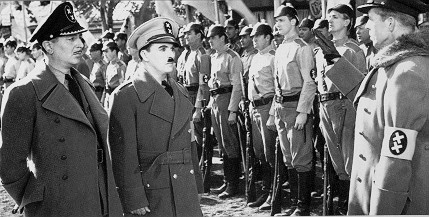 |
Chaplin plays the dictator with a "Charlie Chaplin moustache" -- he looks and
acts just like Hitler. He also plays a Jewish barber, a hero in the "Tomanian" Army
during the previous war World War I, and just happens to look exactly like Hynkel.
While the movie is considered to be a farce, it has aserious message to it -- Chaplin's
speech at the end of the film is quite serious. The humor in this film is best
appreciated by those who have a rudimentary understanding of World War II and
the role the characters Hitler, Mussolini, Göebbels and Göring played in that event.Recognition
1940 National Board of Review Awards: Ten Best films of the Year
1940 New York Film Critics Award: Best Actor (Chaplin)
1940 Academy Awards Nominations
Best Picture
Best Actor (Chaplin)
Best Supporting Actor (Oakie)
Best Original Screenplay
Best Original ScoreAdolf Hitler was a mass murderer and sociopath, he was a political genius,
a powerful orator and one of the first politicians to understand and exploit the mass
media. He had a deep hatred of the Jewish people. Hitler initiated WorldWar II
with his invasion of Poland in 1939. Hitler, in a short period of time, conquered more
of Europe than did Napoleon.Benito Mussolini was the fascist dictator of Italy from 1924 to 1943. The fascist
program was a combination ofnationalism and socialism. For a time Mussolini
seemed to be in competition with Hitler, but Germany had greatermilitarily strength
than Italy. It is during this short time of jockeying for position between Hitler and
Mussolini that the film focuses upon.Joseph Göebbels was the Nazi propaganda chief and one of the closest of
Hitler's henchmen. His responsibility was to organize the Nazi political campaigns
and he skillfully did so, using the mass media masterfully to further theNazi cause.Hermann Göring organized the Gestapo and, as commander of the German
Air Force, prepared the aerial aspects of the Blitzkrieg campaigns during the
Second World War.The Nazi Party made use of young men in "strong arm" gangs, called Storm
Troopers, to intimidate political opponents and Jews. The Brown Shirts, as they
were also called, grew into a private army for the Nazi party.The vast majority of German Jews were patriotic German citizens. Thousands
fought on the German side in the First World War. Many were wounded in battle
and many were decorated for valor. The Jewish barber was one of thesewounded
war heroes.Approximately 12 million people died in German concentration camps during
World War II. Half of these were Jews. The other six million were democrats,
socialists, communists, gypsies, homosexuals, the disabled, the religiousand
anyone who opposed Hitler. The Germans tried to hide what was going on in the
concentration camps. The conditions in these camps were not generally known by
the Allies during the war, although rumors were often "leaking out" to the Allied
countries.Identify the Following:
Nazi:
Storm Trooper (Brown Shirt):
"concentration camp":
fascist:
Match the following as you watch the film:
___ 1) Adenoid Hynkel A) Herman Goering
___ 2) Benzino Napolini B) Capital of Bacteria
___ 3) Herr Garbitsch C) a "take-off" on the Swastika
___ 4) Herr Herring D) Austria
___ 5) Bacteria E) Der Fuhrer
___ 6) Tomania F) Joseph Goebbels
___ 7) the Double Cross G) Germany
___ 8) Osterlich H) Adolf Hitler
___ 9) Anschluss I) the invasion of Austria
___ 10) the Fooie J) Benito Mussolini
___ 11) Aroma K) Italy
1) a. What commentary does Charlie Chaplin's film have to say about German
technology: the "big gun," the "bullet- proof uniform," the "compact parachute,"
and the parade of German armaments?
b. What was the true state of German technology during World War II?
2) What is the significance of the "dictator world dance" with the globe? What is
being said here?
3) What issue does Chaplin satirize in the scene of the arrival of Benzino Napolini at
the train station? Where is the satire in the train moving back and forth?
4) Mussolini was portrayed (in real life) as a model husband and family man. What
was he like really? How does the film portray him?
5) The Nazi party was a proponent of the theory known as the "Aryan Myth." What
was the "Aryan Myth"?
6) The sign of the Nazi party was the swastika. In the movie, the symbol of Hynkel's
party is the "double-cross" whichlooks very much like a dismembered swastika.
What is Chaplin trying to say through this symbolism?
7) What does the scene at the buffet say to the viewer about the ability of dictators
(at least these two dictators) to "talk out" an aggreement with each other? Why
can't they negotiate successfully with each other?
8) In listening to the Jewish barber's speech at the end of the film, how is he counter
to what Herr Garbitsch has to say?
.
9) a. Would you have tried to resist Hitler if you had lived in Germany during this
time? Explain.
b. What could/would you have done?
10) Check the WWW for information on Charlie Chaplin. How outspoken was he
about the Nazi government? Illustrate with some examples.--The Barber's Speech to the German People --
"I'm sorry, but I don't want to be an emperor -- that's not my business. I don't
want to rule or conquer anyone. I should like to help everyone if possible: Jew,
gentile, black man, white. We all want to help one another -- human beings are
like that. We [all] want to live by each other's happiness, not by each other's
misery. We don't want to hate and despise one another. In thisworld there is
room for everyone, and the good earth is rich and can provide for everyone."The way of life can be free and beautiful. But we have lost the way. Greed
has poisoned men's souls, has barricaded the world with hate; has goose-stepped
us into misery and bloodshed. We have developed speed but we have shut
ourselves in. Machinery that gives us abundance has left us in want. Our
knowledge has made us cynical. Our cleverness hard and unkind. We think too
much and feel too little. More than machinery, we need humanity. More than
cleverness we need kindness and gentleness. Without these qualities, life will be
violent and all will be lost.The airplane and the radio have brought us together. The very nature of
these inventions cries out for the goodness of men, cries out for universal
brotherhood for the unity of all. Even now my voice is reaching millions throughout
the world, millions of despairing men, women and little children, victims of a
system that makes men torture and imprison innocent people. To those who can
hear me, I say, "Do not despair."The misery that is now upon us is but the passing of greed, the bitterness of
men who fear the way of human progress. The hate of men will pass and dictators
die, and the power they took from the people, will return; and so long as men die
[now] liberty will never perish . . .Soldiers, don't give yourself to brutes, men who despise you and enslave you.
Who regiment your lives, tell you what to do, what to think and what you feel, who
drill you, diet you, treat you likecattle, use you as cannon fodder. Don't give
yourselves to these unnatural men, machine men, withmachine minds and
machine hearts. You are not machines. You are not cattle. You are men. You
have the love of humanity in your hearts. You don't hate -- only the unloved hate.
Only the unloved and unnatural. Soldiers, don't fight for slavery, fight for liberty!In the seventeenth chapter of Luke, it is written, "the kingdom of God is within
man." -- not one man, nor a group of men, but in all men -- in you! You, the people,
have the power to make this life free and beautiful, to make this life a wonderful
adventure. Then, in the name of democracy, letus use that power. Let us all unite.
Let us fight for a new world, a decent world that will give men a chance to work,
that will give you the future and old age and security. By the promise of these
things, brutes have risen to power, but they lie. They do not fulfill their promise,
they never will.
Dictators free themselves, but they enslave the people.Now let us fight to fulfill that promise. Let us fight to free the world, to do
away with national barriers, to do away with greed, with hate and intolerance. Let
us fight for a world of reason, a world where science and progress will lead to all
men's happiness.Soldiers, in the name of democracy, let us all unite!
Hannah, can you hear me? Wherever you are,look up, Hannah. The clouds
are lifting, the sunis breaking through. We are coming out of the darkness into the
light. We are coming into a new world. A kind new world where men will rise
above their hate, their greed and brutality.Look up Hannah. The soul of man has been given wings, and at last, he is
beginning to fly. He is flying into the rainbow, into the light of hope. Into the
future. That glorious future that belongs to you, to me, and to all of us. Look up
Hannah. Look up.
 |
|
to Home |
 |
 |
|
