
 |
Written by Bernard Rose
Starring
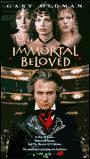
Gary Oldman
as
Ludwig
van Beethoven
Jeroen
Krabbé as Anton Felix Schindler
Isabella
Rossellini as Anna Marie Erdody
Johanna
ter Steege as Johanna Reiss
Matthew
North as Young Karl van Beethoven
Marco Hofschneider
as Karl van Beethoven
Miriam
Margolyes as Nanette Streicher
Barry Humphries
as Clemens von Metternich
Valeria
Golino as Giulietta Guicciardi
Gerard
Horan as Nikolaus Johann van Beethoven
Christopher
Fulford as Casper Anton Carl van Beethoven
Alexandra
Pigg as Therese Obermayer
Luigi Diberti
as Franz Josef Guicciardi
Michael
Culkin as Jakob Hotscevar
Donal Gibson
as Karl Holz
 |
The mysterious letter (written ca. 1811-1812) which Beethoven wrote to
his "Immortal beloved," is the starting point in this story. The viewer
follows Beethoven's secretary's attempt to identify the person to whom
the letter is addressed. No one knows, even to this day, who that person
really was, but the film offers one possible (an quite intriguing) theory.Good morning, on July 7thEven when I am in bed my thoughts
rush to you, my eternally beloved,
now and then joyfully, then again
sadly, waiting to know whether Fate
will hear our prayer. To face life I
must live altogether with you or
never see you. Yes, I am resolved to
be a wanderer abroad until I can fly
to your arms and say that I have
found my true home with you and
enfolded in your arms can let my
soul be wafted to the realm of
blessed spirits. Alas, unfortunately
it must be so. You will become
composed, the more so you know
that I am faithful to you; no other
woman can ever possess my heart.
Never, never -- Oh God, why must
one be separated form her who is
so dear. Yet my life in V[ienna] at
present is a miserable life. Your love
has made me both the happiest and
the unhappiest of mortals. At my
age I now need stability and
regularity in my life. Can this
coexist with our relationship?
Angel, I have just heard that the
post goes every day, and, therefore
I must close, so that you may
may receive the letter immediately.
Be calm; for only by calmly
considering our lives can we
achieve our purpose to live together.
Be calm. Love me, today, yesterday.
What tearful longing for you, for
you, you, my life, my all, all good
wishes to you. Oh, do continue to
love me. Never misjudge your
lover's most faithful heart.Ever yours
Ever mine
Ever ours
The letter is an interesting device used to tell the story of the unusual
genius who was a standout-figure in the Romantic movement in art. The
letter leads to a series of flashbacks that reveal the personality of
Ludwig van Beethoven. The acting is powerful and the music is quite
magnificent.Ludwig van Beethoven (1770-1827) showed tremendous talent as a child
musician, and became professional at the age of 11. As a young man he
was taught by Mozart and Haydn and his performances on the piano
attracted aristocratic patrons in Vienna, the musical center of Europe.
Beethoven is said to be the first musician to make a living from private
patronage, without subsidies from the church or court.Beethoven's best-known works (the Symphonies numbers 2 through 8,
the Moonlight Sonata, the Battle Symphony, and his only opera, Fidelio)
were written in his thirties and forties, when he was already suffering
from deafness. He told friends that his affliction hampered him least
when he was playing and composing, and most when he was in company.
By the time he was 50, Beethoven's career suffered from this handicap,
but he went on composing despite the difficulties--the Ninth Symphony
and several string quartets are from this period.When Beethoven died at age 57, his last words were "Applause friends,
the comedy is over. " The Immortal Beloved -- no one has ever
identified her. She remains one of those historical mysteries that make
Beethoven's life well worth studying.Study Questions:
1) How factual is this film? Did these things really happen to10) Consider Beethoven's Heiligenstadt Testament, what does
Beethoven? If you think so, how do you know this to be so? Give five
(5) examples of factual aspects of the film.2) How did Beethoven's childhood impact his adulthood? Explain.
3) a. Was Beethoven really deaf? Does the film give you any facts
to support the reality of this deafness?b. How did Beethoven compose the marvelous pieces he did if he
was deaf?4) a. Discuss the Patronage system and how it effected the lives of
Mozart, Haydn, and Beethoven. Discuss specific instances where
each composer was expected to live under certain rules and how
this life altered the way that they composed.b. What major events led to a change in how composers earned
their salaries.c. Which composer was pivotal in changing the way the
aristocracy treated musicians.5) Discuss the Beethovenian Pathos. How does this philosophy show
up in Beethoven's compositional style? How does this pathos relate
the Symphony # 5 and to the "Ode to Joy" (Symphony #9)?6) In his political philosophy, Beethoven had very "republican"
sentiments. These can be shown in the film in his comments and
actions.a. What was his response to Napoleon's invasion of Austria? Why?
b. What were his feelings about Klemens von Metternich? Why?
7) Explain the differences in the musical periods of the late 18th
century. Beethoven was a composer who was and the end of the
Classical period and the beginning of the Romantic period (1825-
1900).8) Research the letter from above. What other possibilities need
to be considered in this mystery?9) a. Why was Beethoven's death so pathetic?
b. Why was his life considered to be such a tragedy by many?
this tell you about Beethoven as a man?Use These Sites to Help You
Answer the Research QuestionsLudwig van Beethoven: the Immortal (Biography)
http://home.swipnet.se/zabonk/cultur/ludwig/beetbio.htmLudwig van Beethoven: Deafness
http://www.lucare.com/immortal/deaf.htmlThe Heiligenstadt Testament: Beethoven's Will
http://www.lucare.com/immortal/he_test.html
Return
to HomeTo Film Index



