
|
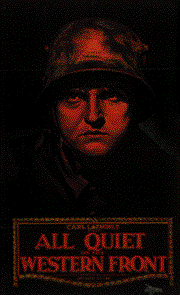
A Study in the Realities of War |
Written by Erich Maria Remarque
Starring
Richard Thomas as Paul Baumer
Ernest Borgnine as Stanislaus Katczinsky
Ewan Stewart as Detering
Donald Pleasance as Kantorek
Ian Holm as Himmelstoss
Patricia Neal as Paul's Mother
Paul Mark Elliott as Behm
David Bradley as Kropp
Matthew Evans as Muller
George Winter as Kemmerich
Dominic Jephcott as Leer
Mark Drewry as Tjaden
Colin Mayes as Westhaus
 |
How
does war affect the lives, emotions, and
thoughts
of those involved?
Propaganda
Analysis Home Page
URL: http://carmen.artsci.washington.edu/propaganda/home.htm
Provides a brief definition/description of propaganda,
along with a Table of Contents -- scroll
down to Wartime Propaganda for examples and information.
3) Read the words to this song produced during the Vietnam era by Eric
Burden and the Animals.
Then compare the message to the character of Kantorek in All Quiet on the
Western
Front. How are they similar?
Eric
Burdon, Vic Briggs, John Weider, Barry Jenkins, Danny McCulloch
Eric
Burdon and the Animals, February 1968
He blesses the boys
As they stand in line
The smell of gun grease
And their bayonets they shine.
He's there to help them
All that he can
To make them feel wanted
He's a good holy man.
Sky Pilot
Sky Pilot
How high can you fly?
You never, never, never reach the sky.
He smiles at the young soldiers
Tells them it's all right
He knows of their fear
In the forthcoming fight.
Soon there'll be blood
And many will die
Mothers and Fathers
Back home they will cry.
Sky Pilot
Sky Pilot
How high can you fly?
You never, never, never reach the sky.
He mumbles a prayer
And it ends with a smile
The order is given
They move down the line.
But he'll stay behind
And he'll meditate
But it won't stop the bleeding
Or ease the hate.
As the young men move out
Into the battle zone
He feels good -
With God you're never alone.
He feels so tired
And he lays on his bed
Hopes the men will find courage
In the words that he said.
Sky Pilot
Sky Pilot
How high can you fly?
You never, never, never reach the sky.
You're soldiers of God
You must understand
The fate of your country
Is in your young hands.
May God give you strength
Do your job real well
If it all was worth it
Only time it will tell.
In the morning they return
With tears in their eyes
The stench of death
Drifts up to the skies.
A young soldier so ill
Looks at the Sky Pilot
Remembers the words
"Thou shalt not kill".
Sky Pilot
Sky Pilot
How high can you fly?
You never, never, never reach the sky.
Sky Pilot
Sky Pilot
How high can you fly?
You never, never, never reach the sky
The Author's Life and Background -
Erich Maria Remarque was born in Osnabruck in Westphalia, Germany, on June
22, 1898...
While attending the University of Munster (1916), he was drafted into the
German army. He was
eighteen years old at the time of his induction.
During World War I Remarque fought at the Western Front and was wounded
five times, the last
time seriously.... The same "lostness" felt by Paul Baumer in All
Quiet on the Western Front seems
to have had a great impact on its author following the Great War.
After his discharge from the army,
Remarque worked at a series of professions.
All Quiet on the Western Front was written in1928. The novel's success
was immediate and
overwhelming, selling over 1,500,000 copies during its first year.
The book generated quite a
controversy: some charged it as being "replete with effeminate pacifism;"
others claimed it was really
"romantic propaganda for war." Whatever the position, All
Quiet on the Western Front
continues
to be a definitive expose of war. The essential point of the
book is to describe war's effects on a
particular generation.... The men who emerged from the trenches were
marked for life by deep,
irreparable psychic wounds. For these young disillusioned,
the world would never hold the same
innocence it had in their earlier youth.... The energies born with
the twentieth century had been
sapped, misspent and destroyed."
All
Quiet on the Western Front
is a firsthand account of this
"hidden cost" of war. Remarque, himself a front-line soldier who
experienced all he wrote of, was
ridden with despair and unrest for ten years before he brought himself
to write his response to the
Great War as he saw it.
Social Criticism -
Although the book is an account of World War I from
the view point of an ordinary soldier, the
criticism of the German war machine and the Kaiser is readily apparent.
From the first chapter, and
throughout the book is a tirade against the boastful supremacy (romantic
view) of German
nationalism ideas professed by the supposedly responsible members of society....
The guardians of
society -- the teachers, the government, the military, the elders -- conspired
knowingly and unknow-
ingly to nurture the myth of German supremacy. The falsity of this
position is revealed, as Paul puts
it, from the first explosion in battle, and when the first of his schoolmates
fell it battle.
The same catastrophic nationalism could be seen growing again in the twenties
and thirties.
The bitter lesson of defeat had not been learned. Remarque, as well
as others, could see the mis-
takes of the Kaiser and the German Republic about to be repeated once again
under the leadership
of Adolf Hitler.
Major Characters for Analysis -
Paul Baumer:is
the character through whose eyes the reader views the action and thought
of the
novel.... Paul, although only twenty years old, is already a hardened
veteran. His idealism, learned
in school and fostered by his parents and teachers, has disappeared.
Although he accepts his lot as
a front line soldier, he becomes inreasingly aware of the futility of war
and its colossal waste of
human life.... His friends are killed, his past becomes meaningless,
and he has no future. His net
gain is a few fundamental truths about war and society. Beyond this
Paul is emotionally and intel-
lectually destroyed.
Kantorek:is
the teacher who persuades Paul and his classmates to "assume their patriotic
responsi-
bilities" and enlist in the army. He uses his position as a teacher
to spread the myth of the German
Destiny. For Paul and his friends, Kantorek represents the misdirection
and betrayal of youth by the
older generation.
Corporal Himmelstoss:
Himmelstoss,
the corporal responsible for the basic training given to Paul
Baumer and his comrades, typifies the truism that "power corrupts."
Himmelstoss, a little man, uses
his petty authority over recruits to satisfy his personal desire for power.
A postman in civilian life, he
takes every opportunity to make life miserable for green army recruits.
Paul and his friends finally
get their revenge, but only a front line shelling has any real effect on
Himmelstoss' character....
Himmelstoss represents a military type universally hated and feared.
A few stripes or insignia make
these individuals tyrants of their own small worlds.
Stanislaus Katczinsky:becomes
Paul's closest friend. He is forty years (old and a cobbler by trade).
Their age and background differences only serve to draw them together.
Called Kat by his friends,
he has the uncanny ability to find food and the comforts of home in places
where not so much as a
crust of bread is available. Paul idolizes the shrewd, self-reliant
soldier who has turned his imagi-
nation and inventiveness to practical uses.... Above all Kat is warm
and good natured. His death...
is the final shock for Paul. Kat is the last and best of his
friends.
4) The Romantic concept of war is brought out early
in the film. Which characters glorify war and
those who fight? Why do you think they have this perception of war?
5) Consider the actions of Paul's family and friends when he is home on
leave. How do these
individual situations illustrate the public's lack of understanding of
the war?
6) Contrast Paul's killing of Gerard Duval with Sergeant Oellrich's sniping
at the enemy front. Where
is the difference in their actions?
7) Considering the story Remarque has written, what do you see as his opinion
of war? Does this
opinion appear to be justified? Use examples from the story to defend
your thesis.
|
to Home |
 |
 |
|
