Poet's Page Forums
Poet's Page Home
The Dark Workings of the Mind
The Dionoil Legends
The Deafening Hush
Escape the Widowed Flame
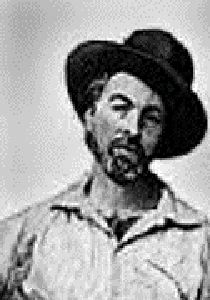
Walter Whitman (1819-1882) was an American poet and a son of Long Island. His
collection of poems, "Leaves Of Grass," is considered one of the world's
major literary works.
Walter Whitman was born in West Hills, Long Island, New York. While he
grew up in Brooklyn, he frequently returned to his roots. He worked as a
printer and journalist in the New York City area. He wrote articles on
politics, civics, and the arts. Whitman loved New York City and loved
the crowds. He attended debates, the theater, concerts, lectures, and
political meetings. He often rode on stagecoaches and ferries just to
talk with people.
During the Civil War, Whitman was a volunteer assistant in the military
hospitals in Washington, D.C. After the war, he worked in several
government departments until he suffered a stroke in 1873. He spent the
rest of his life in Camden, N.J., where he continued to write poems and
articles.
Whitman believed that the vitality and variety of his life reflected the
vitality and variety of America. Most critics accept this view of the
man and his poems and some insist he was a powerful and unusual lyric
poet.
Whitman was a true patriot. His poems sing of the praises of the United
States of America and the cause of democracy. The poet's love of his
country grew from his faith that Americans might reach new worldly and
spiritual heights. Whitman wrote: "The chief reason for the being of the
United States of America is to bring about the common good will of all
mankind, the solidarity of the world."
Whitman began working on "Leaves of Grass" in 1848. This collection of
poetry was so unusual that no publisher would publish it. In 1855, he
published it himself. The edition contained only 12 poems. In the
preface, Whitman said: "The United States themselves are essentially the
greatest poem." Between 1855 and his death, Whitman published several
revised and enlarged editions of his book. He believed that "Leaves of
Grass" had grown with his own emotional and intellectual development.
"Song of Myself," is considered Whitman's greatest. It is a lyric poem
told through the joyful experiences of the narrator. Sometimes the
narrator,"I," is the poet himself. In other passages, "I" speaks for the
human race, the universe, or a specific character being dramatized. Like
all Whitman's major poems, "Song of Myself" contains symbols. For
example, in the poem he describes grass as a symbol of life "the babe of
vegetation," "the handkerchief of the Lord."
Whitman wrote "When Lilacs Last in the Dooryard Bloom'd" on the death of
Abraham Lincoln. Lincoln died in April, springtime-a time of rebirth in
nature. Whitman says that each spring the blooming lilac will remind him
not only of the death of Lincoln, but also of the eternal return to
life.
"O Captain! My Captain!," another poem on Lincoln's death, is Whitman's
most popular poem, but differs from his others in rhyme and rhythm.
Whitman wrote in a form similar to "thought-rhythm." This form is found
in Old Testament poetry. It is also found in sacred books of India, such
as the Bhagavad-Gita, which Whitman knew in translation. The rhythm of
his lines suggests the rise and fall of the sea he loved so much. This
structure is better suited to expressing emotion than to logical
discussion. In general, Whitman's poetry is idealistic and romantic.
By: Billy McAleese
With excerpts from Sylvester Holbrooke