My Favorite Web Sites
Poet's Page Home
The Dark Workings of the Mind
The Dionoil Legends
The Deafening Hush
Escape The Widowed Flame
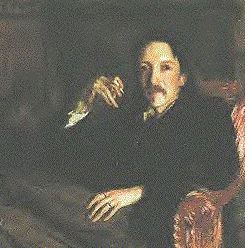
Robert Louis Balfour Stevenson (1850- 1894) was born on November 13,
1850 to well-to do parents in Edinburgh, Scotland. Stevenson was sickly
from his birth. His father, like generations of Stevensons before him,
were lighthouse engineer. His father tried to encourage him to this, for
he was his only child. Stevenson showed no interest in this, however.
The nurse who cared for him filled his head with the myths and legends
of antient Scotland. This impressed Stevenson, and he decided at an
early age that he wanted only to write.
"All through my boyhood and youth, I kept always two books in my pocket,
one to read, one to write in. As I walked, my mind was busy fitting what
I saw with the appropriate words; when I sat by the roadside, I would
either read, or a pencil and a pennybook would be in my hand, to note
down the features of the scene or commemorate some halting stanzas. Thus
I lived with words. It was not so much that I wished to be an author
(though I wished that too) as that I had vowed that I would learn to
write. That was the proficiency that tempted me; and I practiced it, as
men learn to whittle, in a wager with myself."
Stevenson set out to win this wager with himself. He began with a
popular volume of children's verse, 'A Child's Garden of Verses.' He
dedicated this to his childhood nurse. He folled this up with a long
succession of poems, essays, novels, and short stories as he traveled
the earth looking for a helthful climate for his weak lungs. This would
would lead him to ever more exotic locations.
He studied law at the University of Edinburgh, but he rarely went to
class. Instead, he would stay in his room and write. In 1875, he passed
the law exam, but he never practiced.
On one of his trips to France, he met an American woman, and quickly
proposed marriage. In 1879, haggard and feverish with tuberculosis, he
followed her to California, traveling much of the cross-country trip by
stagecoach. When he arrived in California, he fell desperately ill with
hemorrhaging lungs, and the marriage was postponed until the following
year.
One evening, as entertainment for his stepson, Stevenson drew a map of
an island. As he worked on it, his imagination took hold. The result was
the classic novel, 'Treasure Island', for which he is best known. Later,
he wrote his first novel based on Scottish history. The clasic,
'Kidnapped', is the tale of a young man named David Balfour. He was
fictional, but many of the characters in the book are actual figures in
Scottish history, including Alan Breck Stewart, Cluny MacPherson, Colin
Roy Campbell(The Red Fox), and figures both for and agaist the Jacobite
rebellion of 1745. Stevenson was unhappy with the book, for he felt that
he was forced to end too soon. So, we wrote a sequel, David Balfour (it
goes under a different name in Scotland). The book featured, among other
things, the first full female lead he had ever writen of. One critic
commented: "I love the idea, but why did it take him so long?"
His dream of touring the South Seas was realized in 1888 when the family
sailed from San Francisco aboard the schooner-yacht Casco. The captain
was so concerned over Stevenson's sickly appearance that he secretly
made plans for a burial at sea. The captain's fears were unfounded,
however. After visiting the Marquesas, Tahiti, and Hawaii, Stevenson
found his health improved with the sea air, and he bought 400 acres on
the island of Samoa to build a home.
The friendly Samoans soon came to love Stevenson. They gave him the name
"Tusitala", teller of tales, and they made him a chief. At one time,
when he was able to get several chiefs released from prison, the
grateful Samoans worked for weeks building a road up the mountainside to
his home.
Stevenson continued to write. Working ten to twelve hours a day at his
desk, often so ill he could hardly speak, he was barely able to meet the
demands of an ever-growing number of eager readers around the world. In
a late afternoon of December 3, 1894, as he stood on the veranda of his
home talking with his wife about preperations for the evening meal, he
was suddenly sticken with a cerebral hemorrhage. He died within a few
hours.
Stevenson was buried on a Samoan mountaintop, and on his tomb is
engraved his poem "Requiem," the epitaph he had written for himself
years before his death.