
PROGRAMME
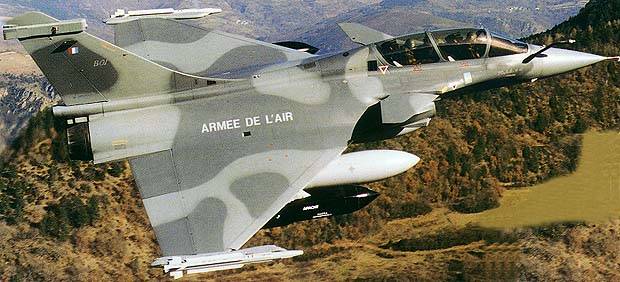
Two-seat Avion de Combat Tactique (French Air Force) or single-seat Avion de Combat Marine (French Navy) interceptor, multirole fighter and reconnaissance aircraft. Ordered to replace French Air Force Jaguars and Navy Crusaders and Super Etendards; for early development history, see 1990-91 and earlier Jane's; first flight of Rafale A prototype (F-ZJRE) 4 July 1986; first flight with SNECMA M88 replacing one GE F404, 27 February 1990 (was 461st flight overall); 865th and final sortie, 24 January 1994. Rafale programme's 2,000th sortie, 5 September 1994. ACE International (Avion de Combat Europeen) GIE set up in 1987 by Dassault Aviation, SNECMA, Thomson-CSF and Dassault Electronique, partly to attract international partners; none found. Production launch officially authorised, 23 December 1992 (and 31 December 1992 for M88-2 power plant). First Rafale B and Rafale M ordered 26 March 1993. Four preproduction aircraft, as under: To accelerate programme, early Rafales for navy will be to SU0 interceptor standard, lacking ASMP, helmet-mounted sight, OSF and voice command controls; definitive SU1 attack version will be delivered subsequently to replace Super Etendards. Air force plans similarly limited capability for initial aircraft, but cost-saving measures applied in 1995 included postponement of first deliveries to 2005, when full standard aircraft will be available. Dassault offers export aircraft from 1999.
VARIANTS
Rafale B: Originally planned dual control, two-seat version for French Air Force; weight 350 kg (772 lb) more than Rafale C; 3 to 5 per cent higher cost than Rafale C. Being developed into fully operational variant for either pilot/WSO or single pilot combat capability.
Rafale C: Single-seat combat version for French Air Force. Detailed description applies to Rafale C, except where indicated.
Rafale D: Original configuration from which production versions derived; now `Rafale Discret' (stealthy) generic name for French Air Force versions.Rafale M: Single-seat carrierborne fighter; navalisation weight penalty, 610 kg (1,345 lb); take-off weight from existing French carrier Foch limited to 16,500 kg (36,376 lb); has 80 per cent structural and equipment commonality with Rafale C, 95 per cent systems commonality. Navy's financial share of French programme cut in 1991 from 25 to 20 per cent.
DESIGN FEATURES:
Minimum weight and volume structure to hold minimum cost; thin, mid-mounted delta wing with moving canard; individual fixed, kidney-shaped intakes without shock cones.
LANDGING GEAR
Hydraulically retractable tricycle type supplied by Messier Dowty, with single mainwheels and twin, hydraulically steerable, nosewheels. All wheels retract forward. Designed for impact at vertical speed of 3 m (10 ft)/s, or 6.5 m (21 ft)/s in naval version, without flare-out.
POWER PLANT
Two SNECMA M88-2 augmented turbofans, each rated at 48.7 kN (10,950 lb st) dry and 72.9 kN (16,400 lb st) with afterburning. M88-3 of 87 kN (19,558 lb st) maximum rating in production aircraft. Internal tanks for more than 5,325 litres (1,406 US gallons; 1,171 Imp gallons) of fuel. Fuel system by Lucas Air Equipement and Zenith Aviation; equipment by Intertechnique. One 1,700 litre (449 US gallon; 374 Imp gallon) drop tank on centreline; 2,000 litre (528 US gallon; 440 Imp gallon) drop tank on each inboard underwing pylon; and/or 1,300 litre (343 US gallon; 286 Imp gallon) tank on each centre underwing pylon. Maximum external fuel 6,600 litres (1,742 US gallons; 1,452 Imp gallons). Pressure refuelling in 7 minutes, or 4 minutes for internal tanks only. Fixed (detachable) in-flight refuelling probe on all versions.
ACCOMMODATION
Pilot only, on SEMMB (Martin-Baker) Mk 16 zero/zero ejection seat, reclined at angle of 29o. One-piece Sully Products Speciaux blister windscreen/canopy, hinged to open sideways to starboard. Canopy gold-coated to reduce radar reflection.
AVIONICS
Provision for more than 780 kg (1,720 lb) of avionics equipment and racks. EAS V/UHF and TRT Saturn UHF radios. TEAM intercom; Sextant Avionique voice activated radio controls and voice alarm warning system. Thomson-CSF/CNI SB 25A IFF. Chelton aerials. For Flight controls the fighter is retrofitted with SOCRAT VOR/ILS; SAGEM Sigma RL90 INS (interface with carrier's navigation on Rafale M); Thomson-CSF NC 12E Tacan; Sigma RL-90 ring-laser gyro INS; Thomson-CSF/CNI AHV 17 radio altimeter and SFIM/Dassault Electronique flight recorder. Sextant Avionique GPS.
RADAR
GIE Radar (Thomson-CSF/Dassault Electronique) RBE2 look-down/shoot-down radar, able to track up to eight targets simultaneously, with automatic threat assessment and allocation of priority.
INSTRUMENTATION
Digital display of fuel, engine, hydraulic, electrical, oxygen and other systems information on collimated eye-level display and two lateral multifunction touch-sensitive colour LCD displays by Sextant. Fourth cockpit screen is head-level tactical navigation/sensor display. Sextant Avionique CTH3022 wide-angle, holographic HUD incorporating Thomson TTD Optronique OTA 1320 CCD camera and recorder. Sextant/Intertechnique Topsight helmet-mounted sight.
MISSION
Thomson-TRT/SAT OSF electro-optical sensors. MIDS (Multifunctional Information Distribution System) datalink (equivalent to JTIDS/Link 16). Various reconnaissance, ECM, FLIR and laser designation pods. Self-defence: Spectra radar warning and ECM suite by Thomson-CSF, Dassault Electronique and Matra. Thomson TTD Optronique DAL (Detecteur d'Alerte Laser) system.
ARMAMENT
One 30 mm Giat DEFA 791B cannon in side of port engine duct. Fourteen Alkan external stores attachments: two on fuselage centreline, two beneath engine intakes, two astride rear fuselage, six under wings and two at wingtips. Forward centreline position deleted on Rafale M. Normal external load 6,000 kg (13,228 lb); maximum permissible, 8,000 kg (17,637 lb). In strike role, one Aerospatiale ASMP standoff nuclear weapon. In interception role, up to eight Mica AAMs (with IR or active homing) and two underwing fuel tanks; or six Micas and 5,700 litres (1,505 US gallons; 1,254 Imp gallons) of external fuel. In air-to-ground role, typically sixteen 227 kg (500 lb) bombs, two Micas and two 1,300 litre (343 US gallon; 286 Imp gallon) tanks; or two Apache standoff weapon dispensers, two Micas and 5,700 litres of external fuel; or FLIR pod, Atlis laser designator pod, two 1,000 kg (2,205 lb) laser-guided bombs, two AS.30L laser ASMs, four Micas and single 1,700 litre (449 US gallon; 374 Imp gallon) tank. In anti-ship role, two Exocet or projected ANS sea-skimming missiles, four Micas and 4,300 litres (1,135 US gallons; 946 Imp gallons) of external fuel.
