
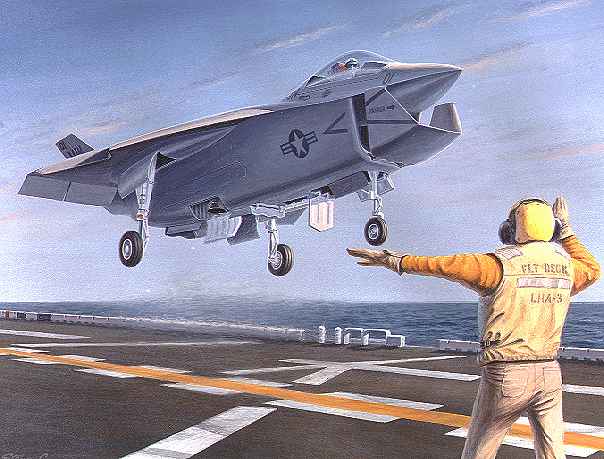
The Joint Strike Fighter, the JSF, is being developed for the US Air Force, Navy and Marine Corps and the UK Royal Navy. It is estimated that approximately 3,000 aircraft are planned for the US Air Force, Navy and Marine Corps and the UK Royal Navy with a further requirement for 2,000 export aircraft over the life of the JSF programme. The Concept Demonstration Phase of the programme began in November 1996 with the award of contracts to two consortia, one led by Boeing Aerospace and the other by Lockheed Martin. The contracts involve each of the consortia building demonstrator aircraft and refining the concepts for three different configurations of next generation fighter aircraft. One of the two consortia will then be selected in 2001 for the development and manufacture of all three variants of Joint Strike Fighter. The Joint Strike Fighter is expected to enter service in 2008.
Three variants of the Joint Strike Fighter are to be produced: a conventional take-off and landing aircraft for the US Air Force; a carrier based aircraft for the US Navy; and a short take-off and vertical landing aircraft for the US Marine Corps and the Royal Navy. The three variants will have a high degree of commonality but with technology and capability to meet the specific service requirements.
LOCKHEED MARTIN JOINT STRIKE FIGHTER
The Lockheed Martin JSF team includes Northrop Grumman, Pratt and Whitney, Rolls-Royce, Allison, and British Aerospace. The three variant models of the Lockheed Martin JSF (designated X-35) are of similar appearance and have common structural geometries. In order to minimise the structural weight and complexity of assembly, the wingbox section integrates the wing and fuselage section into one piece. The major sections of the fuselage contain common parts or closely related parts determined by the operational requirements of the three aircraft. The canopy, radar, ejection system and most of the avionics are common to the three variants. The radar is an advanced electronically scanned array radar.
The aircraft structure incorporates proven stealth features. The sweep angles are identical for the leading and trailing edges of the wing and tail, known as planform alignment. The fuselage and canopy have sloping sides to deflect hostile radar emissions. The seam of the canopy and the weapon bay doors are sawtoothed and the vertical tails are canted at an angle. The serpentine path of the inlet duct covers the forward section of the engine from surveillance radar signals and reduces the radar cross section of the front of the aircraft.
The cockpit will be equipped with colour flat panel displays and helmet mounted displays. Symbols for targeting and navigation are displayed on the pilot's visor and not on a head up display. Stereo speakers are built into the helmet and information such as missile warning are audibly presented with directional discrimination. All three aircraft variants are powered by a derivative of the Pratt and Whitney F119.
BOEING JOINT STRIKE FIGHTER
Boeing's team includes: Raytheon Systems Co, Pratt &Whitney, Rolls Royce, Messier-Dowty, Marconi Electronic Systems and Flight Refuelling Ltd. Boeing are to build and flight test two aircraft - X32A the USAF variant and the US Navy carrier variant, and X32B the STOVL variant for USMC, UK RN and RAF. X32B is based on the established Rolls Royce direct lift concept currently used in the Harrier aircraft of the USMC and UK Royal Navy.
Boeing has completed the final design review of the X-32 demonstrators and made some design alterations to the basic flight qualities including: a refined empennage with horizontal tails for additional control power; a modification to the wing's trailing edge while retaining the same high leading edge sweep of the delta wing, and an aft-swept chin inlet. These improvements are being incorporated into the Preferred Weapon Systems Concept (PWSC) which will be the design for the production model JSF.
The primary propulsion system for all three JSF variants will use Pratt and Whitney SE614 engine which is a derivative of the Pratt and Whitney F119 engine being used for the US Air Force F-22 fighter aircraft. The performance level of the air force version aircraft matches or exceeds that of the F-16 aircraft, and greatly exceeds it in terms of the level of stealth, range on internal fuel and installation of advanced avionics.
DIFFERENT VARIANTS
The air force variant has an internally mounted gun and is equipped with internally mounted infrared sensors and a laser designator. The STOVL propulsion system is designed to minimise noise and heat on the deck of the carrier and on the aircraft. During short takeoff and vertical landings a large proportion of the downward thrust is provided with cool air from the lift fan mounted in the forward fuselage and driven by a drive shaft connected to the main engine. The lift fan arrangement increases the total thrust of the engine and has been developed by Allison. Doors installed above and below the vertical fan open as the fin spins up to provide vertical lift. The main engine has a three bearing swivelling exhaust nozzle. The nozzle, which is supplemented by two roll control ducts on the inboard section of the wing, together with the vertical lift fan provide the required VSTOL capability. The Marine variant of JSF is similar to the Air Force variant but with shorter range. The Marine variant has no internal gun but an external gun can be fitted as a mission option. The internal structure of the naval version is very strong to withstand the high loading of catapult assisted launches and tailhook arrested landings. The landing gear has a higher load capacity and a longer stroke. The aircraft has larger wing and tail control surfaces for improved control on low speed approaches for carrier landing and larger range and payload. Larger leading edge flaps and foldable wingtip sections provide a larger wing area. The aircraft has an internally mounted laser designator and internal gun.
