
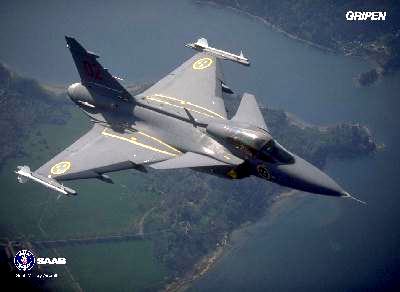
TYPE: Single-seat all-weather, all-altitude interceptor, attack and reconnaissance aircraft. PROGRAMME: Funded definition and development began June 1980; initial proposals submitted 3 June 1981; government approved programme 6 May 1982; initial FMV development contract 30 June 1982 for five prototypes and 30 production aircraft, with options for next 110; overall go-ahead confirmed Spring 1983; first test runs of RM12 engine January 1985; Gripen HUD first flown in Viggen testbed February 1987; study for two-seat JAS 39B authorised July 1989. First of five single-seat prototypes (39-1) rolled out 26 April 1987; made first flight 9 December 1988 but lost in landing accident after fly-by-wire problem 2 February 1989; subsequent first flights 4 May 1990 (39-2), 20 December 1990 (39-4), 25 March 1991 (39-3) and 23 October 1991 (39-5); the 2,000th Gripen sortie was flown (by 39-4) on 22 December 1995; modified Viggen (37-51) retired at end of 1991 after assisting with avionics trials (nearly 250 flights); two single-seat fatigue test airframes (39-51 discarded 1993; 39-52 began 16,000 hour programme, August 1993 and achieved 8,000 hours in early 1996); second production batch (110 aircraft) approved 3 June 1992; first production Gripen (39101) made first flight 10 September 1992 and joined test programme in lieu of 39-1; flight test programme in 1995, included high-AoA and spin trials by 39-2 and trials of an APU (for Batch 2 production) by 39-4; 95 per cent of all contractual requirements had been verified by December 1995. Total programme is over 1,800 hours in 2,300 sorties by six trials aircraft. By 1996 had demonstrated Mach 1.08 cruise without reheat. First production aircraft for Swedish Air Force (39102) made first flight 4 March 1993 and was handed over to FMV 8 June 1993; flight control software modified following loss of 39102 in crash on 8 August 1993 and installed from December 1994; further software upgrade to new generation P11 standard (introducing 11 filters to prevent pilot-induced oscillations) first flown 22 March 1995 in trials aircraft and installed in test Gripens from Autumn 1995; will also go into production aircraft built after early 1996; modified control stick introduced with production aircraft 39108 (first flight 11 April 1995). PP12 display processor for Lot 2 colour displays first flown August 1995. Initial 30 aircraft to be delivered 1993-96 (five in 1994; six in 1995, comprising 39108 to 112 and 120); 16th delivery (39121) on 1 March 1996; second batch of 110 in 1997-2002; first unit is F7 Wing at Satenas; maintenance training begun May 1994 at Linkoping; conversion scheduled to begin 1 October 1995 but postponed to 1996; pilot training centre at Satenas officially opened 9 June 1996; Gripen IOC 1997. JAS 39B prototype (39800) rolled out 29 September 1995; first flight 29 April 1996; 200 test sorties planned; delivery second quarter 1998; first production trainer completed final assembly on 29 February 1996. Two-seat fatigue test airframe began a simulated 12,000 hour programme in February 1996. DESIGN FEATURES: Intended to replace AJ/SH/SF/JA/AJS versions of Saab Viggen, in that order, and remaining J 35 Drakens; partners are Saab Military Aircraft, Ericsson Radar Electronics, Volvo Flygmotor and FFV Aerotech; to operate from 800 m (2,625 ft) Swedish V90 road strips; simplified maintenance and quick turnround with groundcrew comprising one technician and five conscripts. Delta wing with squared tips for missile rails has approximately 45o leading-edge sweepback; independently movable foreplanes have leading-edge sweep of approximately 43o. LANDING GEAR: AP Precision Hydraulics retractable tricycle gear, single mainwheels retracting hydraulically forward into fuselage; steerable twin-wheel nose unit retracts rearward. Goodyear wheels and tyres. Carbon disc brakes and ABS anti-skid units. Nosewheel braking. Entire gear designed for high rate of sink. POWER PLANT: One General Electric/Volvo Flygmotor RM12 (F404-GE-400) turbofan, rated initially at approximately 54 kN (12,140 lb st) dry and 80.5 kN (18,100 lb st) with afterburning. Near-rectangular intakes, each with splitter plate. Fuel in integral tanks in fuselage and wings. Intertechnique fuel management system. ACCOMMODATION: Pilot only in JAS 39A, on Martin-Baker S10LS zero/zero ejection seat. Hinged canopy (opening sideways to port) and one-piece windscreen by Lucas Aerospace. Two seats in tandem in JAS 39B; command sequence in two-seat aircraft ejects rear occupant first, simultaneously inflating an air bag between the two cockpits to protect the front pilot from Perspex splinters. AVIONICS: Comms: CelsiusTech dual VHF/UHF transceivers and IFF. Retrofit planned with tactical radio systems (TARAS). Radar: Ericsson/GMAv PS-05/A multimode pulse Doppler target search and acquisition (lookdown/shootdown) radar (weight 156 kg; 344 lb). For fighter missions, system provides fast target acquisition at long range; search and multitarget track-while-scan; quick scanning and lock-on at short ranges; and automatic fire control for missiles and cannon. In attack and reconnaissance roles, operating functions are search against sea and ground targets; mapping, with normal and high resolution; and navigation. Flight: Ericsson SDS 80 central computing system (D80 computer, Pascal/D80 high order language and programming support environment; upgraded D80E computer flown mid-1994 and introduced from 39.108); three MIL-STD-1553B databuses, one of which links flight data, navigation, flight control, engine control and main systems; Honeywell laser INS and radar altimeter; Nordmicro air data computer. BAe three-axis strapdown gyromagnetic unit provides standby attitude and heading information. Instrumentation: Ericsson EP-17 electronic display system, incorporating Kaiser wide-angle HUD and using advanced diffraction optics to combine symbology and video images; PP1 or PP2 display processors (PP12 in Production Lot 2 for colour imagery); three Ericsson CRT HDDs. Left-hand (flight data) HDD normally replaces all conventional flight instruments; central display shows computer generated map of area surrounding aircraft with tactical information superimposed; right-hand CRT is a multisensor display showing information on targets acquired by radar, FLIR and weapon sensors. Minimum of conventional analog instruments for back-up only. Mission: FLIR pod, carried under starboard air intake trunk, forward of wing leading-edge, for attack and reconnaissance missions at night, providing heat picture of target on right-hand HDD. Self-defence: Radar warning equipment; CelsiusTech countermeasures, including chaff/flare and jamming. Mission: RHWR. ARMAMENT: Internally mounted 27 mm Mauser BK27 automatic cannon in port side of lower front fuselage and two wingtip-mounted Rb74 (AIM-9L) Sidewinder infra-red AAMs standard. (No internal gun in JAS 39B.) Five other external hardpoints (two under each wing and one on centreline) for short- and medium-range air-to-air missiles such as Rb74, Mica or AIM-120 AMRAAM; air-to-surface missiles such as Rb75 (Maverick); anti-shipping missiles such as Saab RBS 15F; DASA DWS 39 munitions dispenser; conventional or retarded bombs; air-to-surface rockets; or external fuel tanks. DIMENSIONS EXTERNAL: Wing span: 8.40 m (27 ft 63/4 in) Length overall: JAS 39A: 14.10 m (46 ft 3 in) JAS 39B: 14.755 m (48 ft 5 in) Height overall: 4.50 m (14 ft 9 in) WEIGHTS AND LOADINGS: Operating weight empty: JAS 39A: 6,622 kg (14,600 lb) JAS 39B: 8,000 kg (17,637 lb) Internal fuel weight: 2,268 kg (5,000 lb) T-O weight, clean: approx 8,500 kg (18,740 lb) Max T-O weight with external stores approx 13,000 kg (28,660 lb) PERFORMANCE: Max level speed: supersonic at all altitudes T-O and landing strip length: approx 800 m (2,625 ft) Combat radius: approx 432 n miles (800 km; 497 miles) g limit: +9 LENGTH (m) 14.10 HEIGHT (m) 4.50 WING SPAN (m) 8.40 MAX T-O WEIGHT (kg) 13000
