
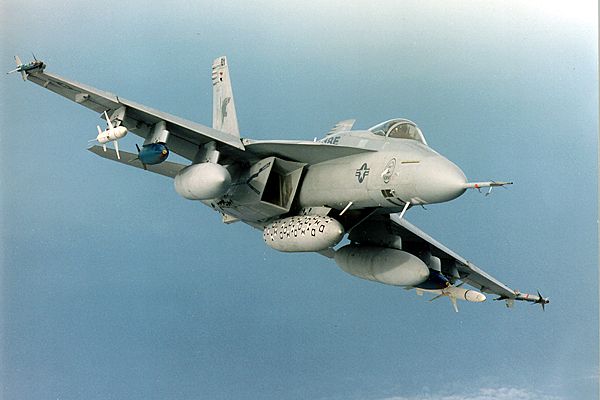
The US Navy Maritime Strike Attack Super Hornet, F/A-18 E and F, from Boeing (previously McDonnell Douglas) flew for the first time on November 29th 1995. The Super Hornet is about 25% larger than its predecessor, the F/A-18C/D but contains 42% fewer structural parts. The single seat F/A-18/E and the two seat F/A-18/F flies greater ranges, with heavier payloads, uses a more powerful engine and provides greater survivability. In January 1997 the aircraft successfully made its first landing and take-off from the deck of a U.S. Navy's Nimitz Class aircraft carrier, the USS John C.Stennis. The John C.Stennis supports 76 fixed wing aircraft including a squadron of 20 F/A-18 Hornets.
The Super Hornet being larger than its predecessor carries more weapons. The aircraft has eleven weapon stations which include two additional wing store stations in comparison to the earlier aircraft. The F/A-18E/F will support a full range of armaments. Flight tests activities carried out during 1997 have included the launching of the air-to-air missiles, AIM-9 Sidewinder, AIM-7 Sparrow and the AIM-120 AMRAAM; the release of guided air-to-ground weapons, Harpoon, SLAM, GBU-10, HARM, and Maverick; the release of free-fall air-to-ground bombs, Mk-76, BDU-48,Mk-82LD, Mk-82HD, and Mk-84. The countermeasures systems are managed by the Integrated Defensive Countermeasures system, IDECM, which provides a coordinated situation awareness, manages the on-board and off-board deception countermeasures, manages the expendable decoys, and signal and frequency control of emissions. The IDECM system includes the ALE-47 countermeasures dispenser, the ALE-50 towed decoy and the AN/ALR-67(V)3 radar warning receiver. The ALE-47 threat adaptive countermeasures dispenser system supplied by Tracor is capable of dispensing chaff cartridges, flares, and the POET and GEN-X active expendable decoys. The ALE-50 Towed Decoy from the E-Systems Goleta Division of Raytheon consists of the decoy, a launcher and a launch control unit. The decoy is installed in a sealed canister which includes a payout reel. The system provides long range detection and extremely fast deployment to defend against most radar-guided threats.The radar warning receiver AN/ALR-67(V)3 developed by Hughes intercepts, identifies and prioritises the threat signals. The signals are characterised in terms of frequency, amplitude, direction, pulse width, etc. and the parameters are compared against a threat library in order to identify the threat.
The structural differences between the F/A-18E/F and the earlier F/A-18s are:
the fuselage is 34 inches longer
modified nose and main landing gear
25% larger wing, with an additional 100 square feet of surface area
36% larger horizontal stabiliser
15% larger vertical tail
two additional wing store stations for additional weapons or fuel bringing the total number of store stations to eleven
33% more internal fuel capacity
new General Electric F414 engines which generate 35% more thrust.
Northrop Grumman is a major subcontractor on the F/A-18E/F programme and are producing the Super Hornet's centre and aft fuselage sections, the twin vertical stabilisers and the associated subsystems.
The Super Hornet F/A-18E is the single seat version and the F/A-18F is the two seat version. The heated and air-conditioned cockpit is very similar to the Hornet's cockpit. The zero/zero ejection seat is the SJU-5/6 from Martin Baker Aircraft Company Ltd in the U.K. The F/A-18 cockpit is equipped with three colour display screens and an advanced head-up display. At night time, television like images from the navigation forward looking infra-red (Nav FLIR) are presented to the pilot on the head-up display, allowing the pilots to see ahead of the aircraft as if it were daytime. The cockpit also has a colour digital map and the pilots are also equipped with night vision goggles.
The cockpit in the F/A-18E/F is equipped with a touch sensitive 3 inch by 5 inch control display, a larger six and a quarter inch multi-purpose liquid crystal colour display which shows tactical information, two 5 inch monochrome displays and a new engine fuel display.
The aircraft retains the mission software and a high proportion of the avionics found in the C/D models.
The Super Hornet is equipped with the APG-73 radar developed by Hughes Aircraft Corporation. The APG-73 radar has an upgraded processor with increased speed and memory capacity in comparison to the AN/APG-65 which was installed on the earlier builds of the Hornet. The modes of the APG-73 include air-to-ground tracking, air-to-air velocity search mode, range while search and track while scan.
The aircraft's power is provided by two F414-GE-400 turbofan engines from General Electric. The engines are an advanced derivative of the GE F404 engines installed on the Hornet. The air inlets have been enlarged to provide increased airflow into the engines. The engines each provide 22,000 lbs thrust with afterburn giving a maximum speed in excess of Mach 1.8.
The structural changes to the airframe on the F/E variant of the aircraft increase the internal fuel capacity by 3,600 pounds, a 33% higher fuel capacity than the F-18C/D variant. This extends the mission radius by up to 40%. Flight testing has been carried out with 480 gallon external tanks and the aerial refuelling store
go back
