
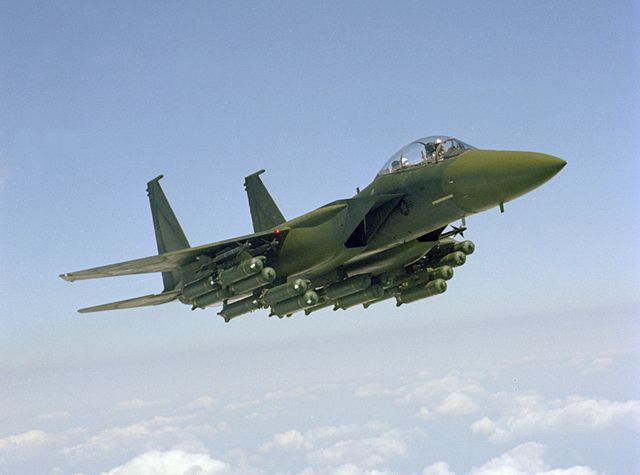
The Boeing (formerly McDonnell Douglas) F-15E dual-role fighter is an advanced long-range interdiction fighter and tactical aircraft. The F-15E is the latest version of the Eagle, a Mach 2.5-class twin-engine fighter. More than 1,300 F-15s are in service worldwide with the U.S. Air Force, the U.S. Air National Guard, and the air forces of Israel, Japan and Saudi Arabia. In Operation Desert Storm, the F-15E maintained a 95.9 percent mission capable rate and since entering service has attained a combat record of 96 victories and zero losses. In 1984 the US Air Force selected McDonnell Douglas to produce the F-15E as its new long-range interdictor, and the aircraft made its first flight on Dec. 11, 1986. The F-15E combines operational air-to-air performance armed with air-to-air missiles that can be launched from beyond visual range, and superior air-to-ground capability to penetrate hostile air and ground defences to deliver up to 24,000 pounds of precision ordnance.
The F-15E aircraft can carry payloads up to 23,000 pounds. The aircraft can carry up to four AIM-9LM infrared-guided Sidewinder air-to-air missiles from Lockheed Martin, Hughes and Raytheon, up to four AIM-7F/M radar-guided Sparrow air-to-air missiles from Raytheon and General Dynamics or eight radar-guided Advanced Medium Range Air-to-Air missiles (AMRAAM) from Hughes and Raytheon. Ranges for these missiles are: Sidewinder - 8 km, Sparrow - 45 km, AMRAAM - 50 km. The range of air-to-ground ordnance includes precision weapons such as guided bomb units, the GBU-10, -12, -15 and -24 bombs, and the AGM-65 Maverick infrared-guided missile from Hughes and Raytheon. Maverick's range is 25 km. The aircraft is also armed with an internal M-61 2Omm Gatling gun installed in the right wing root.
While F-15A/C aircraft are single crew aircraft, F-15B/D/E have a crew of two. The F-15E is crewed by the pilot and the weapon systems officer (WSO). The WSO is equipped with two Sperry full-colour and two Kaiser single-colour cathode ray tubes The WSO can access information from the radar, electronic warfare or infrared sensors and monitor aircraft or weapons status and possible threats. The WSO also selects targets and navigates with the aid of a moving map display produced by a Bendix remote film strip reader.
The pilot's crew station features one full-color and two single-color cathode ray tubes. A holographic wide-field-of-view head-up display (HUD) from Kaiser provides the pilot with flight and tactical information. Both pilot and WSO have Boeing ACES II zero/zero ejection seats. The integrated avionics systems gives the F-15E a highly advanced all weather around-the-clock navigation and targeting capability.
The Hughes APG-70 synthetic aperture radar displays high quality images of ground targets. A special feature of the APG-70 radar is its ability to create and freeze the high-resolution ground maps during a quick sweeps of the target area lasting only seconds.
The F-15E aircraft's ability to operate at night and in all weather is enhanced by the LANTIRN system developed by Lockheed Martin. The LANTIRN navigation pod contains a FLIR (Forward-Looking InfraRed) sensor which produces video images that are projected onto the pilot's head-up display (HUD). The navigation pod also has its own terrain-following radar. The pilot can choose to manually respond to the LANTIRN system or it can be coupled to the flight control system for hands-off terrain following at altitudes as low as 200 feet. The LANTIRN targeting pod contains a tracking FLIR and laser designator. After obtaining a radar image of the target area, the F-15E aircrew can designate individual targets by positioning a cursor on the radar display. The designated target data is transferred to the LANTIRN system for use by the targeting pod's tracking FLIR, which enables the aircrew to aim air-to-ground weapons from up to 10 miles away. Once the target tracking procedure is initiated, targeting information is handed automatically to precision-guided weapons such as Low-Level Laser-Guided bombs, which can be guided to the target after release.
The F15E is equipped with a triple-redundant Lear Siegler Astronics flight control system which drives force motor actuators developed by National Water Lift Co. Using manual terrain following the aircraft can navigate over rough terrain at altitudes down to 200 feet, at nearly 600 miles per hour, with the pilot following commands from the LANTIRN system. Automatic terrain following is accomplished through a digital flight control system linked to the LANTIRN navigation pod's terrain-following radar.
The aircraft is equipped with an integrated internal tactical electronic warfare suite including Lockheed Martin AN/ALR-56C radar warning receiver, Northrop Grumman AN/ALQ-135(V) radar jammer and Hughes AN/ALQ-128 EW warner. It is also fitted with a Tracor AN/ALE-45 automatic chaff dispenser.
F-15Es are equipped with the Pratt & Whitney F100-PW-229 low-bypass turbofan engines, which provide 29,000 pounds of thrust per engine, approximately 20 percent more than the F-15E's original F100-PW-220 engines. Using the digital electronic engine control system, the pilot can accelerate from idle power to maximum afterburner within four seconds. The F-15E carries two electric generators, each with the capacity to meet the complete power requirements of the aircraft's electrical systems.
