
PROGRAMME
Two-seat carrier-based interceptor with attack capability. Won US Navy VFX fighter competition 15 January 1969; first flight of 12 development aircraft 21 December 1970; original programme was for 497 Tomcats including 12 development aircraft; programme since extended into 1990s. Initial F-14A deployed with USN squadrons VF-1 and VF-2 October 1972; total 557 including 12 development aircraft, delivered to US Navy by April 1987, when production ended; final 102 aircraft (beginning 161597) delivered from FY 1983 powered by improved TF30-P-414A turbofans, having same rating as original 93 kN (20,900 lb st) TF30-P-412A. In 1987 the F-14B with an upgraded engine went into production. Further upgrades in the radar, avionics and missile capability resulted in the F-14D Super Tomcat which first flew in 1988. The US Navy currently operates 338 F-14 aircraft of all three variants. The aircraft continues to receive phased improvements and is due to remain in service until 2007.
DESIGN FEATURES
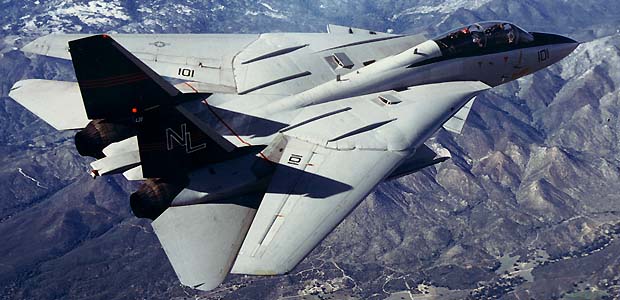
Wing sweepback variable from 20 degrees leading-edge to 68 degrees; oversweep of 75 degrees used for carrier stowage without wing fold; wing pivot point 2.72 m (8 ft 11 in) from aircraft centreline; fixed glove has dihedral to minimise cross-sectional area and reduce wave drag; small canards on F-14A known as glove vanes extend forward progressively to 15 degrees from inboard leading-edge to balance supersonic trim change and unload tail surfaces.
FLYING CONTROLS
Lateral control by long-span spoilers, ahead of flaps, and tailerons; automatic leading-edge slats assist manoeuvring; strakes emerge from wing glove leading-edge at high airspeeds; automatic wing sweep has manual override; automatic scheduling of control with airspeed; autostabilisation and angle of attack protection; autopilot and automatic carrier landing system (ALCS). Airbrake panel above and below tail, between fins. Twin fins and rudders.
STRUCTURE
Wing carry-through is one-piece electron beam-welded structure of Ti-6A1-4V titanium alloy with 6.71 m (22 ft) span. Fuselage has machined frames, titanium main longerons and light alloy stressed skin; centre-fuselage is fuel-carrying box; radome hinges upwards for access to radar; fuel dump pipe at extreme tail; fins and rudders of light alloy honeycomb sandwich; tailplanes have multiple spars, honeycomb trailing-edges and boron/epoxy composites skins. Retractable tricycle type. Twin-wheel nose unit and single-wheel main units retract forward, main units inward into bottom of engine air intake trunks. Original beryllium brakes were replaced with Goodyear lightweight carbon brakes from spring 1981. Arrester hook under rear fuselage, housed in small ventral fairing. Nose-tow catapult attachment on nose unit.
POWER PLANT
Two General Electric F110-GE-400 turbofans rated at 71.56 kN (16088 lb st) dry and 120.1 kN (27,000 lb st) with afterburning. Garrett ATS200-50 air turbine starter. F110 engine has 43 per cent more reheated thrust and 37 per cent more military thrust (without afterburning) than TF30-P-414A in F-14A; results in 20 per cent more specific excess energy, 30 per cent lower specific fuel consumption in afterburner, 62 per cent greater deck launch intercept radius and 34 per cent more combat air patrol time; can be launched without afterburner; time to 10670 m (35000 ft) reduced by 61 per cent and acceleration time by 43 per cent. Integral fuel fanks in outer wings, each with capacity of 1117 litres (295 US gallons; 246 Imp gallons); between engines in rear fuselage, with capacity of 2453 litres (648 US gallons; 539 Imp gallons); and forward of wing carry-through structure, capacity 2616 litres (691 US gallons; 575 Imp gallons); plus two feeder tanks with combined capacity of 1726 litres (456 US gallons; 380 Imp gallons). Total internal fuel capacity 9029 litres (2385 US gallons; 1986 Imp gallons). An external auxiliary fuel tank can be carried beneath each intake trunk, each containing 1011 litres (267 US gallons; 222 Imp gallons). Retractable flight refuelling probe on starboard side of fuselage near front cockpit.
ACCOMMODATION
Pilot and naval flight officer seated in tandem on Martin-Baker NACES (or GRU7A in F-14A/B) rocket-assisted zero/zero ejection seats, under a one-piece bubble canopy, hinges at the rear and offering all-round view.
AVIONICS
In F-14A, Hughes AN/AWG-9 weapons control system, with ability to detect airborne targets at ranges of more than 65-170 nm (120-315 km; 75-195 miles) according to their size, and ability to track 24 enemy targets and attack six of them simultaneously at varied altitudes and distances. Fairchild AN/AWG-15F fire control set; CP-1066/A central air data computer; CP-1050/A computer signal data converter; AN/ASW-27B digital data link; AN/APX-76(V) IFF interrogator; AN/APX-72 IFF transponder; AN/ASA-79 multiple display indicator group; Kaiser Aerospace AN/AVG-12 vertical and head-up display system. During 1995 the US Navy installed the LANTIRN precision strike navigation and targeting pod on the F-14. LANTIRN is supplied by Lockheed Martin and provides the capability of detecting targets at long range and high altitudes. The LANTIRN targeting pod includes a dual field of view FLIR and a laser designator/rangefinder. The navigation pod also contains a FLIR and terrain-following radar. The F-14D carries an optical television camera and a Lockheed Martin infra-red search and track system intalled in a sensor pod under the nose. The F-14D is fitted with the JTIDS Joint Tactical Information Distribution System which allows the transmission and reception of surveillance data and command and control information with naval, army and air force platforms.
SELF DEFENSE
The aircraft is equipped with the Tracor and Lockheed Martin AN/ALE-39 and the earlier AN/ALE-29 chaff, flare and decoy dispensers.The Super Tomcat has a Raytheon AN/ALR-67(V)4 radar warning system and Sanders AN/ALQ-126 jammer
ARMAMENT
One General Electric M61A-1 Vulcan 20 mm gun mounted in the port side of forward fuselage, with 675 rounds of ammunition. Four AIM-7 Sparrow air-to-air missiles mounted partially submerged in the underfuselage, or four AIM-54 Phoenix missiles carried on special pallets which attach to the bottom of the fuselage. Two wing pylons, one under each fixed-wing section, can carry four AIM-9 Sidewinder missiles or, two Sparrow or Phoenix missiles with two Sidewinders. F-14D has bombing capability; Rockeye and CBU-59 cluster bombs validated for F-14 December 1992; GBU-16 LGB and Gator mine to follow; AGM-88 HARM ARM and SLAM ASMs planned, but not yet funded.
