
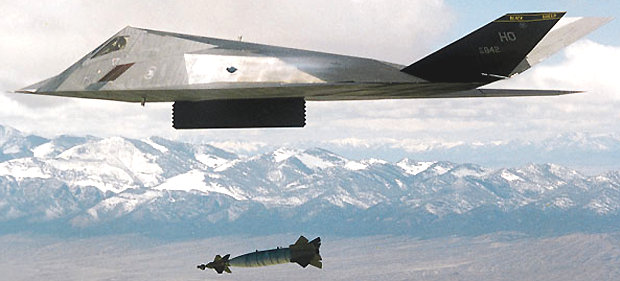
The F-117A Nighthawk Stealth Fighter Attack Aircraft was developed by Lockheed Martin after the development of the advanced stealth technology and the predecessor test demonstrator aircraft, Have Blue, was carried out in secret from 1975. Development of the F-117A began in 1978 and it was first flown in 1981, but it was not until 1988 that its existence was publicly announced. The Nighthawk is the world's first operational stealth aircraft. The US Air Force has 59 Nighthawks. The F-117A aircraft is also known as the Frisbee and the Wobblin' Goblin. The mission of the aircraft is to penetrate dense threat environments and attack high value targets with high accuracy. Nighthawk was in operational service during Operation Desert Storm. The aircraft can carry a range of tactical fighter ordnance in the weapons bay, including BLU-109B low level laser guided bomb, GBU-10 and GBU-27 laser guided bomb units, AGM-65 Maverick from Raytheon and AGM-88 HARM from Raytheon TI Systems.
Before flight, mission data is transferred to an electronic data transfer module which is a portable cartridge used to download the data on the aircraft's onboard computers. The mission control computer, model AP-102, is supplied by IBM. The aircraft's computers integrate the mission data program together with the navigation and flight controls to provide a fully automated flight management system. After take-off the pilot can hand over flight control to the mission program until within visual range of the mission's first target. The pilot then resumes control of the aircraft for weapon delivery. The aircraft is equipped with an infrared acquisition and designation system, IRADS, which is integrated with the weapon delivery system. The pilot is presented with a view of the target on the head up display, first from the forward looking infrared and then from the downward looking infrared. The weapon delivery and impact is recorded on the aircraft's internally mounted video system which provides real time battle damage assessment. The cockpit is equipped with an ACES II zero/zero ejection seat supplied by Boeing. The cockpit has a head up display system, HUD, developed by Kaiser Electronics and the flight deck is equipped with a large video monitor in the centre which displays the infrared imagery from the aircraft's onboard sensors. The cockpit has a full colour moving map developed by the Harris Corporation and instrument display. The canopy has serrated edges to reduce the radar returns from the join between the canopy and the fuselage. The canopy glass has a gold coating which makes the panel appear to a radar as a continuous part of the fuselage surface.
The stealth operation of the F-117A does not allow the navigation or targeting to rely on radar. The aircraft uses an inertial navigation system, INS, supplied by Honeywell. For navigation and weapon aiming the aircraft is equipped with a forward looking infrared, FLIR, and a downward looking infrared, DLIR, supplied by Raytheon TI. The FLIR and DLIR are covered by radar absorbing screen grids. The DLIR incorporates a laser target designator. The aircraft has multi-channel pitot static tubes installed in the nose. Each pitot tube is heated and facetted to match the angles of the surfaces of the aircraft in order to reduce the radar returns. Multiple ports along the length of the tubes provide differential pressure readings. The flight control computers compare these in order to provide the aircraft's flight data. The F-117 is deliberately unstable aerodynamically in order to have a high level of manoeuvrability. The aircraft's orientation is monitored continuously in flight and the on-board computers execute hundreds of small electro-hydraulic adjustments to keep the aircraft flying smoothly. The fly-by-wire system is supplied by GEC Astronics. The F-117A is powered by two low bypass F404-GE-F1D2 turbofan engines from General Electric.The rectangular air intakes on both sides of the fuselage are covered by gratings which are coated with radar absorbent material. The wide and flat structure of the engine exhaust area reduces the infrared and radar detectability of the aft section of the engine. The two large tail fins slant slightly outwards to provide an obstruction to the infrared and radar returns from the engine exhaust area.
The communications antennae are retractable and are fitted on the upper fuselage behind the cockpit. The aircraft normally flies missions in conditions of radio silence. The surfaces and edge profiles are optimised to reflect hostile radar into narrow beam signals directed away from the enemy radar detector. All the doors and opening panels on the aircraft have saw-toothed forward and trailing edges to reflect radar away from the direction of the radar source. The aircraft is mainly constructed of aluminium with titanium being used in the high temperature and high stress areas of the engine and exhaust systems. The outer surface of the aircraft is coated with a radar absorbent material, RAM. The radar cross section of the F-117 has been estimated at between 10 and 100 square centimetres which is two or three orders of magnitude less than the RCS of a conventional fighter aircraft. The F-117A has four elevons on the inboard and outboard trailing edge of the wing. The V-shaped tail which controls the yaw of the aircraft acts as a flying tail which means that the whole surface acts as a control surface. The elevons do not act as flaps to reduce the rate of descent for touchdown so the landing speed of the F-117A is high at about 180 or 190 miles per hour and a drag parachute is used.
