
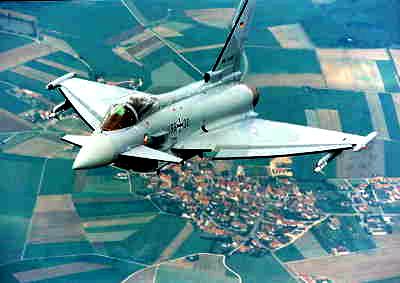
PROGRAMME
Single-seat, highly agile STOL-capable fighter, optimised for air defence/air superiority; secondary capability for ground attack. Outline staff target for common combat aircraft issued December 1983 by air chiefs of staff of France, Germany, Italy, Spain and UK; initial feasibility study launched July 1984; France withdrew July 1985, shareholdings then being readjusted to 33 per cent each to UK and Germany, 21 per cent Italy and 13 per cent Spain; project definition phase completed September 1986; definitive ESR-D (European Staff Requirement - Development) issued September 1987, giving military requirements in greater detail; definition refinement and risk reduction stage completed December 1987; main engine and weapons system development contracts signed 23 November 1988. Planned eight development aircraft (no prototypes apart from BAe EAP - see 1991-92 and earlier Jane's) reduced to seven (DA1-7) early 1991, coincident with 11 per cent cut in intended flight test programme to 4,500 hours. Total to be achieved in 2,990 sorties by prototypes (635, 575, 430, 420, 385, 315 and 290 for DA1 to DA7, respectively) plus 1,700 sorties by first five production aircraft, which will be fitted with test instrumentation. Details of prototypes appear below. Defensive aids subsystem contract awarded to Euro-DASS 13 March 1992, but Germany and Spain initially declined to participate; may develop own equivalent systems. `A' version of ECR 90 radar first flew in nose of modified BAe One-Eleven testbed (ZE433) at Bedford, 8 January 1993; `C' version is first ECR 90 packaged to fit Eurofighter. Fatigue test fuselage at Ottobrunn achieved 6,000 hours (equivalent to one lifetime) in May 1995; target is 18,000 hours (equivalent to 6,000 hours of service use) by January 1997. An overall production contract for 620 aircraft was signed in January 1998 with 232 for UK, 180 for Germany, 121 for Italy and 87 for Spain. Production aircraft are planned to enter service with the four participating nations in 2002. Greece has also chosen to join the Eurofighter programme and is to procure 60 to 90 aircraft, with deliveries beginning in 2005.
DESIGN FEATURES
Collaborative design by BAe, DASA, Alenia and CASA, incorporating some design and technology (including low detectability) from BAe EAP programme; low-wing, low-aspect ratio tail-less delta with 53o leading-edge sweepback; underfuselage box with side by side engine air intakes, each with fixed upper wedge/ramp and vari-cowl (variable position lower cowl lip) with Dowty actuators. Intended service life, 6,000 hours or 30 years. Integrated structural health-and-usage monitoring system (first in any combat aircraft) calculates structural fatigue at 20 positions on the airframe 16 times per second during flight. Maintainability features include 10 mmh/fh and single engine change by four engineers in 45 minutes. Operational turn-round by six ground crew in 25 minutes.
FLYING CONTROLS
Two-segment automatic slats on wing leading-edges, inboard and outboard flaperons on trailing-edges; all-moving foreplanes below windscreen; rudder; hydraulically actuated airbrake aft of canopy, forming part of dorsal spine; Liebherr primary flight control actuators. Full-authority quadruplex ACT (active control technology) digital fly-by-wire flight control system (team leader DASA) combines with mission adaptive configuring and aircraft's instability in pitch to provide required `carefree' handling, gust alleviation and high sustained manoeuvrability throughout flight envelope; pitch and roll control via foreplane/flaperon ACT to provide artificial longitudinal stability; yaw control via rudder; no manual reversion, but DFCS incorporates auto-recovery mode (`panic button') for immediate return to straight-and-level flight in emergency. Ada language, apart from time-critical subroutines in Assembler. STANAG 3910 NATO standard databus. Dowty Aerospace retractable tricycle type. Single-wheel main units retract inward into fuselage; nosewheel unit forward. Nosewheel steering is subfunction of DFCS. Tyre sizes 28 x 9.5 in main; 18 x 7.7 nose.
POWER PLANT
First two development aircraft each powered by two Turbo-Union RB199-122 (Mk 104E) afterburning turbofans (each more than 71.2 kN; 16,000 lb st). DA3-DA7, retrofitted (1996) DA1 and DA2, and production aircraft, will have two Eurojet EJ200 advanced technology turbofans (each of approximately 60 kN; 13,490 lb st dry and 90 kN; 20,250 lb nominal thrust with afterburning), mounted side by side in rear fuselage with ventral intakes. Staged EJ200 improvements available (but not funded) to 103 kN (23,155 lb st) and 117 kN (26,300 lb st). DASA digital engine control system.
ACCOMMODATION
Pilot only, on Martin-Baker Mk 16A zero/zero ejection seat. Smiths Industries glareshields. The pilot's equipment specific to Eurofighter includes the helmet, a liquid conditioning suit, a pressure breathing anti-g-force vest, a full body nuclear, biological and chemical warfare protection suit and outer garments for various environmental conditions.
AVIONICS
BAe has overall team leadership for avionics development and integration. All avionics, flight control and utilities control systems integrated through databus highways with appropriate redundancy levels, using fibre optics and microprocessors. Some functions activated by direct voice input, with 100 word vocabulary. Rohde & Schwarz Saturn VHF/UHF communications; Computing Devices video and voice recorder.
RADAR
The aircraft is equipped with an ECR 90 pulse Doppler radar being developed by the Euroradar industrial consortium. The multi-mode radar has multi-target capability. Euroradar is led by the UK company Marconi Electronic Systems with INISEL of Spain, FIAR of Italy and Telefunken Systemtechnik of Germany.
INSTRUMENTATION
Special attention given to reducing pilot workload. New cockpit techniques simplify safe and effective operation to limits of flight envelope while monitoring and managing aircraft and its operational systems, and detecting/identifying/attacking desired targets while remaining safe from enemy defences. This achieved through high level of system integration and automation, including HOTAS controls; GEC-Marconi wide-angle HUD able to display, in addition to other symbology, FLIR pictures from sensor pod-mounted externally to port side of cockpit; helmet-mounted sight (HMS), with direct voice input (DVI) for appropriate functions; and three Smiths Industries multifunction head-down colour CRT displays (MHDD). Teldix cockpit interface unit.
SELF-DEFENSE
Advanced integrated defensive aids subsystem (DASS), contracted to Euro-DASS consortium, led by GEC-Marconi Defence Systems, includes RWR and active jamming pod at each wingtip plus laser warning receiver, missile approach warning and towed decoys (Germany withdrew from DASS, but still requires RWR and MAW; Spain also withdrew, but intends to rejoin; UK and Spain are only nations to have LWR).
ARMAMENT
Interceptor will have internally mounted 27 mm Mauser gun on starboard side, plus mix of medium-range AIM-120 AMRAAM or Aspide and short-range air-to-air missiles carried externally; four AIM-120s carried in underfuselage troughs; Germany to pursue development of short-range IRIS-T. Short-range missiles carried on ML Aviation underwing ejector release units. Eurofighter will, if necessary, be able to carry considerable load of air-to-surface weapons. Total of 13 external stores stations: five (including one wet) under fuselage and four (including one wet) under each wing.
