
Once upon a time, wrestlers wrestled - I mean REALLY wrestled. Historians have traced wrestling’s ancestry to the ancient Egyptians, then on to the Greeks and the Romans. But that’s not the type of wrestling we’re gonna talk about here. We’re talking about the body-slamming, head-bashing entertainment that has come to be known as professional wrestling - a form of entertainment that is as American as baseball, basketball, and apple pie. And THAT wrestling has a history all it’s own, as you’ll read in this page...
Old World wrestling was of the Greco-Roman variety, which had certain rules - no holds were allowed below the waist, and when one of the combatants hit the ground it constituted a ‘fall.’ In contrast to this “long-hair” variety was the more commercial form of wrestling, like the matches that used to be held in old German beer gardens (Greco-Roman was developed in Europe in the 1860s and in America a decade or so later. But the Greco-Roman of this period had little similarity to the classic style of the early Greeks and Romans. This form of wrestling, called “long-hair” wrestling by some of the older wrestlers like Lou Thesz, persists today in a modified form as an Olympic sport). Although ‘scientific’ in nature, the main idea of these wrestling exhibitions was to sell beer. Old World wrestling is called ‘scientific wrestling,’ an old-style wrestling done as a sport, rather than purely for entertainment. Scientific matches are those that are based on the legit use of standard holds and moves, and are conducted strictly according to Greco-Roman rules.
The longer an exhibition match lasted, the more beer the beer garden sold. And so, the two wrestlers would lock each other in their arms and stay in one position for 30 minutes or more. Then one would straighten his arms slowly, flexing his muscles ever so slightly. The customers would go wild and celebrate this “victory” by ordering more beer. Finally, when the wrestlers got thirsty, one would be thrown to the ground with a mighty thud and they would rest and drink for 30 minutes or so. And so on through the long, wet night, lasting five or six hours.
When wrestling was brought to America by Irish and German immigrants, it was given a New World twist. Beginning in the post-Civil War period, wrestling bouts were staged at country fairs or touring carnivals in “At Shows” (short for athletic shows), where wrestlers with costumes, nicknames, and fictionalized biographies would wrestle each other or accept challenges from all local comers (you may have seen this in a few cartoons).
The carney At Shows featured wrestlers engaging in exhibition matches for challenging all comers from the audience in time-limit contests for money - say $25. The challenger could win in one of two ways: by pinning the star or by managing to stay in the ring with him for 15 minutes. For the star, evading the pin was easy - all he had to do was remain on the defensive for the entire time limit. But staying the limit raised a real risk that the carnival operator could lose money if the local favorite - or “local yokel,” as he was called - managed to go the distance.
In the old days there were three classes of wrestlers: the ‘hooker’ was the most proficient, an able wrestler with the wrestling knowledge, ability and strength, and with a bag full of old carnival ‘hooks’ - illegal tricks, moves, or gimmicks - in his repertoire; the ‘shooter’ was a scientific and competitive wrestler; and the ‘journeymen,’ the largest group, performers who could wrestle just a little. The carneys, who lived by their wits, employed all sorts of tricks to avoid paying money to the local heroes: They paid an operative to hide behind a curtain at the back of the ring, ready with a baseball bat to take out the challenger; or they employed hookers using crippling holds unknown or illegal in competitive matches, put an end to the challenge before the local could sting the carnival. If the local was good enough to stay with the carney wrestler, the hooker would maneuver him into a backdrop, where he would be whacked on the head with a 2 x 4 by a confederate, ending his daredeviltry and preserving the carnival’s money.
Approximately the same time that carnivals traveled the highways and byways of 19th-century America, wrestling barnstormers were traveling the back roads, working by hook and crook to shake money out of the rubes. They promoted money matches for themselves against the local strongmen wherever and whenever they could find them, making side bets with the townsfolk on the outcome. There was a lot of connivance, sometimes with the willing assistance of the local hero, to make sure the underdog always won - and, if done convincingly, the two could stage a rematch and sting the ‘marks’ all over again. The barnstormers’ bottom line was money, not victories, the beginnings of wrestling as a performance sport.
Both carnivals and the barnstormers had a stimulating effect on early America, not only reminding those who had left the tradition of wrestling in the Old World of its existence in the new, but also bringing this new form of entertainment to the yet-unexposed masses.
It was but a short hop, skip, and pin to the next stage in wrestling’s development: matches held in small halls and saloons, much like the old German beer garden experience. Advance men hung up posters announcing the coming of the matches and stayed in town to ‘homestead,’ that is, to promote wrestling. With both the traveling carnivals and the barnstormers spreading the popularity of wrestling and carrying it to the masses - particularly the European immigrants who had long been interested in the sport in all its forms - wrestling was on the threshold of becoming Americanized.
A few U.S. Presidents were wrestlers: George Washington was the champion of the colony of Virginia and Teddy Roosevelt wrestled at Harvard. However, the most famous of all was Abraham Lincoln...
Early in life Lincoln had developed great wrestling skills and soon earned a reputation around his native Springfield, Illinois after defeating a local street fighter named Jack Armstrong. The bout had been arranged by a local saloonkeeper who had offered Lincoln $10 if he could throw Armstrong.
The curious were drawn from miles around to New Salem, where Lincoln was then
employed as a clerk, to see the match. The betting action among the sports was brisk, most of it being placed on the shorter but more powerfully built Armstrong. But once the match started, it was no contest. “Lincoln lifted him by the throat,” wrote Carl Sandburg, “shook him like a rag and then slammed him to a hard fall.” Armstrong merely shook his head and said, “He’s the best feller that ever broke into the settlement.”
Stories and storytellers have it that Lincoln was engaged in a wrestling match when couriers came to tell him in 1860 of his nomination for the presidency by the Republican convention.
Wrestling’s roots were so solidly embedded in the European culture that most of the first wave of great American wrestlers was made up of first-generation Americans of European descent, most from small-town America, and European immigrants - wrestlers such as Martin Burns, William Muldoon, Ernest Roeber, and Evan Lewis. They combined Greco-Roman and catch-as-catch-can wrestling, with one match, between Lewis and Roeber in 1893, alternating for five falls between the two disciplines. This last type of wrestling (catch-as-catch-can) was initially popularized by Frank Gotch and Tom Jenkins at the turn of the century. It allowed wrestlers to grasp any part of their opponents body, and falls were scored whenever both shoulders of a wrestler touched the floor at the same time.
The immigrant experience continued with the second wave of American wrestlers, most coming from mid America, with wrestlers like Frank Gotch, Tom Jenkins, and Dan McLeod, joined by “The Russian Lion” (George Hackenschmidt), who had won international tournaments in Europe and came to the U.S. to defend his title. Gotch and Hackenschmidt would put two of the most celebrated bouts in wrestling history, and two of the most controversial (more controversial than the Hart-McMahon situation? You decide)...
The first bout, for the supremacy of the wrestling world, was held at Chicago’s Dexter Park Pavilion in 1908. It was generally believed that Hackenschmidt’s bear hug and inside trip would be more than enough to make Gotch submit. However, The Lion was unable to get Gotch in his grasp all evening - and was later to complain that Gotch had slathered himself in oil to make him impossible to grab. His inability to grab Gotch, coupled with Gotch’s continual roughhousing and fouling, finally drove Hackenschmidt to quit after two hours and three minutes. The referee had no alternative but to disqualify Hackenschmidt and award the decision and the title to Gotch.
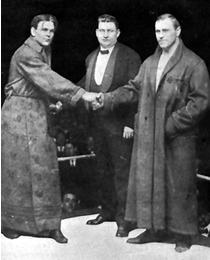
For the next three years Hackenschmidt campaigned for a rematch, finally getting one in 1911 at Chicago’s new Comiskey Park in what was billed as The Match of the Century. Once again, foul tactics reared their ugly head. Only this time it wasn’t during the match itself, but beforehand..
With but one leg and public prejudice running in favor of the two, Hackenschmidt tried to call off the bout. But the promoters, who had already spent the advance ticket money, pleaded with him to keep his injury a secret and go ahead with the bout. He agreed, but only if Gotch agreed to let him win one of the three falls and carry him to a face-saving end. Gotch double-crossed him and pinned the helpless Russian Lion in two straight falls. (For more info on this see The Legends of the Ring, The Peerless One)
The press got wind of Gotch’s duplicity and not only turned their backs on the match, but also on the sport itself. That, and Gotch’s retirement two years later to tour with the Sells-Floto Circus giving wrestling exhibitions, spelled the end of wrestling’s first golden era. It would also mark the end of scientific bouts that took a day - and sometimes a night as well.
Nobody, but nobody, was ever better than Ed “Strangler” Lewis in the long history of pro wrestling. Lewis looked like Babe Ruth - fat and balding with a big chest and small, toothpick-thin legs. After winning bout after bout with a monotonous regularity - usually ending the match with his signature strangulation hold from which no opponent could escape - and creating an undercurrent of displeasure among the fans, Lewis and his brain trust - manager Billy Sandow and promoter Toots Mondt, who along with Lewis, were known as “The Gold Trio” - decided it was necessary to “do business” (agree to lose once in a while) to keep wrestling fans interested. But even though he was to “lose” the title four times - over 6,200 matches in his long career he was to “lose” only 33 times - The Strangler would win it back an equal number of times, most in “shoot” matches.
Like all other forms of entertainment, wrestling struggled for its very existence - people without enough money to fill their bellies and had very little extra to spend on frills and extravagances like entertainment.
Still the sport labored on, with wrestlers like Dick Shikat, Jim Londos, Jim Browning, and Gus Sonnenberg passing the title around like a parcel nobody wanted. But then again, wrestling was a sport nobody wanted either. Especially in its interminable, never-ending matches which produced thousand-yard stares in its fans.
And so the promoters tried several innovations to lure the fans, including putting a time limit on the matches of 10 to 15 minutes, in an effort to liven up the sport, much as baseball introduced the “lively ball” in 1930 to increase that sport’s offense. Promoters also started scheduling novelty bouts - women’s wrestling, tag teams, and even mud wrestling.
The biggest innovation was to recruit a new breed of wrestlers - former collegiate football stars - in an attempts to capitalize on their names and popularity. The first of this new breed was Wayne “Big” Munn, a lineman from the University of Nebraska back in 1920. By he 1930s, Gus Sonnenberg of Dartmouth and the University of Detroit, “Jumping” Joe Savoldi of Notre Dame, and Bronko Nagurski of the University of Minnesota and the Chicago Bears all left the gridiron for the wrestling arena.
But the addition of the collegiate greats was not enough to turn wrestling’s fortunes around. As the hand of the Great Depression closed her all-enveloping fingers around the nation’s wallet, wrestling, like all other forms of entertainment, continued to suffer.
It’s fortunes didn’t improve throughout World War II. Those who wanted wrestling in the proverbial “worst way,” got just what they asked for: Promoters combed the country signing babes in swaddling clothes and throwing nets over anybody this side of the undertaker to fill its depleted ranks. But wrestling was on the cusp of a monumental breakthrough, courtesy of a newfangled household appliance called television...
Television and pro wrestling were made for each other. Wrestling offered an almost made-for-television format, tailored to the dimensions of the TV tube. And, in a symbiotic relationship, television offered wrestling an entirely new group of fans and fans-to-be. Soon wrestling was being offered up from arena and studio alike almost every day of the week - and served on Fridays more times than fish. But the wrestling boom of the late 1940s and ‘50s wouldn’t have been possible for one man: Gorgeous George.
With Luna Turner bleached-blond hair and a bag of gimmicks - including marching into the arena to the strains of “Pomp and Circumstance” - Gorgeous George always put on a show: having his formally attired valet spray the ring with an atomizer filled with perfume-scented disinfectant called, appropriately enough, “George No. 4”; wearing his fur-trimmed robe; and giving away “Georgie Pins” to the crowd. Gorgeous George became wrestling’s biggest-ever draw. The man introduced as “The Human Orchid, The Toast of the Coast” became wrestling’s poster boy. And, not incidentally, became wrestling’s first pure “performer,” setting the stage, for wrestling’s all-new direction: showbiz.
From that point on, wrestling became “rasslin” as hordes of masked men, high-stepping Germans, monocled lords, Indian chiefs, Arab chieftains, and all other manner of gimmicked-up “rasslers” followed Gorgeous George’s awake. The second golden age of wrestling had begun.
Soon, however, television which had used wrestling as a mere filler, found other programming. Wrestling sank back into oblivion until the 1980s, when promoter Vince McMahon found a way to use the media to his own advantage, and wrestling roared into its third golden age - one that it is still enjoying.
Back then there were no organizations nor federations. There were only barnstormers, carnival operators, and just plain ol’ hustlers who homesteaded areas, staking out the territory and holding wrestling bouts there. These early-day Barnums of wrestling were con men, most of whom had shaken hands with the process sever more than once.
And they were the forerunners of the wrestling promoter, the freelance entrepreneurs who roamed the landscape in the early 20th century. They had no more legal right to control a territory than a claim jumper, but they agreed among themselves to respect their territorial boundaries. Soon, the countryside took on the look of a patchwork shed put together by drunken carpenters, as each territory abutted and sometimes even overran an already-established one.
Their ranks were filled with boxing promoters such as Jack Curley and Jesse McMahon, ex-wrestling such as Toots Mondt and Ed “Strangler” Lewis, and promoters such as Jack Pfefer, who came straight into wrestling with no previous career stops along the way.
By the 1930s the wrestling landscape was as depressed as the rest of the country. The champions had the life spans of mayflies, while matches were interminable, going on until the wee hours of the morning. Promoters were double-crossing what few attractions they still had, not to mention each other. Accordingly, crowds, with the notable exception of those who came out in droves to watch Jim Londos (wrestling’s ONLY consistent drawing card during this period), had fallen off disastrously. Something had to be done, and fast. The promoters were barely earning enough to survive on.
Promoter Toots Mondt understood that wrestling fans would no longer stand for even the biggest name wrestler holding a headlock on an opponent for five minutes or more. He borrowed an idea from vaudeville - the blackouts, where acts lasted but a few minutes - and gave wrestling fans more entertainment bang for their buck by imposing time limits of 10 or 15 minutes. Other innovations of the era included the introduction of “character” wrestlers, good-guy/bad-guy oppositions, and novelty acts like midget wrestling and women wrestlers.
More promoters got into the game as it became more viable. Rudy Dusek in Nebraska, Ed White in Chicago, Pinkie George in Iowa, Tony Stetcher in Minnesota, Ray Fabiani in California, Paul Jones in Atlanta, LeRoy McGuirk in Tulsa, Nick Gulas and Roy Welch in Nashville, Sam Muchnick in St. Louis, Morris Sigel in Houston, and Paul Bowser in Boston.
They weathered the tough times of the Depression and emerged into sunshine of the eagerly awaited post-war boom. That’s when wrestling suddenly found itself in a boom of its own - this one courtesy of TV. All of a sudden, the new golden age of wrestling had arrived and the promoters were going to make sure they made the most of it.
Most of the promoters formed an organization in 1948 called the National Wrestling Alliance (NWA), which covered the entire West Coast from Seattle to San Diego, and included Texas, Oklahoma, Kansas, Missouri, and almost the entire South, plus Mexico, Australia, and parts of Japan and Canada. But the NWA was an organization in name only. It was really a loosely knit confederation or promoters, most of whom were, in the words of Lou Thesz, “hypocrites and lowlifes who’d stage a dogfight if they thought it would draw money.”
The typical NWA convention had all the back slapping found at a Shriner’s convention and all the back stabbing found at reunion of the Borgia family, as each promoter tried to get the better of fellow alliance members. Vince McMahon Sr., was the only major promoter not to join the NWA. He controlled the Washington, DC territory, which ran from Richmond, Virginia up to Lewiston, Maine.
Even though wrestling’s cast of characters always seems to be changing, there has been one constant throughout the years - the McMahon family. The patriarch of the McMahon clan was Jess McMahon, a boxing promoter who turned to wrestling. A debonair, handsome gentleman of indeterminate age, Jess had co-promoted the heavyweight championship boxing match between Jess Willard and Jack Johnson in 1915, and then joined Tex Rickard in bringing big-time boxing to Madison Square Garden. From there it was an easy transition into promoting wrestling bouts, first in the Garden and then throughout the East Coast.
His son, Vince McMahon Sr., became the second member of wrestling’s First Family to enter the game on the promotional side. Originally, Vince Sr. ran something called Capital Wrestling out of Washington, DC - a territory which covered the eastern seaboard from Virginia all the way up to Main and as far west as the Alleghenies, about the same region covered by America’s first coaxial (TV) cable. The near approximation of McMahon’s territory and the area covered by the coaxial cable gave McMahon a huge advantage in selling his local wrestling bouts to the fledging TV medium, which was desperately searching for programming to fill its screens.
Vince Sr. teamed up with old promoter, Toots Mondt, who controlled the talent just as Vince controlled TV access. Together they became the most successful wrestling promoters of the late 1940s and early ‘50s. Capital Wrestling’s territory was so large and its operation so successful and lucrative, that they didn’t need the NWA. And so they went on their merry way, stronger as a single entity than the NWA was a coalition.
One of Capital’s first great attractions was Antonio Rocca, the Argentine acrobat whom they imported in the late 1940s. Then they brought in Gorgeous George from the West Coast, and he caused an instant sensation - he was a made-for-television celebrity. McMahon and Mondt carried a “Cold War” with the NWA throughout the 1950s, but in 1961 the war heated up over a new wrestler on the scene, “Nature Boy” Buddy Rogers...
Rogers, the biggest draw since Rocca and Gorgeous George, had won the NWA World Heavyweight Title from Pat O’Connor at Chicago’s Comiskey Park in 1962. But soon thereafter the NWA found that “their” champion had gone over to Mondt, who had taken over Rogers’ bookings and was using him exclusively in the McMahon-Mondt eastern circuit. Only on rare occasions would a magnanimous Mondt consent for Rogers to wrestle for NWA promoters, allowing barely a handful of dates each month.
Things got so bad that Sam Muchnick, then head of the NWA, was heard to mumble aloud to anyone who would listen :”Toots controls Rogers now and he’s seeing to it we can’t even use our own champion.” Muchnick persuaded the venerable Lou Thesz, who had first held the world title back in 1937 and five times thereafter, to take on Rogers and bring the belt back home. But even though Thesz was to beat Rogers in one fall in January of 1963, the east coast circuit continued to recognize Rogers as “champion.”
Four months later, in May of 1963, McMahon and Mondt formed the World Wide Wrestling Federation (WWWF). And while not precisely “world wide” - it covered only the eastern seaboard - it was an impressive territory with an impressive sounding name. Soon one of the Ws was dropped and it became the WWF.
Shortly thereafter, the McMahon-Mondt tandem came to an end. Mondt, who had been on the scene since God knows when decided to pack it in and sold his interest in the WWF back to Vince then resold that interest to Gorilla Monsoon, Phil Zacko, and Arnold Skaaland, keeping a majority interest in the new entity for himself.
In 1983, Vince sold his interest in the WWF to his son, Vince Jr. What followed was a nationwide wrestling blitzkrieg - a take-no-prisoners war of expansion that would radically change the world of pro wrestling.
Vince Jr. was able to voyage into the territories of the other promoters because of the dawning of cable TV and the production values made possible by another innovation, videotape. His theory was, what worked in the Northeast could be exported and made to work nationally - and internationally. So he declared war on the other promoters and invaded or brought up their territories.
While he was carrying out this “scorched-earth policy,” Vince Jr. was vulnerable: “We did it all with mirrors, it was all cash flow. Had those promoters known that I didn’t have any money, they could have killed us.”
But the point is, they ‘didn’t’ know. And even if they had, it’s doubtful that the disorganized organization known as the NWA could have held Vince Jr. off. Rather than banding together to repel his invasion, they bickered among themselves and kept their heads firmly planted in the sand while Vince Jr. planted his WWF flag across the country, changing the face of pro wrestling forever. Of the 20 regional promoters operating throughout the country in1984, fewer than five remained by 1989.
“My dad would never have sold me his end of that company, nor for that matter would the other stockholders have followed if they knew what I was going to do,” Vince Jr. said. “He just thought I was going to continue to operate in the Northeast and respect the other promoters and their territories...He said, ‘Oh my God, now you’ve just angered half the promoters in the business.’” But Vince Jr. had his own plans, so after he bought out his dad’s partners he began syndicating his television programming into Los Angeles, then St. Louis, then throughout the country.
Wrestlemania made the WWF. Not just with the publicity - which McMahon played for all it was worth - but because its coverage established the WWF as truly worldwide.
Now McMahon was able to continue his onslaught against other promoters, using TV as his primary weapon. This time, unlike what happened in wrestling’s earlier golden age back in the ‘50s, McMahon used the medium instead of the other way around. The new cable channels were scrambling for programming that McMahon was able to provide, even if he had to buy up the air time to shut out the competition.
As more and more promoters folded up their tents and faded into the sunset, the WWF filled the void with its shows, which were now telecast on every newly minted cable channel. The notable exception was ESPN, which carried wrestling from Jim Crockett’s NWA circuit.
Crockett was the only promoter left to carry the banner against the WWF - all the others had gotten out. Also gone were Verne Gagne’s AWA in the Midwest and Fritz Von Erich’s WCCW in Texas. Crockett’s North Carolina-based organization, became, by default, the NWA. His stars were equal to those in the WWF- Dusty Rhodes, Ric Flair, and others of equal stature - but the trouble was the nobody outside of Charlotte knew them. The WWF’s monopolization of cable kept them off the tube. Crockett soldiered on anyway, losing money hand over handstand.
It looked like McMahon held all the cards and could dictate terms to TV networks, most of which were so eager to keep their wrestling programming that they rolled over on his command. All except Ted Turner, of the Turner Broadcasting System (TBS).
Rumor has it that Turner was upset with Vince Jr.’s demands for time slots. Or that he was pissed with McMahon for buying up some of Crockett’s talent, which was now showing on TBS. Whatever the reason, Turner decided to declare war on McMahon and bought up Crockett’s promotional territory. According to McMahon, Turner called to gloat about his new acquisition, announcing that he now was in the rasslin’ business. “Good,” said McMahon, “WE’RE in the entertainment business.” And McMahon hung up.
While Turner had bought Crockett’s business, he hadn’t bought the NWA designation - at least, according to what remained of the loose alliance of regional promoters from the territory. They sued Turner for his use of the NWA initials. That made no nevermind to Turner - he just changed the initials to WCW, as in World Championship Wrestling. It was, after all, already the name of his number-one TV show on Saturday Nights.
It turned an all-out war between the two monguls, now. And although Turner lost money for the first eight years, this man never blinked. Having accomplished his primary purpose, preventing McMahon and the WWF from monopolizing cable-TV wrestling, Turner was also creating his own programming for TBS, a superstation that beamed its signals all across the country.
With Turner’s WCW, McMahon was faced for the first time with the WWF not being the top wrestling dog - and with the defections of some of his top stars from the ranks. And it seemed as if the standard wrestling good-guy versus bad-guy scenario had run out of steam, too: After four decades it suffered from thematic exhaustion. So he hit upon a new plan to pump up interest and work a twist on the old routine - he cast himself on WWF shows. This struck a responsive chord among the fans and shot the WWF back to the top.
Today the war between wrestling’s promoter titans pits Turner’s money against Vince’s ingenuity. And although Turner can always outspend Vince, Vince can always fight back with new ideas, newfangled plot lines, and outrageous gimmicks. McMahon cut deals left and right to keep Turner out of the top arenas. Turner’s response was to start his own pay-per-view shows, cluttering the already crowded PPV schedule and diluting the impact of Wrestlemania.
The two soon began a game of “anything you can do I can do better.” For instance, WWF’s Monday Night Raw had always been a huge success. Turner countered by moving his show to Monday nights, calling it Monday Nitro. Then Turner did what every promoter has done from time immemorial - he started raiding the WWF’s roster for stars...
One of those to come over was Hulk Hogan, who had changed his name to Hollywood Hogan in the face of a lawsuit by the WWF when it claimed rights to the original name. Turner changed Hogan’s persona as well. WCW’s ratings went through the roof, and Monday Nitro passed Raw is War in the ratings for the first time.
As the WWF and WCW changed their storylines from a focus on blood and simulated maimings to more convoluted plots and juvenile raunchiness, more busty valets and managers and more action-figure acrobatics, they left a void. Hardcore wrestling - the way it used to be, with lots of blood, weapons, and over-the-top violence - was left behind. But not for long...
The organization that best exploited the void left by the WWF and WCW was Eastern Championship Wrestling (ECW). The ECW presented alternatives to the fare offered by the WWF and WCW: harder story lines, lots of blood, plenty of weapons and violence.
The ECW began its life in a bingo hall in South Philly in the early 1990s, the creation of Tod Gordon and wrestler Eddie Gilbert. When Gilbert left, he was succeeded by wrestling visionary Paul Heyman. In an earlier, WCW life, Heyman had been known as Paul E. Dangerously. Heyman changed the “E” in ECW from “Eastern” to “Extreme,” bought infomercials on major TV stations in major markets in the wee hours of the morning, and brought the newly Extreme Championship Wrestling organization to the attention of millions of fans who were hungry for the old-time violence.
The ECW has become a semi-major organization, though not quite in the league of the WWF and WCW. And it has proven that there is room for others. Now the number of wrestling affiliations has begun to mushroom, including the Century Wrestling Alliance, the International Wrestling League, the United States Wrestling Association, and even remnants of the old NWA.
Copyright 1999
From The Complete Idiot’s Guide to Pro Wrestling by
Captain Lou Albano
Bert Randolph Sugar
and Roger Woodson
