It is very loooong, but very descriptive and detailed good for papers, but I wouldn't blame you if you just page downed to the 1990's part.
1960s
1965: Pakistani nuclear research reactor at Parr,
Rawalpindi, starts functioning.
1968: Nonproliferation Treaty completed. Pakistan
refuse to sign.
1970s
1974: India tests a device of up to 15 kilotons
and calls the test a ``peaceful nuclear explosion.'' Pakistani Prime minister
Zulfikar Ali Bhutto tells meeting of Pakistan's top scientists of intention
to develop nuclear arms.
1974 -- Pakistan proposed to India the establishment
of a nuclear weapons free zone in south Asia
1978 -- Pakistan proposed to India a joint Indo-Pakistan
declaration renouncing the acquisition and manufacture of nuclear weapons
1979 -- The United States cut off aid to Pakistan
under section 669 of the Foreign Assistance Act of 1961 FAA) after it was
learned that Pakistan had secretly begun construction of a uranium enrichment
facility.
1979 -- Pakistan proposed to India mutual inspections
by India and Pakistan of nuclear facilities
1979 -- Pakistan proposed to India simultaneous
adherence to the NPT by India and Pakistan
1979 -- Pakistan proposed to India simultaneous
acceptance of full-scope IAEA safeguards
1980s
Early 1980's--Multiple reports that Pakistan obtained
a pre-tested, atomic bomb design from China.
Early 1980's--Multiple reports that Pakistan
obtained bomb-grade enriched uranium from China.
1980
1980--U.S. Nuclear Export Control Violation: Reexport via Canada (components of inverters used in gas centrifuge enrichment activities).
1981
1981--U.S. Nuclear Export Control Violation: New
York, zirconium (nuclear fuel cladding material).
1981--AP story cites contents of reported US
State Department cable stating `We have strong reason to believe that Pakistan
is seeking to develop a nuclear explosives capability * * * Pakistan is
conducting a program for the design and development of a triggering package
for nuclear explosive devices.'
1981--Publication of book, Islamic Bomb, citing
recent Pakistani efforts to construct a nuclear test site.
1982
1982/3--Several European press reports indicate that Pakistan was using Middle Eastern intermediaries to acquire bomb parts (13-inch `steel spheres' and `steel petal shapes').
1983
1983--Declassified US government assessment concludes that `There is unambiguous evidence that Pakistan is actively pursuing a nuclear weapons development program * * * We believe the ultimate application of the enriched uranium produced at Kahuta, which is unsafeguarded, is clearly nuclear weapons.'
1984
1984--President Zia states that Pakistan has acquired
a `very modest' uranium enrichment capability for `nothing but peaceful
purposes.'
1984--President Reagan reportedly warns Pakistan
of `grave consequences' if it enriches uranium above 5%.
1985
1985--ABC News reports that US believes Pakistan
has `successfully tested' a `firing mechanism' of an atomic bomb by means
of a non-nuclear explosion, and that US krytrons `have been acquired' by
Pakistan.
1985--U.S. Nuclear Export Control Violation:
Texas, krytrons (nuclear weapon triggers).
1985--U.S. Nuclear Export Control Violation:
US cancelled license for export of flash x-ray camera to Pakistan (nuclear
weapon diagnostic uses) because of proliferation concerns.
1985/6--Media cites production of highly enriched,
bomb-grade uranium in violation of a commitment to the US.
1985 -- Pressler Amendment [section 620E(e) of
the Foreign Assistance Act] requires a total cut-off of U.S. aid to Islamabad
unless the president can certify that Pakistan does not possess a nuclear
weapon, and that continued US aid will significantly decrease the probability
of its developing one in the future.
1986
1986--Bob Woodward article in Washington Post
cites alleged DIA report saying Pakistan `detonated a high explosive test
device between Sept. 18 and Sept. 21 as part of its continuing efforts
to build an implosion-type nuclear weapon;' says Pakistan has produced
uranium enriched to a 93.5% level.
1986--Press reports cite U.S. `Special National
Intelligence Estimate' concluding that Pakistan had produced weapons-grade
material.
1986--Commenting on Pakistan's nuclear capability,
General Zia tells interviewer, `It is our right to obtain the technology.
And when we acquire this technology, the Islamic world will possess it
with us.'
1986--Declassified memo to then-Secretary of
State Henry Kissinger states, `Despite strong U.S. concern, Pakistan continues
to pursue a nuclear explosive capability * * * If operated at its nominal
capacity, the Kahuta uranium enrichment plant could produce enough weapons-grade
material to build several nuclear devices per year.'
1987
1987 -- Pakistan proposed to India an agreement
on a bilateral or regional nuclear test ban treaty
1987--U.S. Nuclear Export Control Violation:
Pennsylvania, maraging steel & beryllium (used in centrifuge manufacture
and bomb components).
1987--London Financial Times reports US spy satellites
have observed construction of second uranium enrichment plant in Pakistan.
1987--Pakistan's leading nuclear scientist Abdul
Qadeer Khan states in published interview that `what the CIA has been saying
about our possessing the bomb is correct.'
1987--West German official confirms that nuclear
equipment recently seized on way to Pakistan was suitable for `at least
93% enrichment' of uranium; blueprints of uranium enrichment plant also
seized in Switzerland.
1987--U.S. Nuclear Export Control Violation:
California, oscilloscopes, computer equipment (useful in nuclear weapon
R&D).
1987--According to photocopy of a reported German
foreign ministry memo published in Paris in 1990, UK government official
tells German counterpart on European nonproliferation working group that
he was `convinced that Pakistan had `a few small' nuclear weapons.'
1987 -- China concluded a deal with Pakistan
to sell M-11 missiles and launchers.
1988
1988--President Reagan waives an aid cutoff for
Pakistan due to an export control violation; in his formal certification,
he confirmed that `material, equipment, or technology covered by that provision
was to be used by Pakistan in the manufacture of a nuclear explosive device.'
1988--Hedrick Smith article in New York Times
reports US government sources believe Pakistan has produced enough highly
enriched uranium for 4-6 bombs.
1988--President Zia tells Carnegie Endowment
delegation in interview that Pakistan has attained a nuclear capability
`that is good enough to create an impression of deterrence.'
1989
1989--Multiple reports of Pakistan modifying US-supplied
F-16 aircraft for nuclear delivery purposes; wind tunnel tests cited in
document reportedly from West German intelligence service.
1989--Test launch of Hatf-2 missile: Payload
(500 kilograms) and range (300 kilometers) meets `nuclear-capable' standard
under Missile Technology Control Regime.
1989--CIA Director Webster tells Senate Governmental
Affairs Committee hearing that `Clearly Pakistan is engaged in developing
a nuclear capability.'
1989--Media claims that Pakistan acquired tritium
gas and tritium facility from West Germany in mid-1980's.
1989--ACDA unclassified report cites Chinese
assistance to missile program in Pakistan.
1989--UK press cites nuclear cooperation between
Pakistan and Iraq.
1989--Article in Nuclear Fuel states that the
United States has issued `about 100 specific communiques to the West German
Government related to planned exports to the Pakistan Atomic Energy Commission
and its affiliated organizations;' exports reportedly included tritium
and a tritium recovery facility.
1989--Article in Defense & Foreign Affairs
Weekly states `sources close to the Pakistani nuclear program have revealed
that Pakistani scientists have now perfected detonation mechanisms for
a nuclear device.'
1989--Reporting on a recent customs investigation,
West German magazine Stern reports, `since the beginning of the eighties
over 70 [West German] enterprises have supplied sensitive goods to enterprises
which for years have been buying equipment for Pakistan's ambitious nuclear
weapons program.'
1989--Gerard Smith, former US diplomat and senior
arms control authority, claims US has turned a `blind eye' to proliferation
developments Pakistan in and Israel.
1989--Senator Glenn delivers two lengthy statements
addressing Pakistan's violations of its uranium enrichment commitment to
the United States and the lack of progress on nonproliferation issues from
Prime Minister Bhutto's democratically elected government after a year
in office; Glenn concluded, `There simply must be a cost to non-compliance--when
a solemn nuclear pledge is violated, the solution surely does not lie in
voiding the pledge.'
1990
1989-1990--reports of secret construction of unsafeguard
nuclear research reactor; components from Europe.
Spring 1990 -- Pakistan reportedly reacted to
Indian Army war game maneuvers near its border by preparing to drop one
of seven weapons from a specially configured C-130 cargo plane. [02 December
1992 NBC News report]
1990--US News cites `western intelligence sources'
claiming Pakistan recently `cold-tested' a nuclear device and is now building
a plutonium production reactor; article says Pakistan is engaged in nuclear
cooperation with Iran.
1990--French magazine publishes photo of West
German government document citing claim by UK official that British government
believes Pakistan already possesses `a few small' nuclear weapons; cites
Ambassador Richard Kennedy claim to UK diplomat that Pakistan has broken
its pledge to the US not to enrich uranium over 5%.
1990--London Sunday Times cites growing U.S.
and Soviet concerns about Pakistani nuclear program; paper claims F-16
aircraft are being modified for nuclear delivery purposes; claims US spy
satellites have observed `heavily armed convoys' leaving Pakistan uranium
enrichment complex at Kahuta and heading for military airfields.
1990--Pakistani biography of top nuclear scientist
(Dr. Abdul Qadeer Khan and the Islamic Bomb), claims US showed `model'
of Pakistani bomb to visiting Pakistani diplomat as part of unsuccessful
nonproliferation effort.
1990--Defense & Foreign Affairs Weekly reports
`US officials now believe that Pakistan has quite sufficient computing
power in country to run all the modeling necessary to adequately verify
the viability of the country's nuclear weapons technology.'
1990--Dr. A.Q. Khan, father of Pakistan's bomb,
receives `Man of the Nation Award.'
1990--Washington Post documents 3 recent efforts
by Pakistan to acquire special arc-melting furnaces with nuclear and missile
applications.
October 1990 -- President Bush announced that
he could no longer provide Congress with Pressler Amendment certification
that Pakistan does not possess a nuclear weapon. Economic and military
aid was duly terminated, though the Bush administration continued to permit
a limited number of commercial military sales to Pakistan. Pakistan handled
the cutoff with little public rancor and committed itself to freezing the
nuclear program in an attempt to placate the United States.
1991
1991 -- Pakistan proposed to India commencement
of a multilateral conference on the nuclear proliferation in south Asia
1991--Wall Street Journal says Pakistan is buying
nuclear-capable M-11 missile from China.
1991--Sen. Moynihan says in television interview,
`Last July [1990] the Pakistanis machined 6 nuclear Pakistan warheads.
And they've still got them.'
1991--Time quotes businessman, `BCCI is functioning
as the owners' representative for Pakistan's nuclear-bomb project.'
1991--India and Pakistan enter agreement prohibiting
attacks on each other's nuclear installations.
July 1991 - Reliable reports from Islamabad confirm
that Pakistan had frozen production of HEU and halted the manufacturing
of nuclear weapons components.
1992
1992--Pakistani foreign secretary publicly discusses
Pakistan's possession of `cores' of nuclear devices.
Late 1992 -- The US Government determines that
China had transferred items controlled under the international Missile
Technology Control Regime to Pakistan.
December 1992 -- The US Government asked Pakistan
to return eight US Navy frigates and a supply ship that had been leased
to the Pakistan Navy, which accounted for more than half of Pakistan's
major surface combatants.
01 December 1992 -- Senator Larry Pressler reportedly
stated in a press interview that he had been told by the Central Intelligence
Agency (CIA) that Pakistan had assembled seven weapons and could air drop
one in a matter of hours [Dec. 1, 1992
NBC News broadcast].
1993
1993 -- Pakistan proposed to India creation of
a missile-free zone in south Asia
25 August 1993 -- The United States imposed "Category
Two" sanctions against certain Chinese and Pakistani entities that were
involved in an M-11 missile-related transfer, which is prohibited under
US law.
Late 1993 -- The Clinton Administration, citing
what it considered to be asymmetrical treatment accorded to Pakistan and
India over their respective nuclear programs, proposed revising the Pressler
Amendment and certain "country-specific" sections of the Foreign Assistance
Act. The administration argued that by the time nuclear nonproliferation
provisions had been added to the Foreign Assistance Act, India had already
acquired the capability to build nuclear weapons and thus Pakistan had
borne the brunt of most United States sanctions.
1994
Early 1994 -- The Clinton Administration withdrew
its proposal to revise the amendment because of strong criticism from a
number of influential members of Congress, including Senator Pressler himself.
April 1994 - Deputy Secretary of State Strobe
Talbott visits Islamabad to propose a one-time sale of F-16 fighter aircraft
to Pakistan. Delivery of the planes would be contingent on specific commitments
from Pakistan regarding its nuclear program, including a verifiable cap
on the production of fissile materials. Talbott states that there is "broad
agreement" between the United States and Pakistan on the goal of "first
capping, then reducing, and eventually eliminating weapons of mass destruction
and
ballistic missiles from South Asia."
1995
April 1995 -- Prime Minister Bhutto visits Washington.
September 1995 -- The Clinton Administration
proposes revisions to the Pressler Amendment, citing the Amendment's roadblocks
to cooperation with Pakistan's Government in areas such as combatting terrorism
and furthering US commercial interests in Pakistan. Under the Brown Amendment,
the US would not deliver the controversial F-16 aircraft or resume an official
military supply relationship with Pakistan, but the President decided to
sell the F-16 aircraft to other countries and return the proceeds to Pakistan.
1996
01 January 1996 -- India and Pakistan exchange
lists of atomic installations which each side has pledged not to attack
under an over seven-year-old confidence-building agreement.
January 1996 -- The Brown amendment was signed
into law to relieve some of the pressures created by the Pressler sanctions,
which had crippled parts of the Pakistani military, particularly the Air
Force. The Brown amendment allowed nearly $370 million of previously embargoed
arms and spare parts to be delivered to Pakistan. It also permited limited
military assistance for the purposes of counter-terrorism, peacekeeping,
anti-narcotics efforts, and some military training.
March 1996 -- Pakistan commissioned an unsafeguarded
nuclear reactor, expected to become fully operational in the late 1990s,
that will provide it with a capability to produce weapons-grade plutonium.
Late 1996 -- Pakistan's main nuclear weapons
laboratory, the A.Q. Khan Laboratory in Kahuta, purchased 5,000 ring magnets
from China. The ring magnets would allow Pakistan to effectively double
its capacity to enrich uranium for nuclear weapons production.
03 October 1996 -- Pakistani Prime Minister Benazir
Bhutto called for the convening of a South Asia security conference that
would deal with, among other things, Kashmir and the nuclear arms issue.
1997
04 July 1997 -- Pakistan confirms test-firing
of new indigenous Hatf missile.
06 September 1997 -- Pakistani Prime Minister
Nawaz Sharif claims Pakistan possesses nuclear weapons, saying that: "Pakistan's
nuclear capability is now an established fact. Whatever we have, we have
a right to keep it...."
1998
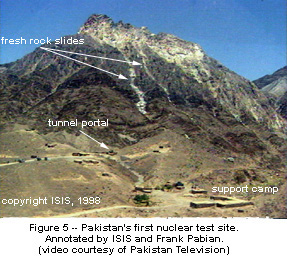
28 May 1998: Pakistan detonates five nuclear
devices. Pakistan claimed that the five nuclear tests measured up to 5.0
on the Richter scale, with a reported yield of up to 40 KT (equivalent
TNT).
30 May 1998: Pakistan tested one more nuclear
warheads, with a yield of 12 kilotons, bringing the total number of claimed
tests to six.
1999
April 15 1999: Pakistan tests its new series
of missiles developed by the PAEC, Saheen I. Saheen II with other many
missiles waiting to be tested.
Vistis to this site