
SPRING 2004
:
ARMY TO PARTNER WITH TRUST FOR PUBLIC LAND TO ESTABLISH LAND USE BUFFER ON OAHU'S NORTH SHORE. During the week of February 17-20, the DPW Conservation Branch hosted a team from the US Army Environmental Center (AEC) looking at possible Army Compatible Use Buffer (ACUB) opportunities in Hawaii. ACUB is a new program designed to establish partnerships with non-governmental organizations, and State and local governments whereby the Army contributes to the initial purchase of land by these eligible entities. The Army does not end up owning the land but places certain restrictions/conditions in the deed whereby the installation's mission and activities are buffered from future encroachment. A great example of where the ACUB program has worked is at Fort Bragg, NC. There the Army cost-shared the purchase of Red-cockaded Woodpecker habitat that adjoined the installation to the west. Purchase of this parcel and future management by The Nature Conservancy allows less restricted training to occur on Fort Bragg itself. So the purchase not only provides a traditional buffer from development pressures from encroaching upon the installation, it also provides a conservation buffer whereby the installation is not the only agency trying to stabilize or recover the species.
The team concluded that one of the best opportunities to implement ACUB in Hawaii exists on the North Shore of Oahu adjacent to the Army's Kahuku Training Area. There a large parcel (1,100 acres) owned by a Japanese developer is up for sale. The Trust for Public Land (TPL) and a local community group is proposing to purchase the land to protect against future development and conserve open space. Other potential partners include the State of Hawaii, the City and County of Honolulu, and the National Oceanic and Atmospheric Administration (NOAA). If the Army's proposal to enter into this cooperative partnership is approved by AEC, funds would be provided to TPL for purchase of this property. The Army, while not owning title to the property would ensure that restrictions against future development were included in the deed, as well as guarantees that helicopters can continue to overfly the property in order to access the Kahuku Training Area. The property could also provide some conservation benefits to an endangered plant found on adjoining Army property, Eugenia koolauensis.

Eugenia koolauensis, an endangered plant that would benefit from ACUB in Hawaii.
While currently this project is only at the pre-proposal stage, Colonel David Anderson, US Army Garrison Commander expressed optimism that this project could provide not only an important encroachment buffer to the Kahuku Training Area, a training area that is key to the Army's Transformation Program in Hawaii, but it also "lets the community on the North Shore of Oahu know that we want to be good neighbors and good stewards of the environment."
AN EARTH DAY PROJECT: MAKUA WEED ROMP 2. The Army’s Oahu natural resources staff will be leading a service trip to Makua Valley on April 17 to celebrate Earth Day 2004. It will be similar to last year's highly successful and enjoyable project. Volunteers will help eradicate non-native plants from a native ecosystem. Specifically, non-native trees will be cut and an herbicide applied. This is an great opportunity to see breathtaking views of Makua Valley, see native plants such as Maile, Ohia, Kookoolau, Koa, and Mamaki, as well as observe the Army's stewardship program for endangered species on one of its training areas. Appropriately, the Army's theme for Earth Day this year is "Preserving the Environment While Protecting Our Freedom." Hope to see you there! For more information and to sign up for this event, please call Ms. Leilani Durand at 656-7641 or 656-7741.
For those that can't make it out to Makua, the Army is also going to participate in the City and County-sponsored Earth Day celebration at the Kapiolani Park Bandstand on April 24 from 10:00 AM to 2:00 PM.
In addition, several special events are being planned to observe Earth Day at the Army's Pohakuloa Training Area on the Big Island. Call Sean Gleason at (808) 969-1966 for more information.
CAVE MAPPING AT POHAKULOA TRAINING AREA by Bill Godby. Cultural resource management staff at Pohakuloa Training Area (PTA) on the Big Island hosted a group of spelunkers the first week in February 2004. The spelunkers hailed from both the Hawaiian Islands and various parts of the United States and were at PTA to survey and map portions of a large lava tube system on the western boundary of the 109,000-acre installation.
PTA Senior Cultural Resource Specialist Bill Godby invited Don Coons, a longtime spelunker and member of the National Speleological Society and president of the Hawaii Cave Conservancy, to assist in mapping lava tube systems at PTA. After finishing up his duties on his family farm in Illinois, Mr. Coons spends his winters in Hawaii caving. He has worked closely with numerous federal and state agencies in Hawaii for many years, supporting cave management efforts. A total of 12 members of the caving community were recruited by Mr. Coons to participate in the mapping event.
PTA is home to some of the most interesting and extensive lava tube systems on the island. The system chosen for mapping has been identified previously as being extensively used for both shelter and water collection, with occupation dates ranging as far back to the early 1600's. Although it has been known for some time that the cave systems were utilized as temporary shelter sites, relatively little is known as to how far these systems were explored by Native Hawaiians.
The group utilized a method known as Station-to-Station survey to begin mapping the lava tube system. By collecting elevations, width and height of the tube system, along with Global Positioning System (GPS) coordinates at entry points from the surface, a complex digital representation of the tube system is possible. By utilizing this method to record lava tube systems, including cave morphology as well as biological and cultural features, cave management and research possibilities are greatly enhanced. The fear of heavy equipment falling through the surface, such as a bulldozer, can be avoided by knowing in advance the location and surface depth of an existing system.

After a week of survey and mapping, the findings indicate that this particular system was explored and utilized more extensively by Native Hawaiians that had previously been thought. Charcoal scatters found near water collection areas have been identified throughout the entire system, far beyond shelter areas near entrances. This is an exciting new addition to our ongoing attempt to understand the cultural uses of the cave resources at PTA. Due to the success of these efforts, all parties involved anticipate future mapping events to help document and manage the extensive cave resources known to exist at PTA.
RARE PLANTS OUTPLANTED AT PTA AND VICINITY. Big Island natural resources staff have been busy outplanting several species of rare plants into PTA’s Kipuka Kalawamauna. Outplanted species include Solanum incompletum, Silene lanceolata, Haplostachys haplostachya, Tetramolopium arenarium, as well as several common native species. All plants were outplanted inside two of the 32 intensive management units at PTA. The purpose of these units is to provide for ecosystem-based management focused on preserving and enhancing rare plant habitat through the control of threats (fire, weeds, goats, and sheep) as well as augmenting existing rare plant populations. Through these efforts, the Army is able to offset the potentially negative impacts of military training on endangered species.
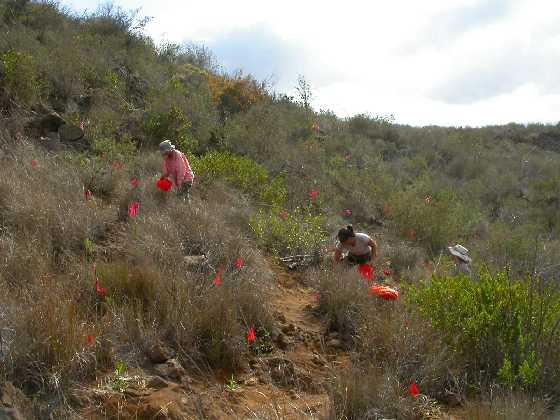
Outplanting site in Kipuka Kalawamauna. All plant locations are marked with red flags to facilitate weeding and site management activities.
Natural resources staff from PTA and the State of Hawaii's Division of Forestry and Wildlife have been outplanting Solanum incompletum on Pu`u Huluhulu, a State-managed wildlife preserve. Prior to S. incompletum’s re-discovery on PTA, Pu`u Huluhulu was the last known location where S. incompletum could still be found. The original natural population on the pu`u has since gone extinct. All plants were propagated in the PTA greenhouse and were then brought to Pu`u Huluhulu where PTA staff and State staff work together. This is the second outplanting effort at Pu`u Huluhulu. To date there are over 50 plants now established on the pu`u and all are doing quite well. Next time you're in the area, go check them out!

Solanum incompletum, a member of the tomato family, was thought to be extinct until its re-discovery by Army biologists at Pohakuloa.
NEW NATURAL RESOURCES CREW AT PTA. We are pleased to announce that the Natural Resources Crew at Pohakuloa Training Area has now been expanded to 13 people. New team members include:
Travis Belt. Travis comes to us from Ft. Hunter Liggett where he worked for the ITAM program. He has experience with vegetation monitoring, database management, erosion control, and plant propagation. He also has experience in landscape construction. Travis holds a BS in Forestry and Natural Resources from California Polytechnic State University. Travis is one of our Natural Resource Specialists.
Jon Giffin. Jon comes to us from the Division of Forestry and Wildlife where he served as the Hawaii Island Forestry and Wildlife Manager for the last seven years. He holds a BS in Zoology from the University of Utah. He has over 36 years of experience working in Hawaii’s ecosystems.
Cora Stryker. Cora worked as a plant ecologist for Camp Edwards Military Training Facility. Prior to working at Camp Edwards she worked as a field assistant at Haleakala National Park. She has worked as a research assistant for both Brown and Stanford Universities. She holds an BA in Biology from Brown University. Cora is one of our Natural Resource Specialists.
Lance Tominaga. Lance, a Big Island native, comes to us from Hawaii Volcanoes National Park where he worked as a Field Project Supervisor for the Research Corporation, University of Hawaii. Prior to this, Lance worked for CEMML studying rare plant distribution patterns at PTA. Lance holds a BS in Wildlife Biology from Colorado State University. Lance is one of our Natural Resource Specialists.
Brian Tucker. Brian Tucker comes to us from Wisconsin where he worked for the Lumberjack Recreation, Conservation and Development Council. He has experience with forest inventory collection, data analysis, restoration ecology, and invasive species management. Brian holds a BS in Natural Resource Conservation and Management from the University of Wisconsin. Brian is one of our Natural Resource Specialists.
Erin Wascher. Erin comes to us from the University of Hawaii where she is finishing up her senior year, majoring in Biology. She has gained much experience in plant propagation and plant and soil analysis while working as a lab assistant for the University of Hawaii. Erin holds certificates of study in environmental and marine science. Erin is studying the pollination biology and ecology of Hedyotis coriacea.
Darryl York. Darryl comes to us from Fort Collins, Colorado where he worked for the USFWS. Darryl has a wealth of experience with Section 7 consultation processes and wildlife biology field methods. He has experience in habitat restoration and wildlife research in five different states. Darryl holds a MS in wildlife Science from New Mexico State University and a BS in Fisheries and Wildlife from the University of Missouri. Darryl is one of our Natural Resource Specialists.

Top row, left to right: Kuhea Paracuelles, Lena Schnell, Steve Evans, Lance Tominaga, Erin Wascher. Bottom row, left to right: Travis Belt, Brian Tucker, Darryl York, Jon Giffin, Cora Stryker, Aubrey Kelly. Missing from photo: Kathy Kawakami and Sean Gleason.
NEW RARE PLANT SPECIES DISCOVERED ON OAHU by Kapua Kawelo. The Army’s Natural Resource Program on Oahu has been working managing rare and endangered species on Army Training lands for almost 10 years. Over this time the emphasis of our program has shifted from surveying for new populations of rare taxa to managing these populations to stabilize their numbers and the habitat that supports them. This being said we are always on the look out for new rare species populations and have discovered a number of new populations in the last quarter. At Makua Military Reservation, Nesoluma polynesicum and Bonamia menzesii were discovered in an area that used to be infested with feral goats. We believe that these rare species re-appeared because of our successful removal of goats from MMR. In addition, in the northern part of the Kawailoa Training Area, natural resource staff discovered a new robust population of Eugenia koolauensis. This population is located within 50 meters of the Drum Road. In Schofield Barracks West Range, two populations of the extremely rare plant Labordia cyrtandrae were discovered. These plants are located in the habitat that is protected by the newly constructed fencing atop Mt. Kaala.

Alsinodendron obovatum.
The Army is also conducting off-site rare plant surveys related to stabilization of species that are found at MMR. These surveys have resulted in some very significant finds on non-Army lands. Joel Lau of the Hawaii Natural Heritage Program discovered a new population of Alsinodendron obovatum in the Pahole Natural Area Reserve. This population increases the number of known plants of this species in the wild by 500%. Alsinodendron obovatum is a genetic safety net species and previously was only known from one extant population of three individuals. Army natural resource staff and State of Hawaii staff have already fenced this population. In addition, large numbers of Neraudia angulata have been found adjacent to known populations increasing the total numbers statewide significantly. New individuals of Flueggea neowawrae have also been discovered at two locations off Army lands. These exciting and biologically significant discoveries this year were possibly helped by the ample winter rains. We will add these new finds to the many populations of rare and endangered species we currently protect. Finding and protecting more populations helps stabilize these endangered species and preserves the Army's training mission.
NEW OAHU PROGRAM PERSONNEL. A warm "aloha" and welcome to the newest members of the Oahu Army natural resources staff.
Leilani Durand. Leilani began work with our program as a Natural Resources Implementation Manager in June 2003. Her job is to oversee the Makua Implementation Plan actions. Leilani previously worked with the Hawaii Natural Heritage Program who was the subcontractor writing the Makua Implementation Plan. Leilani has a strong background in botany. Leilani has a Master’s degree in Plant Physiological Ecology. Leilani worked previously with Range Division’s ITAM program as a Botanist monitoring LCTA plots. Leilani has strong organizational and supervisory skills. She has already proven a great asset to our program.
Other new personnel include Kaleo Wong, Steve Mosher, and Seth Cato. A warm "aloha" and welcome to the program. We will highlight new Oahu staff members in our next issue!
