|
Luis
Francisco Acevedo Hueso |
|||||||||
|
|

NEUROLOGICAL DATA ACQUISITION
Beng (Hons) Electronics And Computing Engineering = (Ingeniero De Telecomunicaciones (Spanish Qualifications)) Student: Luis Acevedo
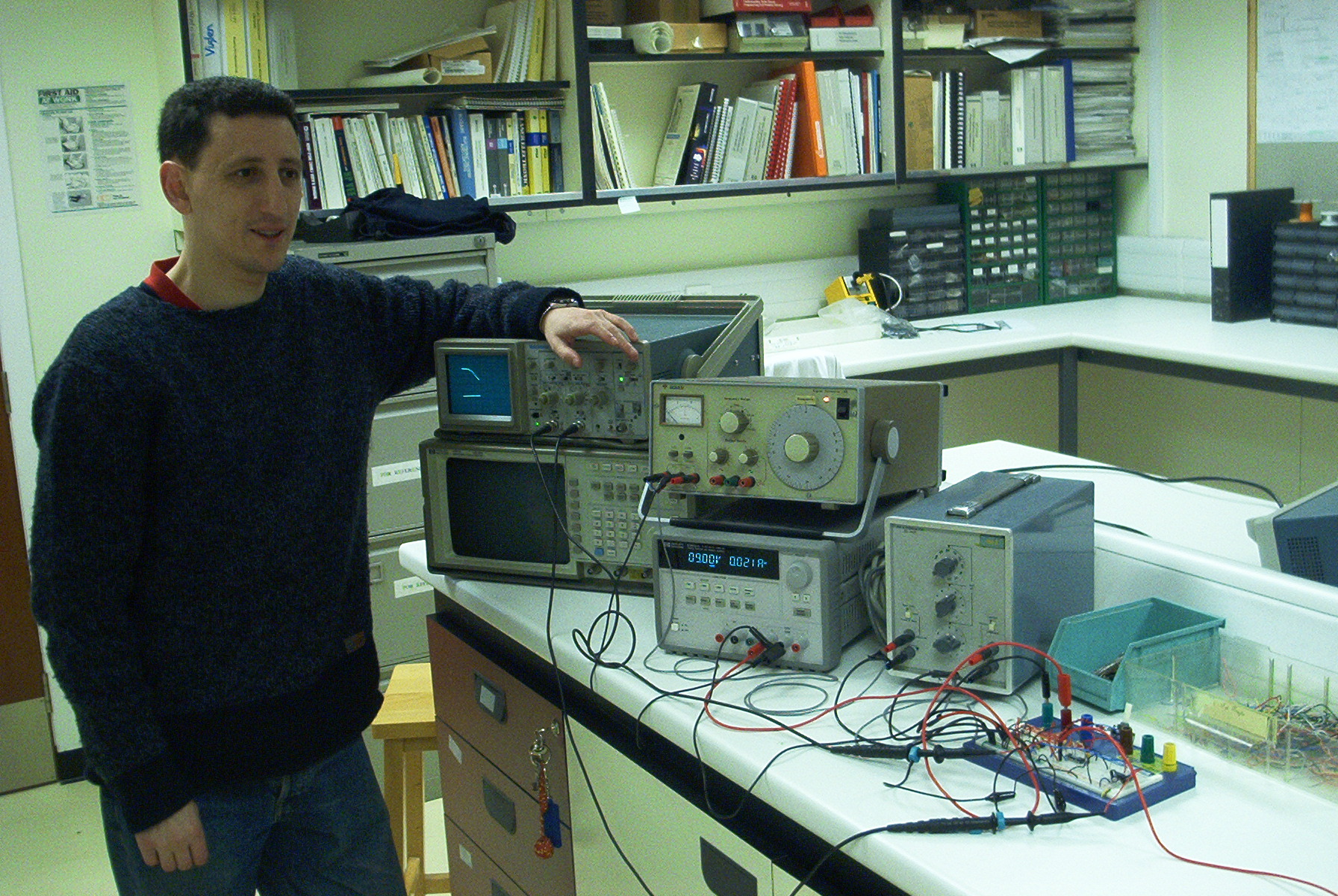
The purpose of this project is to develop a system to read brain waves in different areas for mapping the brain. It is required to have an analogue design to read the brain waves, which will be codified and digitalized by software, displaying the brain waves on the computer screen. Then are required sensors, interfacing, multiplexor, ADC converter and microprocessor as part of the MicroController.
my supervisor Ian Mackenzie to encourage research in the medical instrumentation and find new applications. my adviser Frank Greig for helping me in the interfacing field, who gave me ideas to capture and process signals using different techniques. my laboratory mate Stewart Scotland for helping me to find useful applications for the project, extending it to PhD research in the future. CONCLUSION The aims of the project have been undertaken successfully in all the requirements, touching and analysing different fields in electronics and computing as it is detailed below. The purpose of the project was to analyse electrical activity of the brain in different areas. Therefore a detailed knowledge about different types of brain waves in the four sections of the brain. This is COMPLETE EEG (Electroencephalograph) waveforms and behaviour gave the amplitude and frequency in the four parts of the brain to enable to start to design the analogue system, which simulates the real brain wave, supplied with a special signal generator. The system is isolated and the waveform is amplified and filtered in different steps to eliminate noise from very tiny frequencies and amplitude voltages. This is COMPLETE Also were required electrodes, interfacing (Micro- Controller) and software tools as C and HPVEE. Electrodes will be connected to the patient once the prototype includes more channels because it works with a channel only when the analogue system gives the proper signal the suitable Micro Controller read data and transmit it via RS232 to the HyperTerminal or HPVEE. This is COMPLETE Then HPVEE reads data and displays waveforms (small frequency and amplitude) in Real Time, analysing frequency spectrum to detect diseases. This is COMPLETE Then an ungrounded signal generator and attenuator, supply the suitable sine wave to the system. This is COMPLETE Possible Dummy patient to generate brain signals because it will be an implementation of the system and also it was a optional case to study in the future. This is not COMPLETE The project has been a challenge to deal with different fields and to capture a signal from the external world and read these signals to find a real application to the medical side. The purpose of the project was to eliminate all possible noise and read very small signals to help doctors in their research. Sampling brain waves and supplying amplification detailed, which show some possible disease from the patient. I suggest that this project can be implemented for
another student, medical institutions, universities etc to improve quality
of life. FURTHER APPLICATIONS 1. A centralised monitoring system for hospitals. It will minimise nurse effort and will improve care and remote patient state observation from the medical side by nurses or doctors at anytime, checking several rooms or patients at the same time. 2. Analyse brain signals using the Mat Lab tools to accurately diagnose diseases. 3. Frequency Spectrum of the signal can determine the importance of possible diseases and prevent the patient getting them. 4. Importance to analyse different responses when the same action is ordered from the brain in different people as say how the response is when closing the hands or eyes etc… is different in everyone whether the brain send the same order to the muscular system. 5. The above outcomes could be considered by a research student (PhD). 6. Collaborative work between Napier and other Universities or Hospitals. Project Information: References
Scanning and Detection of EEG Diseases
September 2004 ABSTRACT The aim the project is to analyse non real time EEG signal using different mathematical models in Matlab to predict abnormal derivation of the signal applying frequency spectral analysis for linear, continuous or discrete input data signal. This will involve a filter for Linear equations, Short Time Fourier Transform, DFT, FFT, Neural Networks for more that one signal and Bayesian classification. All the results will be observed and improved in different models graphically in Matlab and mathematically proved following the theoretical law.
I would like to thank my supervisor, Dr. Yvan Petillot for this guidance, encouragement and support on this project. I would like to thank to my wife, General Practitioner An Yu for her care and encouragement to research in the medical field. It gives a general idea how deseases have been found by research in Medical signal processing. IMPORTANT: The department of Epileptology, University of Bonn (Germany) has supplied the EEG time series of different data type. Professor Andrzejak RG has recorded this epilepsy data from patients. --------------------------------------------------------------------------------------------------------- WORK- PLACEMENT: VENDING MACHINE SIMULATOR
VIANET LIMITED Buchan House, Carnegie Campus www.vianet.co.uk A Vending machine simulator that can be used for both testing and marketing purposes. This is to be designed with a laptop at as the main processing engine with the minimal amount of electronics surrounding it. Functional To simulate the following machine hardware: MDB Note that the MDB and DEX receive to be selected from the PC. To simulate the following protocols. Sielaff (MDB 1). Additional hardware for simulation Door switch. Control functions via software Select type of the machine interface.
VIANETcorrectLTD , this the prototype poster presentation. Finally, the prototype worked and it was demostrated in the Vending Symposium at Germany the last November of 2002. ---------------------------------------------------------------------------------------------------------
|
||||||||