
PROCESS DURING PRODUCTION
After the completion of pre-production for 'A Ray of Hope', the second stage for the entire project, also
known as production, is being conducted to visualize the complete picture along with several experiments and trial and error before being approved.

In the early stage, several 3D models are created within the first week based on the designs on scrapbook.
Noted that design alterations are inevitable due to experimental stages.

While waiting for the models and sequences to be well approved, the animator then focuses on multipurpose segments.
They are in fact media mixed sequences created in various types of animation techniques (claymation, 2D animation, cut-out, photos) in his purpose to
expand his knowledge and appreciate their respectable roles in every genre and movie. These experimental tasks are not only tiring
and repetitive, but the outcome of some of these results are impressive. Sometimes it is best to create crazy ideas and mix them with
other technical standards to stylized his own pattern. Overall, the multipurpose segments are a challenging yet enjoyable method.
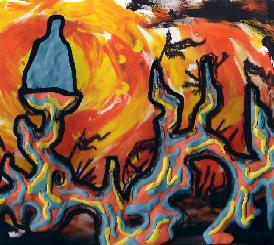
The real problem, however, lies within the process of 3D animation (done with Maya and uses a different approach to
its 2D look) in which many of the sequences face major issues and don't seem to work well
such as cluttering textures that blend with others of the same texture as well
as the background being to bright. The rough edges of the models also possess a real problem, whether to smoothen them (which
makes the rendering slow) or leave it as a claim of the animator to be 'schizophrenic' and 'wild'.

Finally, due to depression and lack of time, the animator decides to smoothen the 3D edges to make them look cleaner and prettier. As for the
main character, she is supposed to be colorful within the entire film but her colorful 'outfit' creates a major headache because it blends badly with the flower and
her face. (The same goes with the flower's colorful face blending badly with her face, only to be resolved by adding a flat head under her face)
The only way to solve the problem is to put same colored textures in every process Elysia faces. In the first stage, she is grey (as she looks better in the final
animatic playblast, so the animator takes this choice). It is also quite logical that due to her first appearance into the human counsciousness
and while she is still young and immature, it is a safe bet that her colors will continue to evolve (from grey to yellow and red to colorful) as if it's like
going through the process of a ladybird or a dragonfly.
