|
| |
Previous Page
Home
Aeolian mode and playing out of position
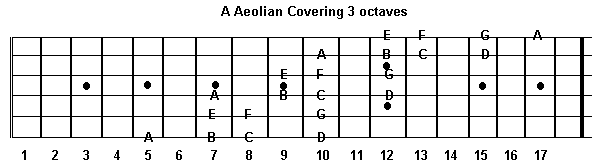
The illustrations below show the Aeolian or A
natural minor scale covering 3 octaves. You don't have to stay in the box or in
normal position to play scales. It is a good idea to learn how to play each note
of the scale using a different pattern or layout.
The first illustration below shows the Am
scale, also called the Aeolian mode or natural minor. The notes are illustrated
starting at the root note 5th fret. It then works its way to the A note 17th
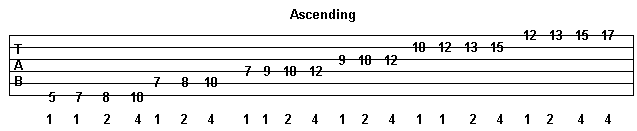
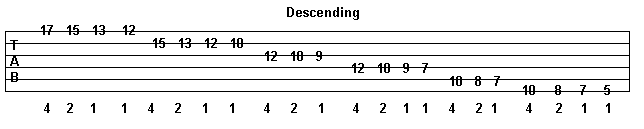
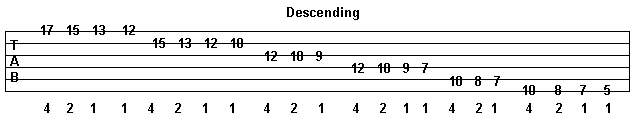
fret. The next two illustrations show the same scale in tablature ascending and
descending.
The numbers under each of the illustrations
below are the recommended fingering for both ascending and descending. This
fingering pattern may take some time to get use to, but is well worth learning.
There may come a time when you say, when can I quit playing all these scales and
begin to play some real leads? Well that's up to you. There eventually comes a
time when you no longer consciously think of these as scales, but as notes to
create a certain sound or melody. Once you have these scales, modes, chords and
other tools engrained in your mind, your musical ability begins to take over.
Before this usually happens, you must learn each scale. No you don't have to
learn all of the scales or chords, but an understanding of them is essential.
There are many guitarists who only use the pentatonic scales or maybe just the
Aeolian mode.
I recently received a letter from a member
who wanted to know how I determine what mode to use in a certain situation? What
I would like to do is place my reply to that letter below.
When I use modes, it really does go by the
feel of the song. One trick I do, is think of each mode as a particular scale.
If I were to have a C, F and G progression, I would use the C major scale. Or,
if I was playing over the F chord, I may use the F major scale or the Dm Aeolian
scale.
Lets say I am playing lead over the Am chord. The first thing I would do was
think of the Am pentatonic scale. I then relate each of the minor modes to the
Am pentatonic scale. Play the Am chord and then play the Aeolian mode over that
chord. The notes of the Am pentatonic are A, C, D, E and G. The notes of the A
Aeolian scale or A natural scale are A, B, C, D, E, F and G. Notice that the
pentatonic scale has five of the same notes. So if you played the Am, F and G
progression, you could play the Aeolian mode.
Now say the song was going to the F chord. You could stay with the A Aeolian, or
I would consider playing the F major pentatonic scale. However, you could also
use the F major scale or Ionian mode. The notes in the F major scale (Ionian)
are F, G, A, Bb, C, D and E. The notes in the F major pentatonic scale are, F,
G, A, C and D. You could use both of these scales.
Now say the song stayed on the G chord. I would think of the G major pentatonic
scale. G, A, B, D and E. And I would also think of the G major scale (Ionian).
G, A, B, C, D, E, F#.
What you have done, was played three different keys over three different chords.
Am scale, F major scale and the G major scale.
Another way I play is to use the relative minor scales. The relative minor
scales are the Aeolian modes. So I write the song in Am and use the Aeolian
scale. This would be Am, B dim, C, Dm, Em, F and G. The A is minor, the F and G
are major. So that's why I use the minor over the A and the major scales over
the F and G chords. But I also use the minor over the A, the Dm over the F and
the Em over the G. OR JUST STAY WITH THE Am SCALE, The Aeolian scale has all
the notes of each chord used.
Dm is the relative minor to F major. Em is the Relative minor to G major. So you
could use all three Aeolian modes over these chords. A Aeolian, D Aeolian, and E
Aeolian. Or you could try A Aeolian, F Lydian, and G Mixolydian. This is still
minor, major, major. Or try A Aeolian, F major, E Aeolian.
I always think of each chord as major or minor and choose some type of major
or minor scale to play over each chord.
The minor modes give the darker sad sound and the major modes give the happier
type of sound. The Locrian gives the darkest sound. I like to write my songs
using the minor sound.
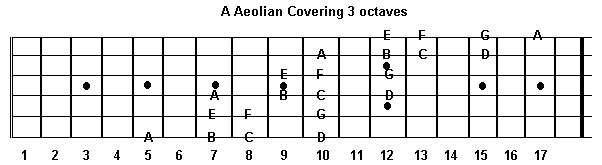
The
illustrations below show the Aeolian or A natural minor scale covering 3
octaves. You don't have to stay in the box or in normal position to play scales.
It is a good idea to learn how to play each note of the scale using a different
pattern or layout.
The
first illustration below shows the Am scale, also called the Aeolian mode or
natural minor. The notes are illustrated starting at the root note 5th fret. It
then works its way to the A note 17th fret. The next two illustrations show the
same scale in tablature ascending and descending.
The
numbers under each of the illustrations below are the recommended fingering for
both ascending and descending. This fingering pattern may take some time to get
use to, but is well worth learning. There may come a time when you say, when can
I quit playing all these scales and begin to play some real leads? Well that's
up to you. There eventually comes a time when you no longer consciously think of
these as scales, but as notes to create a certain sound or melody. Once you have
these scales, modes, chords and other tools engrained in your mind, your musical
ability begins to take over. Before this usually happens, you must learn each
scale. No you don't have to learn all of the scales or chords, but an
understanding of them is essential. There are many guitarists who only use the
pentatonic scales or maybe just the Aeolian mode.
I
recently received a letter from a member who wanted to know how I determine what
mode to use in a certain situation? What I would like to do is place my reply to
that letter below.
When
I use modes, it really does go by the feel of the song. One trick I do, is think
of each mode as a particular scale. If I were to have a C, F and G progression,
I would use the C major scale. Or, if I was playing over the F chord, I may use
the F major scale or the Dm Aeolian scale.
Lets say I am playing lead over the Am chord. The first thing I would do was
think of the Am pentatonic scale. I then relate each of the minor modes to the
Am pentatonic scale. Play the Am chord and then play the Aeolian mode over that
chord. The notes of the Am pentatonic are A, C, D, E and G. The notes of the A
Aeolian scale or A natural scale are A, B, C, D, E, F and G. Notice that the
pentatonic scale has five of the same notes. So if you played the Am, F and G
progression, you could play the Aeolian mode.
Now say the song was going to the F chord. You could stay with the A Aeolian, or
I would consider playing the F major pentatonic scale. However, you could also
use the F major scale or Ionian mode. The notes in the F major scale (Ionian)
are F, G, A, Bb, C, D and E. The notes in the F major pentatonic scale are, F,
G, A, C and D. You could use both of these scales.
Now say the song stayed on the G chord. I would think of the G major pentatonic
scale. G, A, B, D and E. And I would also think of the G major scale (Ionian).
G, A, B, C, D, E, F#.
What you have done, was played three different keys over three different chords.
Am scale, F major scale and the G major scale.
Another way I play is to use the relative minor scales. The relative minor
scales are the Aeolian modes. So I write the song in Am and use the Aeolian
scale. This would be Am, B dim, C, Dm, Em, F and G. The A is minor, the F and G
are major. So that's why I use the minor over the A and the major scales over
the F and G chords. But I also use the minor over the A, the Dm over the F and
the Em over the G. OR JUST STAY WITH THE Am SCALE, The Aeolian scale has all
the notes of each chord used.
Dm is the relative minor to F major. Em is the Relative minor to G major. So you
could use all three Aeolian modes over these chords. A Aeolian, D Aeolian, and E
Aeolian. Or you could try A Aeolian, F Lydian, and G Mixolydian. This is still
minor, major, major. Or try A Aeolian, F major, E Aeolian.
I always think of each chord as major or minor and choose some type of major
or minor scale to play over each chord.
The minor modes give the darker sad sound and the major modes give the happier
type of sound. The Locrian gives the darkest sound. I like to write my songs
using the minor sound.
Good
luck,
|

