|
| |
Previous Page
Home
Am Pentatonic Scale
|
Now that you know
how to pick each note and do a few
exercises, it's time to learn scales. You will use scales to play
leads and build melodies. Once you get over this small hurdle, things will
really begin to fall into place. In our lessons, we will concentrate on
the Am pentatonic scale and the Key of C major. Once you learn these
scales, others will be just a matter of moving to a different location.
The Am
pentatonic scale is a 5 note scale, that's what pentatonic means. The
notes are A C D E and G.
(The
Little m after the A note above means the minor chord and we will learn
more about that later)
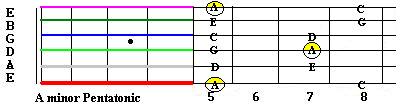
Look at the
illustration Below. This illustration shows the Am pentatonic scale at its
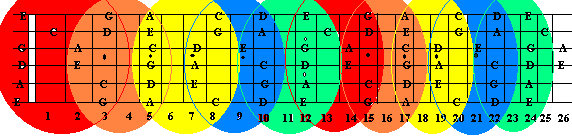
root note fret. Now look at the first yellow circle above, that is the Am
Pentatonic root note fret and it starts at the 5th fret A note, Low E string.
|
|
|
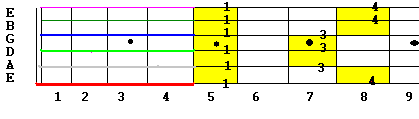
1 = Index finger
2 = Middle finger
3 = Ring finger
4 = Pinkie
T = Thumb
|
|
Now it's time for
you to go review the Am
pentatonic scale at the root note fret position and return here to
lesson 5.
Once you review the
Am pentatonic section you will need to do the assignments.
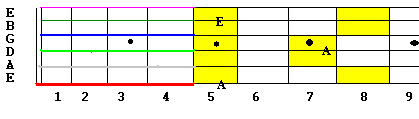
- Use
one illustration below to fill in the notes
of the Am pentatonic scale root note fret only.
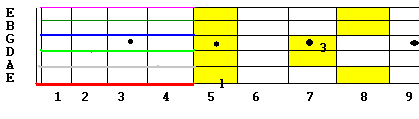
- Use
one illustration below to fill in the fingers used to play the Am pentatonic scale root note fret
only.
|
|
|
Three
notes have been filled in for you to get started. Fill in the remainder of
the notes of the Am pentatonic scale root note fret.
|
|
|
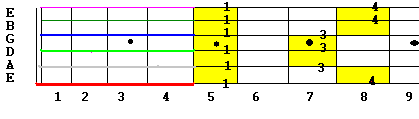
Two
fingerings have been filled in to get you started. Fill in the rest of the
fingerings used for the Am pentatonic scale root note fret.
|
|
In
this lesson we need to dig a little deeper into the Am pentatonic scale.
We will continue to work on the root note fret, which is the most popular
position to play this scale. Look at the image below and notice that you
can play every note on the 5th fret using just your 1 finger. This means
you can really move around this scale and burn up the notes. Playing the
same notes of the Am pentatonic scale at other positions requires a little
different fingering. We will eventually learn this scale in other
positions down the road. But for now, let's master this position before
moving on.
|
|
Notice
how it starts with the 1 finger on the Low E
string 5th fret. Then the next note is played with the 4 finger at
the 8th fret. Look above and see those two fingerings on the Low
E String. 1 - 4. Also look below and notice those two notes are the
A and C notes.
|
Am Pentatonic Scales
|
|
This
is what your illustration should look like after filling in the notes from
our last homework
assignment.
|
|
|
This
is what your homework should look like after filling in the fingering for
the Am root note fret.
|
Playing
Lead Guitar and using the pentatonic scales
|
By now you should be familiar with the A minor
pentatonic scale in the root note fret position, tablature,
exercises and triplets.
I would now like to expand a little more on the A minor pentatonic scale
at a different position. What I mean by position is, another position of
the guitar to play the A minor pentatonic scale. The root note fret for
the A minor pentatonic scale starts on the 5th fret. But, the same
scale can be played starting at other frets.
|
|
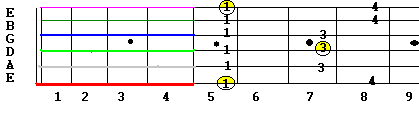
Once again the illustration above is the A minor
pentatonic scale in the root note position. The root note fret for A minor
starts at the 5th fret. In the image above, the numbers on each fret
illustrate what finger plays each note of the scale.
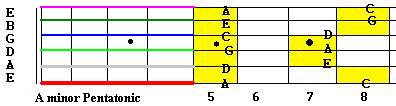
Look above, notice the same A minor pentatonic scale with the notes that
make up the scale. The notes for the A minor pentatonic scale are (A, C,
D, E, G)
Fingers 1-4, 1-3,
1-3, 1-3,
1-4, 1-4 =
notes A-C, D-E,
G-A, C-D, E-G,
A-C.
|
|
Look at the scale below and notice that the scale now
starts at the 8th fret or C note. This is the same A minor
pentatonic scale as above, but starting at a different fret and has a
different fingering pattern. All of these scales should be learned to play
lead guitar. Remember I stated that the root note fret is the easiest to
play. This is true because the 1 finger can play every note of this scale
on 5th fret. In the next position you have a different fingering pattern
to learn. All of the patterns of the Am pentatonic scale, have the
same notes. A, C, D, E and G. All of the different patterns should be used
will playing lead guitar or practicing scales.
Listen to this
position C to C
Now Watch the
scale
|
|
The new fingering for this position will be 2-4,
1-4, 1-4,
1-3, 1-3,
1-3. This will be starting at the C
note 8th fret Low E string, look below.
Remember to pick up and down. Work your way down the scale and then back
up. So the above illustration shows the A minor pentatonic scale with the
notes and the lower illustration shows the A minor pentatonic scale with
the fingers in the VIII position. Notice that the C notes are highlighted
in blue and the Root note A in yellow. To play lead guitar, play from A to
A for Am pentatonic and C to C for C major pentatonic. This is a popular
position to play lead over the C chord. Notice the root 6 E type bar chord
for the C chord in this position.
|
|
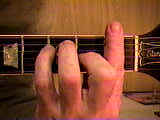
|
This is a Root 6 E type bar chord. The note on the
Low E string determines the chord. If you played this chord with your 1
finger at the 8th fret using this fingering pattern, it would be the C
chord. Strum this chord and play from C to C using the illustration below.
|

|
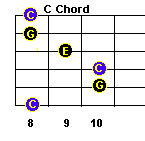
|
The notes that make up the C chord are C, E and G.
The chord illustrated to the left is the Root
6 C bar chord. The note on the Low E string determines the chord.
Notice how the C chord fits over this pattern above. Try to play the C, E
and G notes only, 1 at a time. Once you can pick each note of the C chord
one at a time, strum the C chord and play lead from C to C starting on the
Low E string to the high E string.
|
|
So we have learned the fingering of the root note
fret above and the VIII position below. Each position has a different
fingering, but the same notes. Remember, all of the A minor pentatonic
positions you learn will have the same notes. A-C-D-E-G. Start with the 2
finger at the eighth fret below Low E
string, play that note. Then the 4 finger on the 10th fret Low
E string, play that note. Then the 1 finger
on the 7th fret A string, play that
note. The next note is on the 10th fret A
string, play that note. Now continue through the scale in the same
fashion for every note on each string.
|

|
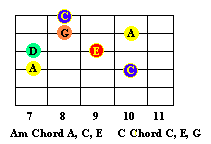
|
Shows notes used in riff to the left.
|
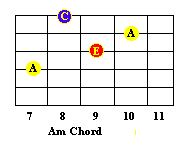
|
The illustration to the left shows another way to
play the Am chord. The riff below starts on this A note. Notice each of
these notes in the scale above
|
|
|
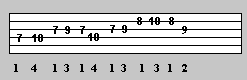
Here is a riff played in the VIII position starting
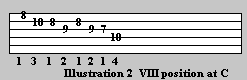
on the A note. Illustration 2 below finishes up the riff and plays
the notes of the C chord. All of these riffs will help with lead guitar.
|
|
|
Once you play the lead above play this lead to finish
it off. It starts on the C note and ends on the C note. Both of these
leads are played over the VIII position of the Am scale.
|
|
|
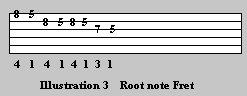
The illustration to the left is the exact same thing
as illustration 2 above. Illustration 2 is played at the 8th fret, VIII
position starting on the C note. Illustration 3 to the left also
starts on the C note, but plays the lead at the root note fret. They both
play the exact same notes, but are played in a different position of the
Am pentatonic scale.
|
|
|
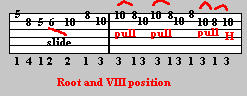
This riff uses the root fret position and the VIII
position of the Am pentatonic scale. Notice the slide, hit that note and
slide to the 10th fret. You also have three pull-offs and a hammer on.
|
|

