
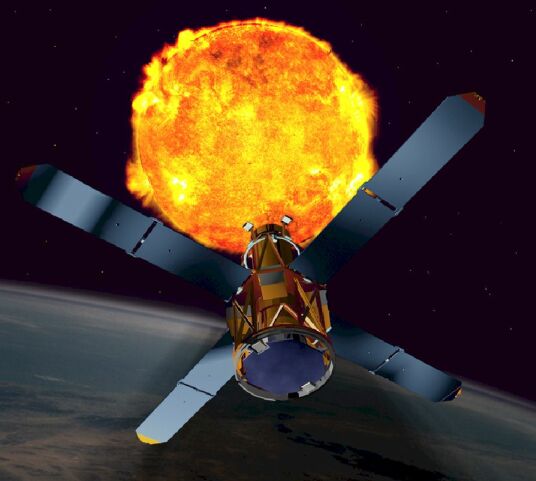
HESSI, The High Energy Solar Spectroscopic Imager, will study the high energy X-rays and Gamma-rays produced during a solar flare. HESSI will orbit 373 miles above the planet to observe the Sun with a mission life of 2-3 years. HESSI has the finest angular resolution, the ability to see fine detail, and spectral resolution, the ability to distinguish the component wavelengths of light, of any hard X-ray or gamma-ray instrument ever flown in space.
HESSI carries one instrument, an imaging spectrometer, which produces pictures of flares using a method unlike any conventional telescope or camera. This spectrometer has no lenses and no mirrors to focus the light and form an image. Instead, detectors aboard HESSI count the number of X-ray and gamma-ray photons passing through pairs of grids and measures their energies with exceptional precision. Astronomers will then use the variable rates of photons detected as the spacecraft rotates to make high-resolution pictures of a flare, showing their color, or energy.
Solar science objectives for HESSI include:
Non solar science objectives include:
HESSI firsts will include:
It is believed that the energy of a solar flare comes originally from the violent motions below the solar surface. Prior to a flare, it is thought that energy builds up from below and is stored in the magnetic field that pervades the solar atmosphere. This usually occurs near a sunspot, but exactly how it happens and what triggers it to be suddenly and explosively released is not known. Large numbers of electrically charged particles are rapidly accelerated to high energies, and gas is quickly heated to tens of millions of degrees. HESSI will allow researchers to find out where in the solar atmosphere these particles are accelerated, when in the flare explosion the particle acceleration occurs, and what energies are achieved by the accelerated particles.
In order to achieve a full understanding of the acceleration of electrons and ions, and their transport through the solar atmosphere, it is essential to obtain support observations of the plasma and the magnetic fields where the hard X-ray and gamma-ray sources are situated, the thermal, dynamic, and magnetic context of the high energy flare. As the first solar science mission to produce high-resolution spectrographic X-ray and gamma-ray pictures of flares, HESSI will allow scientists to see for the first time where the high-energy events in flares take place.
In essence, a solar flare produces copious radiation across the full electromagnetic spectrum from the longest wavelength radio waves to the highest energy gamma rays. The contrast over the background, quiet Sun, emission is much higher at the shorter X-ray and gamma-ray wavelengths that will be observed with HESSI. These high energy radiations carry direct information about the energetically dominant products of the energy release that is not available from emissions at any other wavelength.
X-rays are believed to be produced by the electrons accelerated in the solar corona during the flare. As the electrons travel at velocities about one third the speed of light in the corona, a small fraction of them (1 in 100,000) suffer close encounters with the ambient protons. In such an interaction, the electron is attracted towards the proton as a result of the opposite charges, and its path is bent. An X-ray photon is produced at the point of the electron's closest approach to the proton. This is known as "bremsstrahlung", from the German word meaning braking radiation. By detecting these X-ray photons with HESSI, scientists will be able to determine where and how many electrons are accelerated and to what energies.
Just as electrons are accelerated during solar flares, free protons and the nuclei of heavier elements in the solar atmosphere are also accelerated. Some accelerated protons encounter the nuclei of carbon, oxygen, neon and other elements found in the solar atmosphere. When a proton collides with one of these nuclei, the nucleus is excited to a higher energy level. The excited nucleus gives off a gamma-ray photon with a specific energy characteristic of the element involved and returns to its original energy level or ground state. Alternatively, an accelerated heavy nucleus can interact with an ambient low-energy proton and become excited to a higher energy level. It continues on at a similar velocity and emits the characteristic gamma ray as it decays back to the ground state. Because of the velocity of the heavy nucleus, the gamma-ray energy is Doppler shifted up or down, depending on whether the nucleus is moving towards or away from the observer, respectively.
Context observations from ground-based observatories and a theory program are also integral parts of the HESSI mission. Ground-based optical and radio telescopes will provide complementary data on the magnetic fields, electric currents, hot plasma, and the energetic electrons in the flaring regions where the X-ray and gamma-ray emissions are generated.
Working together with other solar spacecraft, Yohkoh, the Solar and Heliospheric Observatory (SOHO), Geostationary Operational Environmental Satellites (GOES), and the Transitional Regional and Coronal Explorer (TRACE) for flare radiation, the Advanced Composition Explorer (ACE), Ulysses, and Voyager for particle detection, HESSI will provide vital insight into the impulsive energy release and particle acceleration processes at the Sun.
Instruments on Skylab, the Japanese/US Yohkoh mission and other spacecraft have recorded many flares in X-rays over the last twenty years or so. Ground-based observatories have recorded the visible and radio outputs. These data form the basis of our current understanding of a solar flare. But there are many possible mechanisms for heating the gas, and observations to date have not been able to differentiate between them.
Set for launch last July, the satellite was significantly damaged in ground vibration testing and had to be repaired. Then part of the Pegasus stage separation system had to be redesigned, delaying the launch from this spring. NASA has halted plans to fly its HESSI solar probe aboard an Orbital Sciences Pegasus rocket until investigators determine what likely caused the failure of the X-43A test launch earlier in June.
For the X-43A test, only the winged first stage of the Pegasus rocket was used. The stage also featured modifications to its thermal protection, plus a new guidance system and repackaged avionics. HESSI will ride a full three-stage Pegasus XL vehicle and will be carried aloft by an air-launched Pegasus dropped from the belly of Orbital Sciences L-1011 Stargazer aircraft 39,000 feet above the Atlantic Ocean, about 60 miles east of the Florida coastline.
Credits to NASA.
