
White light illuminates a cm wide diffraction grating at normal incidence. The dispersed light falls upon a viewing screen. The entire first order and second order patterns are observed. The four arrows in the figure below represent the first and second order red and blue bands. Let the wavelengths of red and blue light be nm and nm, respectively. Identify the color of each of the four bands by entering the wavelength of the light in the appropriate box.
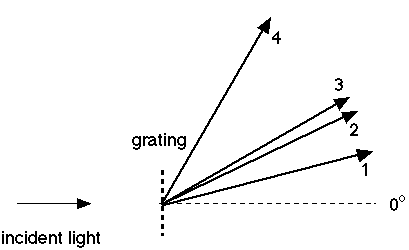
a) The wavelength of band 1 is nm
b) The wavelength of band 2 is nm
c) The wavelength of band 3 is nm
d) The wavelength of band 4 is nm
e) Band 4 appears at an angle of °. Calculate the number of lines per cm for this grating.
Lines/cm
f) Do all colors of the third order pattern appear on the screen? Enter 1 for yes and 2 for no.
g) Does any of the third order pattern overlap the second order pattern? Enter 1 for yes and 2 for no.
h) The yellow color of sodium vapor is due to two spectral lines of 588.995 nm and 589.592 nm. Can these two spectral lines be resolved by this grating? Enter 1 for yes and 2 for no.
