
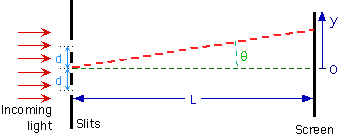
Two identical narrow slits, separated by d = 0.01 mm, are illuminated at normal incidence by laser light of wavelength l = 500 nm. An interference pattern is observed on a screen at a distance L = 2 m from the slits. The experimental layout is as shown in the figure below. (The vertical scale is greatly expanded in order to show the slits.) The phase difference f between the two waves arriving at an angle q on the screen is given by f = 2 p d sin(q) / l.

Answer parts a-e, by entering the number of the correct phasor diagram. The notation is that of Halliday and Resnick, figures 36-8 and 36-10, with the phase difference being that of the second phasor (following the arrows) minus the first:

a) A phase difference of 0 radians corresponds to phasor
b) A phase difference of p/2 radians corresponds to phasor
c) A phase difference of p radians corresponds to phasor
d) A phase difference of 3p/2 radians corresponds to phasor
e) A phase difference of 2p radians corresponds to phasor
f) Find the angle q for which the phase difference f is 3p/2 radians.
q = radians
g) If the position y = 0 corresponds to the phase difference f = 0, find the position on the screen which corresponds to the phase difference 3p/2.
y = m
A third identical slit is uncovered so that the laser light now illuminates three slits with the same 0.01 mm spacing. The resulting interference pattern from the three slits is observed on the same screen, 2 m away as before.
Answer parts h-n, by entering the number of the correct phasor diagram:
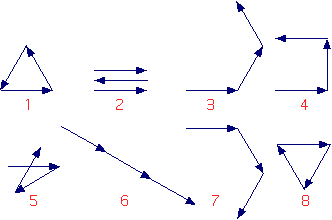
h) A phase difference between adjacent slits of 0 radians corresponds to phasor
i) A phase difference between adjacent slits of p/3 radians corresponds to phasor
j) A phase difference between adjacent slits of 2p/3 radians corresponds to phasor
k) A phase difference between adjacent slits of p radians corresponds to phasor
l) A phase difference between adjacent slits of 4p/3 radians corresponds to phasor
m) A phase difference between adjacent slits of 5p/3 radians corresponds to phasor
n) A phase difference between adjacent slits of 2p radians corresponds to phasor
The intensity for a phase difference between adjacent slits from -2p/3 (-120°) to 8p/3 (480°) is shown in the graph below.

From the graph we see that the intensity for a phase difference of 180° is one-ninth the intensity for a phase difference of 0°. From the graph we also see that for some angle between 0° and 120°, indicated by the arrow, the intensity is also one-ninth. Find the phase difference in radians at which this intensity occurs, and also find the corresponding position on the screen.
o) The phase difference between adjacent slits is radians.
p) The position is m.
