The objective of Minesweeper Flags is to find more of the 51 mines in the 16*16 grid than your opponent, as the chances of hitting a mine is less than 20% you need to have some idea of what you're doing to stand much chance of winning (unless your opponent is similiarly clueless of course!)
If a player clicks in a space without a mine a collection of numbers appear which represent how many mines are in the 8 spaces adjacent to the space. The area revealed can be quite large if there aren't many mines nearby, and this can be quite a bad idea. Therefore a good place to start is in a corner, where you may only reveal one number. This is not a certainty though!
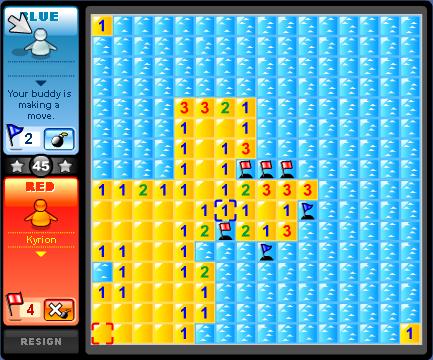 |
Here is a picture of me going in the bottom left hand corner and revealing rather more than I wanted to!! There are 12 mine locations that can be determined from this position, not what you want when you are 4-2 ahead! |
The easiest way to find where a mine MUST be is to find a square that has a number of unexposed mines adjacent to it equal to the number of unexposed spaces next to it, in which case all the spaces must be mines.
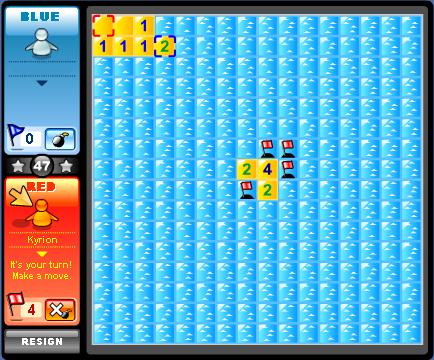
This image is clearly quite early in the match. The centre area with the 4 and two 2's looks tempting but there are four mines next to the 4 and two next to each 2, so there are no mines in the remaining 8 squares around this group.
The top left is a better idea, the 1 on the top row only has one space next to it (to the right), and as there isn't yet a mine next to it the mine must be in this space.
|  |
Obviously picking off the odd mine that you can spot will get you some points, but what you want is a large batch of them. If you find a mine you get another go, so you can theoretically amass 10+ mines in one turn if you are good (and lucky!).
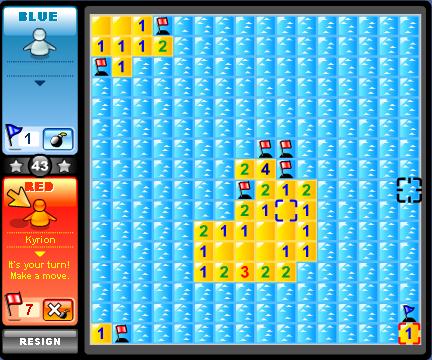 |
Here is a position later in the game where my opponent has had the misfortune of revealing a reasonable size area.
Firstly the 3 at the bottom has three empty spaces next to it, so these must all have mines in (3's on flat sides like this are one of the best ways of getting mines). Also the 1 two squares below the blue marker and the 1 two squares left and a square down from the blue marker both have one free square.
Note that the 1 above the blue marker has a space free, but the mine next to it has already been found.
|
|

