
The King

The King is the most important piece of the game, and has remained unchanged in most chess variants. It is a royal piece, actually the only royal piece in the game, so the match is won by checkmating or stalemating your enemy's king.
Despite not being especially powerful, its value is higher than any of the other pieces: if your enemy attacked both your king and any of your other pieces, you would have to save your king and let the other piece be captured (unless you were able to capture the threatening piece).
The king moves, and captures, to any adjacent cell. This means that the king can go to any cell that is in contact with its present cell (whether circularly, radially or diagonally). You will probably use this movement to make your king escape from danger, rather than to attack, but the king can be used to capture just as the other pieces can.
You cannot move your king to a cell where it would be in check. Actually, you cannot move any of your pieces in such a way that you leave your king in check, since such movements would be illegal.
Examples of movement: in all the following examples the color of the circles will mean:
Black - Cell where the king currently is
Red - Cells to which the king can move or capture
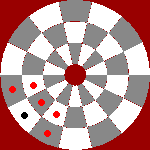
The image above shows the movement of the king from the 1st crown.

Another example of the movement of the king, in this case situated in the 3rd crown.

For a king situated in the centre, just remember that it moves to any adjacent square. This means that in this case the king is able to go to any of the cells in the 3rd crown. The king seems to have more escaping ways from the centre, but it is also a dangerous position where it can be more easily exposed to check.
Previous: The Diplomat | Next: A Final Word
