
Dateline: 14 June 2001
Microsoft bashers took to the Net in droves this week, protesting the company's latest attempt to extend the functionality of
Internet Explorer. The controversial piece -- a new feature in the browser called Smart Tags -- promises to improve our ability to navigate the Web.
In fact, the latest hubbub has little to do with Microsoft, operating systems or Web browsers. This story perfectly illustrates the ever-growing impact of computer networking and communications on our daily lives.
Microsoft's Smart Tag feature first appeared in beta versions of
Windows Office XP. Using
eXtensible Markup Language (XML), a person can annotate keywords in documents with "links" (not necessarily Web hyperlinks) to additional information on related topics.
The feature seemed harmless enough. Although Smart Tags have been designed for sharing, in Office XP the content publisher retains full control over their use. Precursors to this feature appeared in earlier versions of Office that automatically recognize and create hyperlinks for
URLs and email addresses. Although this behavior has irritated some people, it has generated nowhere near the amount of angst that Internet Explorer Smart Tags have already generated in their brief public exposure.
In Internet Explorer, Smart Tags are links on Web pages generated automatically by the browser, not the page author. A Smart Tag appears and functions differently than an ordinary hyperlink.
IE6 renders Smart Tag-annotated keywords with a squiggly purple line similar to the red and green underlines Microsoft Word uses for spelling and grammar errors. Moving over a tagged word with the cursor causes IE to display a clickable icon. Then, clicking on the icon raises a pop-up window containing informative text and hyperlinks as defined in the tag's markup.
In its current form, Smart Tags generally appear for the names of sports teams, colleges and companies as illustrated below. Microsoft's keyword dictionary will likely expand significantly in the future. Some people fear that the choice of content for specific Smart Tag keywords will be slanted toward the company's own interests, and that Microsoft might someday encourage "bidding wars" for keyword tagging.
Background
What Is a Smart Tag?
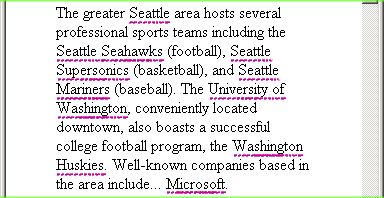
They can behave like "hyperlinks on steroids," but the function of Smart Tags can also be altered in various ways. First, Microsoft will provide (an as-yet undefined) programming interface for third parties to build Smart Tag add-on modules, modules that can differ substantially in their behavior from Microsoft's base implementation. Microsoft will also provide a mechanism (a new <META> tag) that allows Web authors to disable Smart Tags on a page-by-page basis. Finally, the browser user can completely disable Smart Tags. Microsoft claims the feature will be disabled by default in the official release of IE6.
Several companies before Microsoft have experimented with technology similar to Smart Tags. NBCi unveiled the QuickClick program last year, billing the free service as "a speedy new way to get information" that avoids "Web rage." Until a few months ago, Third Voice offered the Third Voice 2000 "search and annotation tools" to the general public. The Gooey annotation utilities likewise faded from existence, but a few other services, such as
CritSuite remain viable.
These precursors to Smart Tags received little of the scrutiny that Microsoft now faces. Integrating such a feature too closely with the world's most popular Web browser alarms some people. Others also assume the worst of Microsoft's intentions.
When Windows XP ships (scheduled for later this year), it will include Internet Explorer 6 (IE6). Recent test builds of Windows XP with limited public distribution have shown Smart Tags incorporated into IE6. Microsoft did not publicly announce the feature nor did they include it in any official XP Beta release to date.
However, Microsoft appears committed to keeping Smart Tags in IE6, and several Microsoft officials have already come to the defense of the feature. The Wall Street Journal quoted Chris Jones, vice president for Windows XP development, as saying
Shawn Sanford, a Microsoft product manager, acknowledged the controversy as quoted by Newsbytes:
Opponents of Smart Tags object to the technology on a number of grounds, ranging from security and privacy concerns to questions of copyright law
[3] to fears that the tags will become a marketing weapon. One writer even created a parody to illustrate one worst-case scenario.
[4]
The chart below summarizes arguments on both sides. Who is right?
The uproar over IE Smart Tags underscores our growing reliance on computer network communications. We object to Smart Tags in Internet Explorer because they have the potential to interfere with our ability to gather (or publish) the information we want on the Web. No longer just a "toy," the Internet has become a serious tool for important work, and the tendency of Smart Tags to clutter pages with unwanted data will be difficult to avoid.
Smart Tags make sense in authoring tools like Microsoft Word. Tagging allows us to augment traditional written communication in the context of our thinking. Internet Explorer Smart Tags, however, literally require the browser to guess at this context and our intent. Alternatively, we could say that Smart Tags in today's Web environment fail to implement a two-way communication necessary for maximum usefulness.
In the future, the Smarter Tag (tm) will take full advantage of the network, either
local area networks (LANs) or wide area networks like the Internet. These tags will interact with content providers, either directly or through knowledge bases. For example, the person or agent viewing a tag might ask the page's author or content management system for clarifiying details. Consumers could also recommend additions or changes to the page. A Really Smart Tag (tm) would recognize the personality of the user and present itself accordingly. Close-knit network communities like corporate
intranets will benefit the most from future smart tagging.
Perhaps the real problem with Smart Tags is not that they are being implemented in a Web browser, but that today's Web browsers do not function as proper authoring tools. Dave Winer of Userland Software and
Scripting News fame advocates personal authoring/collaboration tools for the Web and has closely followed the Smart Tags controversy. Watch for future innovations in user-level networking and communications to emerge from many different places like Dave's, not just the folks at Microsoft.
Old Idea, New Precedent
Microsoft's Position on IE Smart Tags
"Smart Tags represent another step in personalizing the Web and helping bring it to life for individuals by allowing them to get the information they want in the way they want it."
[1]
""We believe in total empowerment of the user to decide what content they want to look at. Everybody tends to focus on the negative side of this like we're going to expose (users) to a lot of bad content ... I think we're going to expose people to a lot of good content."
[2]
Critics' Position On Smart Tags
Opponents Advocates Annotating Web pages without the author's permission is rude and may violate copyright law Other companies have done it for years Link content will become commercialized, biased, and/or offensive The Web is what we make it, technology is not to blame; there is much potential for good Violates interface design principles Can improve quality of sparsely-linked content; is an optional feature Publishers should be able to opt in, not be forced to opt out Majority of publishers will not want to opt out; users lose if opt ins don't happen Exposes security weaknesses, invites crackers Does not add any new security problems that don't already exist somewhere else Invades our privacy Smart Tags not that smart Microsoft cannot be trusted to "do it right" Microsoft isn't so bad as some people claim Smart Tags and Computer Networking
The Future of Smart Tags
