

CONSIDER:
-- There's Something About Peppermint Patty.
-- Linus has a huffing problem. If someone had spilled paint thinner on Linus' security blanket, this would explain his odd behavior over the years. Always cuddling it to his face, going through withdrawals when someone hides it or puts it in the dryer, feeling euphoric when the blanket is returned to him.
-- Lucy repeatedly offers to get on her knees and hold still while Charlie Brown runs up behind her and does something he has wanted to do for years. At the last moment, Lucy disengages, then laughs at Charlie Brown's embarrassing position. Charlie Brown is left on his back, on the ground, staring at the sky and wondering what just happened.
-- Schroeder shows skill beyond his years at playing his toy piano, but often seems uncomfortable interacting with his peers. Undiagnosed autism?
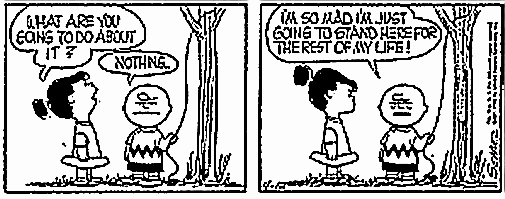
-- Q: Which regular Peanuts character has said, "I'm just going to stand here in the rain until I catch pneumonia and DIE."
.....Charlie Brown?
.....Linus?
.....Snoopy?
A: all of the above.
Under their veneer of cute characters and magic kingdoms, children's stories often deal with painful adult themes. Little Red Riding Hood offers a thinly veiled warning against rapists and child molesters. Alice In Wonderland grows and shrinks and gets threatened with decapitation, playing on children's fears of puberty, aging, death. Where The Wild Things Are has Max acting like a monster, threatening to eat his mother. Freud would have had a field day.
The same themes bubble up through Charles Schulz's 17,897 daily and Sunday comic strips. I'm exaggerating about Linus' addiction to his blanket, Schroeder's obsession with Beethoven and his piano, the twisted relationship between Lucy and Charlie Brown. But at the heart of it, the themes of loneliness, alienation and pain are very real. Why is Linus so "insecure?" Why do we never see adults or The Little Red-Haired Girl except "off-camera"? Why is Lucy such a -- to put it politely -- "fussbudget?"
PEANUTS GROW UNDERGROUND seeks to uncover and discuss these hidden themes. Submissions are welcomed at deidzoeb13@yahoo.com. I'm trying to keep this subsite down to a PG or PG-13 rating, discussing adult themes in clinical terms, using only "foul language" that would pass on network television. Facetious articles and throwaway gags should be taken with a grain of salt. (Linus a huffer, indeed! How could he be, when his blanket is always getting taken away and washed?)
FEATURED ARTICLE:
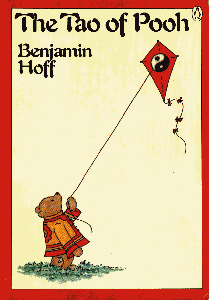
Benjamin Hoff's The Tao of Pooh
Similarly, you can use examples from Peanuts to explain the muddy concept of POSTMODERNISM. Then you can hold up Charlie Brown's PoMo world next to Hoff's Taoist Pooh bear, and show how Hoff and Pooh are both full of stuffing.
Read the full story...
Other Articles:
You're obviously a die-hard Peanuts nut, so enjoy some of these other pedantic articles and lists of important (?) dates.
FUTURE TOPICS: