



- call for deeper probe of imprisoned Coast Guardsmen
Boat operators at the Parika Stelling are convinced that like Dweive Kant
Ramdass, foul play was responsible for the deaths of Henry Gibson and
Dinanauth Jainarayan, and the disappearance of Jainarayan’s son, Rickey.
While not pointing fingers, the boat operators are unanimous in their
conviction that despite the post mortem report which stated that the men died
from drowning, the men were murdered.
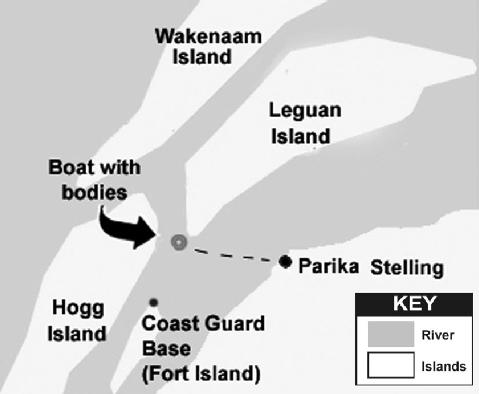
On August 10, the bodies of Gibson and Jainarayan were discovered in a boat
that was tied off the coast of Leguan.
A report prepared by the army’s Board of Inquiry had described the
circumstances surrounding the men’s death as an accident.
“The accident occurred at a time which the Coast Guard vessel was reportedly
moored at the Fort Island wharf,” the army had stated.
However, the boat operators disputed this, pointing out that the damage to the
men’s boat was a cover-up for their murder.
According to the boat operators, some of whom had been in the business for as
many as 26 years, had it been a legitimate accident, the boat in which Gibson
and Jainarayan’s bodies were found would have sustained much more damage and
the bodies would have been badly mutilated.
“If a speed boat jam dat boat it would sink it and de propeller would’a
cut up dem men bad bad. No man would’a deh hanging out like how dem men de
hang out,” one of the boat operators told this newspaper yesterday.

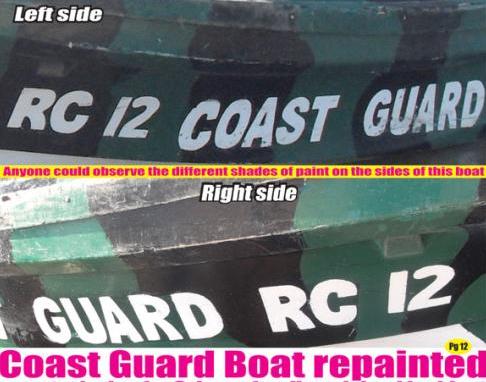
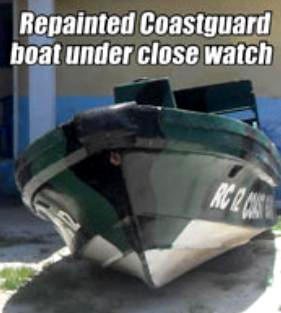
The GDF Coast Guard vessel appears to be the centre of attention as it is now positioned just outside the door of the Parika Police Station.
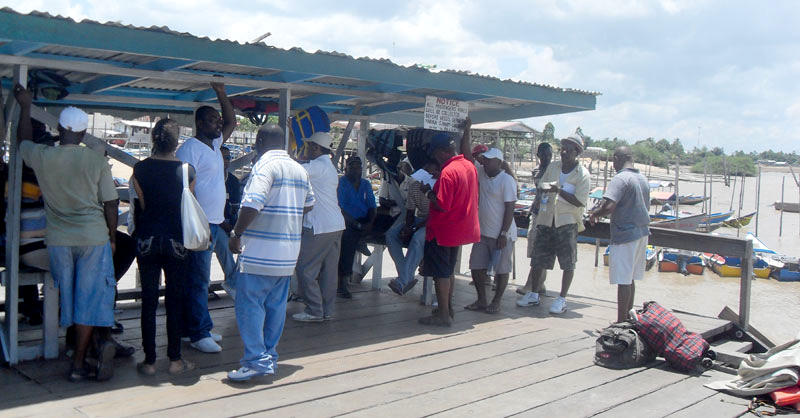
Boat operators speaking with reporters from Kaieteur News yesterday.
Another point of contention was the post mortem report which gave the
men’s cause of death as drowning.
“If that is the case then de men must be drown and jump back in de boat,”
one of the operators said, sarcastically.
“You could see dem people get murder man. Dey drown dem people and put dem
in de boat,” one operator concluded.
They pointed out that there was not an ounce of blood in the boat in which
Gibson and Jainarayan’s bodies were found.
The boat operators’ suspicions grew even more when they were shown a copy of
the army’s findings as declared in the report of the Board of Inquiry.
The report stated that a re-supply trip to Parika was done by the Coast Guard
stationed at Fort Island between 4:35pm to 5:55 pm, on the day of the
incident.
The army claimed that the Coast Guard vessel returned around the time
Jainarayan’s boat was on its way from Parika to Hogg Island.
The vessel was commanded by Coast Guard rank Hart, who was the reported
mastermind of the abduction, robbery and murder of Dweive Kant Ramdass.
According to the army findings, Jainarayan called his son Rickey who was at
Hog Island and told him to pick him up at Parika.
Rickey Jainarayan and boat captain Henry Gibson, departed Hogg Island at
5:00pm for Parika and reached their destination at approximately 5:30pm.
They then left Parika immediately for Hogg Island.
The army’s findings stated that Jainarayan’s reputed wife Salim Rahaman
called him at about 5:40pm and he told her that they were on their way.
Approximately 10 minutes later she called again and did not get through to
him.
She continued to call throughout the night but received no answer.
Most of the operators agreed that the report left enough doubt for
investigators to dig even deeper into the activities of the Coast Guard ranks
on the day in question.
The boat operators reasoned that it is possible for the Coast Guard boat to
come into contact with Jainarayan’s boat while heading back to base from its
re-supply trip to Parika.
A boat operator who has been plying the Essequibo River for more than quarter
of a century explained with its 200-horsepower engine, the GDF Coast Guard
boat should take no more than 15 minutes from Parika to its base at Fort
Island.
The boat with the men’s bodies was discovered just off the coast of Leguan.
“From Leguan point to Fort Island should take about 12 to 15 minutes and the
army boat should even make it less than 10 minutes,” the boat operator
stated.
The army board of inquiry was set up to among other things identify what
measures, if any, could have been taken to avoid the allegations which were
made against the ranks of the Guyana Defence Force Coast Guard.
It noted that several standing orders were breached.
These include: (a) Departure from the location by Petty Officer Kendell for 24
hours and beyond without authorization from Officer Commanding MLED.
(b) Granting of time off by Petty Officer Kendell without authorization to do
so.
(c) No Operation, Location or Patrol Orders were issued to the members of
location Fort Island by the Officer Commanding MLED.
(d) Daily Sit Reps were not sent to Headquarters Coast Guard.
(e) Patrol programmes were not prepared and sent to Headquarters for approval.
(f) No regular Patrol reports were sent to headquarters Coast Guard.
(g) There were no established form of communication between Headquarters Coast
Guard and location Fort Island.
(h) The operation of the Coast Guard Vessel (RC /2) without the permission of
Petty Office Kendell.
(i) The location was abandoned in breach of GDF SOPs and commonsense.
The board of inquiry also found that Headquarters Coast Guard failed to
recognize the signs that Coast Guard rank Hart possessed the proclivity for
insubordinate behaviour.
It was also noted that the,” hands off,” system of command contributed to
the break down in discipline of the ratings stationed at Location Fort Island.
The Board of Inquiry opined that an autonomous location such as location Fort
Island which is required to interact on a daily basis with the general public
should be commanded by a Commander at the rank no less than a Sub Lieutenant.
It found that Hart’s action was in no way a spin-off from the lack of any
order(s) but his intent to disobey instructions when given.
The lack of foresight by the Headquarters Coast Guard to properly administer
location Fort Island may have contributed to the ratings conducting illegal
activities, the board of inquiry noted.
Meanwhile the boat operators say following a meeting with the army’s chief
of staff Commodore Gary Best, they no longer stop on for the Coast Guards.
“We following he orders so anytime they want we stop, them have to follow we
to the nearest port, because we ain’t stopping fuh nobody especially the
Coast Guard, “said one boat operator with approval from others gathered at
the Parika Stelling.
The operators said that over the years they have been continuous victims of
army ranks demanding monies and goods with menace. Most notable was
Sunday, September 20, 2009
