


cen.taur \'sen-.to.(*)r\ n [ME, fr. L Centaurus, fr. Gk Kentauros]
ne of a race fabled to be half man and half horse and to dwell in the mountains of Thessaly.
The centaurs of Greek mythology are creatures that are part human and part horse.
They are usually portrayed with the torso and head of a human, and the body of a horse.
Centaurs are the followers of the wine god Dionysus
and are well known for drunkenness and carrying off helpless young maidens.
They inhabited Mount Pelion in Thessaly, northern Greece.
According to one myth, they are the offspring of Ixion, the king of Lapithae (Thessaly), and a cloud.
He had arranged a tryst with Hera, but Zeus got wind of it and fashioned a cloud into Hera's shape.
Therefore, the Centaurs are sometimes called Ixionidae.

Notorious is their bestial behavior on the wedding of Pirithous, king of the Lapiths.
They violated the female guests and attempted to abduct the bride.
What followed was a bloody battle, after which they were driven from Thessaly.
An exception was the kind and wise centaur Chiron, the teacher of the Greek heroes Jason and Achilles.
In medieval romances, the centaurs were called 'Sagittary'.
Centaurs
Centaurs II
Centaurs of Greek Mythology
Centaurs Legend
The Centaur Compendium
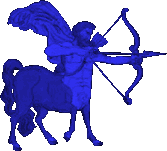
Sagittarius - "the Archer" in Latin, called Toxotes in Greek. Two of the most ancient, surviving sources - Eratosthenes (1st/2nd century CE) and Hyginus (1st century BCE) - say this is not necessarily correct.
In mythology, satyrs were creatures depicted as having the body of a man,
I am a Saggitarus and therefore find the Centaurs quite interesting indeed.
Of all the 12 zodiac signs, Sagittarius has what likely could be considered as the most controversial and/or disputed origin.
Most modern sources (and apparently some ancient sources) like to identify Sagittarius,
the archer, with a kindly mentor centaur (horse with a man's body from the waist up),
Chiron (or Cheiron). Most centaurs were wild, warring, lustful beasts.
However - kindly, wise Chiron was the exception to this rule,
and he was a teacher/mentor to many of the Greek heroes (such as Achilles, Jason, and Asclepius).
These two ancient authors identified the constellation of Sagittarius, the archer, with a mythological satyr by the name of Crotus.
tail of a horse, and the legs (or horns) of a goat.
Like centaurs, satyrs were normally wild, warring, lustful beasts.
Like Chiron, the satyr Crotus was an exception to the rule -
and Crotus was said to be a satyr having a peaceful nature.
Crotus lived on Mount Helicon, he delighted in the company of the muses (sounds like fun),
and he was known as being an avid hunter. In mythology,
Crotus is credited with the invention of the bow.
(Eratosthenes points out that centaurs, such as Chiron,
did not traditionally use bows.)
Crotus was also considered to be the swiftest of the forest and accomplished in his musical skills.
