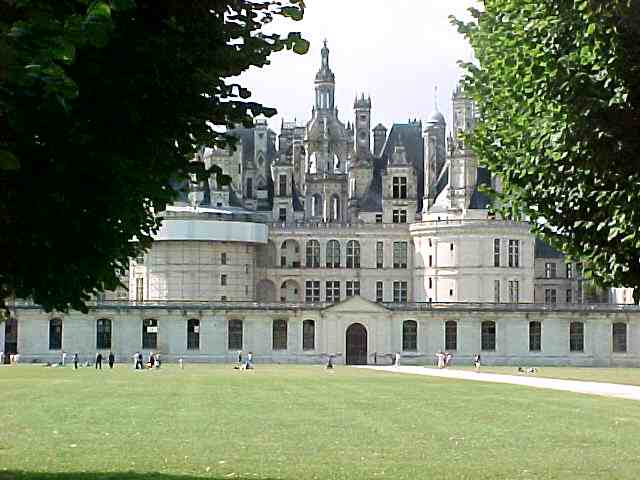

Large stone castles were built in Europe from about the 1100’s to about the 1500’s.
These huge buildings served not only to defend the country from foreign invaders
but as the basic tool in preserving the king’s and the nobles’ power over the land.
The social system was very rigid in the Middle Ages.
Under Feudalism, the basic social structure in this time,
all land was held by the king.
The king gave pieces of this land to various high nobles,
in return for their help in fighting his wars or in putting down rebellions.
Not only did the higher nobles have to fight for the king themselves,
they had to supply a certain number of lesser lords and other knights to help fight also.
These higher nobles then gave some of their land to lesser knights,
in return for their help in battle.
Below all the knights were the serfs, who actually farmed the land.
They gave a portion of their crops each year
to the lord who ruled over them, in return for use of the land and protection.
The king could not be everywhere in the country, especially
with the poor roads and the limited transportation of the Middle Ages.
The king’s vassals, the lords, however, could be all over the country,
with their castles as symbols of their power for all to see.
A man’s son inherited his lands and his obligations to fight.
As time went on, inheritances became complicated,
because there were lords who had no living children,
who had only daughters as heiresses,
and who split their inheritances among their sons (rarely daughters).
When the daughter of a lord married the son of another lord,
the young couple inherited land from both families.
The castle was both a residence for the lord and his family, and a fortification.
It was a strong place for the lord to defend himself
against his enemies (and the king’s enemies, and his overlord’s enemies),
a safe place for him and his knights to return to,
and a place to live which emphasized his power.
A few heavily armed knights could control a large area,
if there was no organized army to go against them.
Not only did knights fight against foreign enemies, they fought a lot against each other,
and they put down rebellions among the peasants.
Showing that you had a lot of power sometimes made actual fighting unnecessary.
In Britain, many of the castles are along borders, to stop raids
by the Welsh and the Scots, and as a basis for raiding in return.
Castles were built to keep out enemies.
When an attack was expected, the drawbridge was raised,
the gates and portcullis were closed, and archers were stationed on the towers.
The walls were not only high, in a well-planned castle,
but they were arranged as much as possible
so that anyone climbing the walls could be shot at from two directions.
Many castles have strange shapes because the castle was designed
to accommodate the terrain, and to catch attackers in a crossfire.
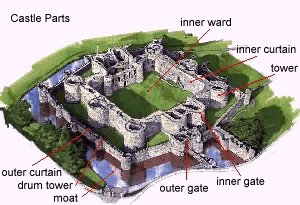
A castle was both a fortress and a residence for the lord and his family.
By means of a castle, the lord could extend his power out over the surrounding countryside.
He offered protection to the peasants over whom he ruled, but he also exerted his power over them.
In peace time, there might be only 10 or 12 knights and their horses
staying in the castle, but when war threatened there would be many more.
Part of the purpose of a castle was to be impressive,
and to be an assertion of the lord’s power over the area.
It also served as a warning to others who might want to take over that part of the land.
Castles were usually on high ground, which was generally not flat,
and there were differing risks of attack from different directions.
Castles were often not symmetrical,
because they were built according to an individual landscape, and the specific needs of the time.
Each castle was arranged differently,
and not all parts stayed as they were originally built.
Successive lords, who might want more room, or a more impressive sight,
added rooms, walls or towers, as they saw fit.
Stone and wood were about the only building materials available.
Slate and thatch (bundles of reeds or other plants in a thick bundle)
were used for roofs, but not for walls.
Fortunately, northern Europe had large amounts of both wood and stone.
Wood didn’t last as long, but, worse, it could be set on fire by the other side.
Stone is very strong in compression (stone can hold up a great deal of weight).
Mortar and gravity kept the stones in place.
Once a stone building is constructed, it needs very little maintenance and lasts a long time.
It is not, however, very pleasant to live in—a stone castle is cold, damp and dark.