
 |
Unit Plan Shawn Parker English 517.30 Western Carolina University Dr. Mary Warner |
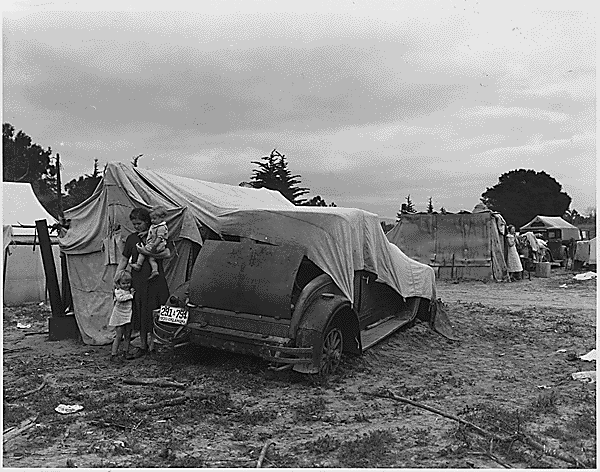 |
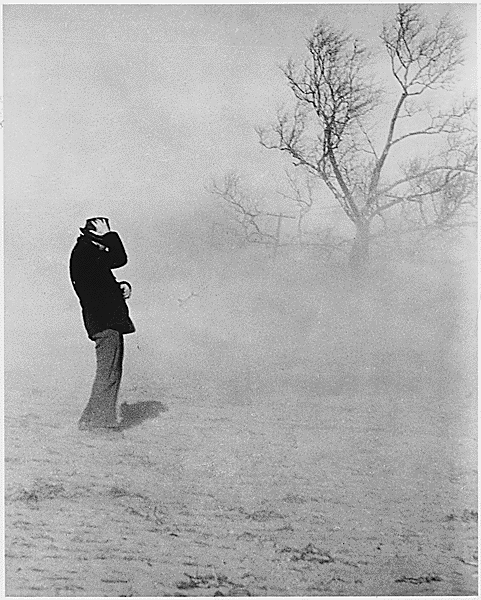
Unit Overview: This unit provides insight into the migrant workers and their struggles during the Dust Bowl Era. Students will study ballads from the era, evaluating various literary devices used in the poems.
Preface to Unit: This unit may be taught as a preface to or in conjunction with the study of other genres of Depression/Dust Bowl era literature. The poems tie well with the novel Cat Running by Zilpha Keatley Snyder, featured in the young adult novel unit which may be accessed on my home page. I have made references to novel parallels for these poems. One poem also relates well to the short story "Learning the Game," an accompanying text in my multicultural unit.
Ballads used in unit:
*These ballads were performed by Woody Guthrie.
Information needed for ordering these are given at the bottom of the page.
Day 1: Provide overview of ballad using textual definition. Allow students to brainstorm examples with which they are familiar. "This Land is Your Land," "Ode to Billie Joe," and "The Legend of Tom Dooley" are good examples to discuss. Include in discussion the stories/events that led to the writing of such works. Allow students to listen to these ballads to aid in discussion.
Information on ballads may be accessed at http://lib.virginia.edu/speccol/exhibits/music/ballads.html
Day 2: Discuss background of Dust Bowl era. Information may be accessed at http://memory.loc.gov/ammem/afctshtml/tsme.html
Begin "Talking Dust Bowl." Background information to the poem is given on the link prior to the text. Terms for focus: dialect, rhyme, rhythm, voice, allusion, simile, exaggeration. Read text aloud to students to allow them to hear the author's voice. Ask each student to write a one-sentence summary of each stanza and then mix the order of the statements on a separate sheet of paper. Exchange with a partner and order the statements correctly.
Day 3: "The
Great Dust Storm"
Students will be given background information
to the poem's content provided on the link prior to the text. Teacher
will read poem aloud to allow students to hear the author's voice.
Students will speculate who the speaker is--male or female and age.
Terms for focus: simile, personification, metaphor.
Activity: Students will be asked to
create an illustration to the poem based on the images created by the oral
reading. Materials will be provided for one-dimensional illustrations.
Students wishing to create a three-dimensional creation will be allowed.
Illustrations will be presented on Day 5 of unit.
Teacher note:
If using this unit in conjunction with my young adult novel, this poem
would be appropriate when Sammy tells Cat of the dust storm that demolished
their home.
Day 4: "Dust
Pneumonia Blues"
Discuss what students know about pneumonia
and how this illness might have affected people during the Depression era.
Go over background to poem given prior to
text on poem link.
Remind students of who the "Okies" are and
of the connotations associated. Divide students into groups of four.
Each student will read the poem aloud to the group. Students will
discuss the different students' readings and the effect of the different
readings on the poem's meanings. Students will discuss the poverty
and why the speaker might not have long to live.
Mini research assignment: Research
the physical effects and illnesses that afflicted people during the Dust
Bowl.
Teacher note:
This poem will work well with young adult novel Cat Running when
Cat goes to visit Sammy and realizes her condition has worsened.
Day 5: Students will present illustrations of "The Great Dust Storm." Students will be given the rest of the class period to work in the computer lab locating information about the physical effects/illnesses of the Dust Bowl period.
Day 6: "I
Ain't Got No Home"
Ask two students to read the poem aloud
to the class. Discuss the readings and then each stanza individually.
Give students a 3 X 5 index card on which to write their interpretation
of stanza four.
Teacher note:
This poem will work well with young adult novel Cat Running when
Zane tells Cat of how they lost their home.
Day 7: Students will present
to the class and discuss their findings informally with the class.
"Vigilante
Man"
Discuss with class the meaning of vigilante.
Read
aloud poem to class. First reading will be at a slow pace.
Second reading will be at a much quicker pace. Ask students to discuss
the effectiveness of both readings. Discuss repetition of lines.
Students will choose a partner. With the partner, discuss the following:
This unit would work
well with Out in the Dust by Karen Hesse. For a synopsis of
this text, click
here.
Ballads by Woody Guthrie
may be ordered through your local music store.
WOODY
GUTHRIE
DUST BOWL BALLADS
(RCA Victor),
recorded RCA Victor Studios, Camden, NJ, April 26, 1940;
released early July 1940.
Reissued on RCA/CAMDEN
as "WOODY GUTHRIE: A Legendary Performer,"
(LP CPL1-2099(e),
1977; CD REISSUE: CAMDEN 74321317742, 1995).
