
| [ TITLE PAGE | CONTENTS | INTRODUCTION ] |
The Purari is one of the largest rivers in Papua New Guinea, and near its mouth on the edge of the Gulf of Papua in the Gulf Province, it branches into several rivers which are connected together by a network of passages forming a delta of numerous low-lying forested and swampy islands. The delta extends to the West to include the mouths of several other rivers, including the Pie, Era, Paia and Kikori. A number of tribes live on these islands and adjoining mainland, but this documentation focuses on a group of related tribes in eastern end of the delta, around the mouths of the Purari and Pie. Those tribes are the Koriki, I'ai (also called Iare by the Motu), Varoi, Kaimare, Vaimuru and Maipu'a. According to the 2000 census, they number over 7,900 people, although local people report that there are as many again of their relatives who have migrated to Port Moresby and other cities of the country. (See more notes on the people and population in the Culture section.)
These tribes all speak mutually intelligible dialects of the same language. The tribes have no overall name for their people group, nor their common language; instead they apply the names of the various tribes to the dialects they speak. Amongst linguists (e.g. Wurm & Hattori, 1981), however, the language group is primarily known as the PURARI language, after the river, and it is classified as a branch of the ELEMAN SUB-PHYLUM-LEVEL STOCK (42,345 speakers) of the TRANS NEW GUINEA PHYLUM of PAPUAN LANGUAGES. Alternative names are KORIKI (which is actually just one of the dialects) and NAMAU (which is deprecated as an insulting term by the people themselves).
This map from Wurm & Hattori (1981)[1] clearly shows the location of the tribal group near the mouths of the Purari and Pie (to the lower right).
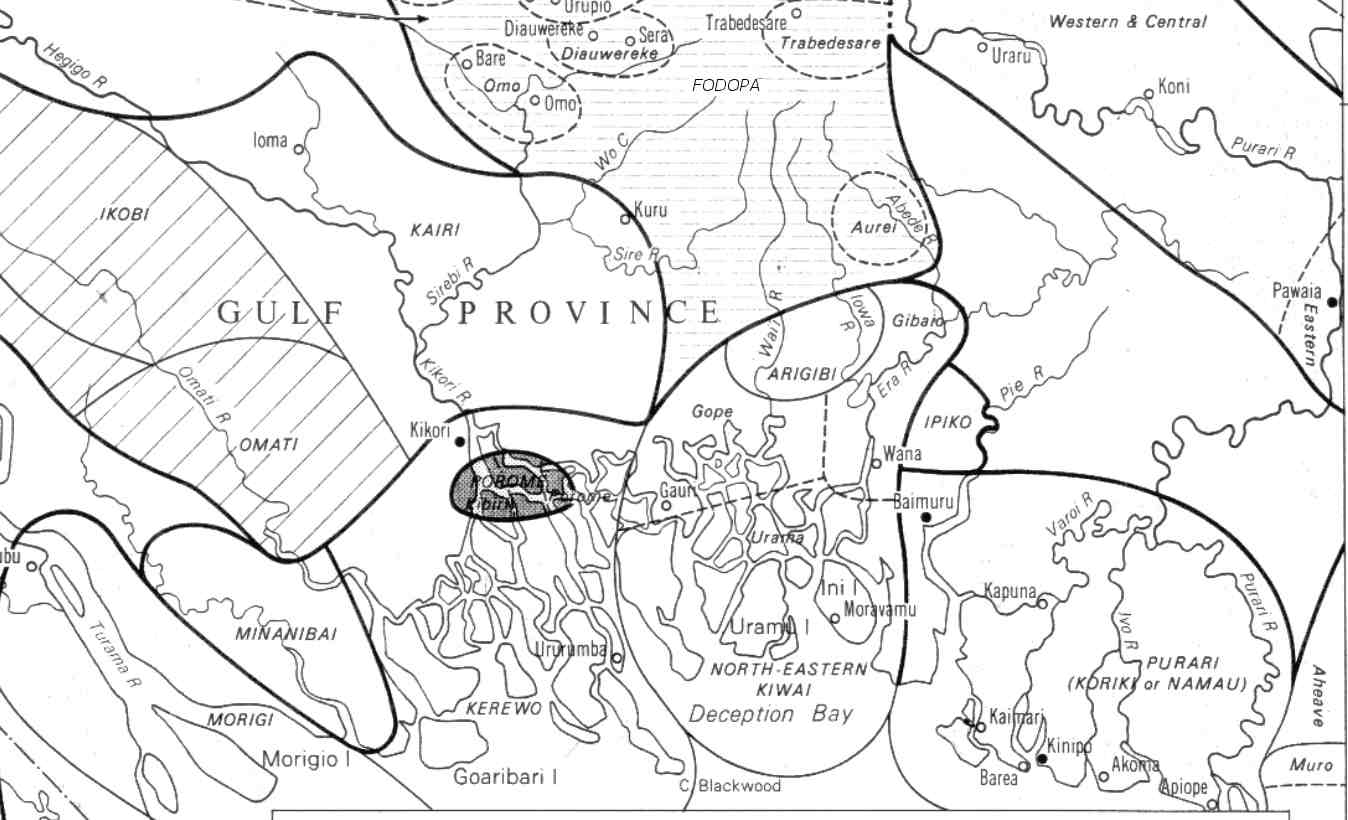
The map also shows the location of the main service town, Baimuru. This town has government offices, a wharf, an airstrip, a general store, a hospital, a primary school and a sawmill. Also located in the PURARI area is Kapuna, where there is a training hospital. The other named localities in the area are villages.
[1] A mistake in naming the FODOPA language group as POROME has been corrected.
