FOODS AND FEEDING
Like human babies, feeding patterns and food types change as they grow. Rule number one is they WILL NOT TAKE A NIPPLE!
Don't be surprised if your new-found babies avoid all food for the first day or two. This is normal for them in the beginning, but at this time, handle them, get them USED to you, then usually around the evening of the second day, they will be ready!
For their first drink, I use a half cup of warm water, and add a little sugar to it, and only about a teaspoon of milk, and just a pinch of powdered milk for baby animals. The mixture will be a little whitish in color, and slightly sweet to taste, and from here I gather my babies up, and take one at a time to feed it - and here's how I do it!
I pour very little of the liquid into a small plastic lid, and gently place it to the baby possum, and gently touch it to its nose, and in most cases it will immediately start licking it out of the lid! Congratulations!! You just completed the first step! Do this twice or three times a day for the next three days, and you're ready for the next step! Also with each feeding, they will get a little more tame - as well as a little larger! They do grow fast! UPDATE! In 2008 I used a "mouser" bottle to start them. This is like a standard hamster (or small animal) bottle, but the spout lacked the traditional metal ball, and the hole through which the liquid comes is much smaller, and I'll admit, it does drip at feeding time, so remember to feed them over a large bucket to catch the drippings! Anyways this method seems to work better than the "lid" method spoken of here, but I still used the lid for their very first drink! Anyways the whole bottle can be placed into the fridge between feedings, but I kept it room-temperature for the day with no harm done, but made new mix for them each day. Also I substituted the sugar for Karo (or some other brand) corn syrup, which is a thick, very sweet liquid, and is perfect for mixing into things, and only a very small amount is needed.
Keep them on this diet for about a week, and with each passing day they will eat (or drink) a little more with each feeding, and increase the calcium intake ever so slightly (THEY WILL NOT DRINK STRAIGHT MILK!), and after about a week of this, they're ready for the next phase (Over all, they like their drink to be "mostly WATER"...... and if their drink is too "strong" they will simply refuse to drink it, so please "keep it mellow" for them!).
APPLE SAUCE
This is a WONDERFUL medium for introducing them to solid food! I buy several small jars rather than one big one, and I add to one jar the following ingredients: A pinch of powdered milk (or calcium-based reptile vitamin powder), and a small squirt of Linatone, or another similar "fur and coat food supplement" liquid, and I stir it all together, and the completed product should taste like regular apple sauce! Also it's OK to add just a little water to the apple sauce mix, and this can be stored in the fridge.
At feeding time, I heat a little of the sauce, and offer it to them either on a plastic spoon, or a lid, and once they feed on this, I let them have their fill, plus I give their "usual" liquid drink, and I immediately place them in a box, and it is here they will go to the bathroom, and afterwards I'll place them back into their "home" box, in which is kept their original sock, plus several other small items of clothing.
After about a week of this, you will notice how they seem to ever-so-greedily devour this mixture! From HERE, it's time to move them onto "Step THREE"!
One of the classic "I Love Lucy" episodes was the hilarious "Vitameatavegamin" episode, and there's a "possum version" of this that I use for the next ten days or so (No, it won't get them drunk!)
This "Wonder mix" is made of one part lean ground beef, and one part apple sauce (with the usual vitamins - described earlier - added in), and I make it really "soupy" for them by adding to it one part water, and at feeding time, I serve it on a spoon, lid, or small shallow bowl. If they are still unsure about this new food, simply add more water!
They will "lick, lick, lick....... chew, chew", and spit out a small wad of meat from time to time, which is normal, and they will soon learn to LOVE this stuff, and they are fed this for the next two weeks, in addition to their apple sauce, and once they grow to very freely accept this diet, you can omit the apple sauce if you'd like, and replace it with an actual apple, cut into fourths. They will "work" on the apple for a day or three until it's all gone, and another can be added, and in fact, once they get to this stage, I always keep an apple before them!
All their necessary vitamins are added directly into their apple sauce/raw hamburger mix, and slowly I phase out their sugar water/milk mix, and work them over to "just plain water", and if you'd like, add a little Quik-Chik to their water (available at Mc Murray Hatchery), and I keep them on this diet for the two weeks, until they exceed the 6-inch length....... then it's onto the next phase!
From here I move them to a cage, in which is placed a small cardboard box into which they will retire (they are still kept indoors at this time), and there's also another change to the diet!
From here, I get a pack of pure, lean hamburger, and into it I add a dash of reptile calcium powder, a little "fur and coat liquid food supplement", and in other words - the same things I HAVE been giving them - now it's just added to the hamburg, along with a little water. At feeding time they are so tame by now all I have to do is reach my hand in, and they all climb aboard!
I feed them small pieces of the meat, and they will usually eat their fill in about 10 minutes or so, before wanting to wander off, and at this time I take the "full" ones, and place them into their "potty box", along with a small but sturdy container for their water, and after the whole group is fed, I place them into their cage (or "home" box - if you're still using one!).
When it comes to actually feeding them, here's two things to think about:
* When giving them bits of the meat mix, give them even smaller pieces than they think they can handle, otherwise they will appear to choke and gag on it! Some GOOD news is I've never had one DIE from this! Anyways smaller the better!
* This is a good time to choose what ones you will keep as pets! Trust me....... you will want those who take small, careful bites of the food from your fingers! Even though they are still completely harmless at this stage, those teeth stay needle-sharp into adulthood, and those individuals who grab for "fingers and ALL" at feeding time as youngsters, will in turn be a possible danger to you later on! Even an "accidental" bite from an adult can create a bloody mess! Yes....... by all means select those who are gentle feeders!
What about Hydrophobia (Rabies) -
Some good news here! Possums have a naturally low body temperature, so a bite from one is "safe"! If a bite DOES occur though, wash the wound well in case of bacteria, etc.
THE NEXT STEP:
Now that they're feeding well on the meat mixture, and they're devouring apples freely, and they are now going on their second month, and they are between 7-8 inches by now, it's time to add a NEW item! Kitten food!
Wal-Mart "Special Kitty" Kitten food is some good stuff...... when "doctored UP" a little for the needs of the Possum. At first I introduce it to them by tossing in a few pellets, and once they take it readily, I reduce their hamburger to twice a week ONLY......... then eventually ONCE a week! I of course keep apples before them life-long! Also it's a very good idea to introduce them to rabbit or Guinea pig food pellets at this time, since this will get them to eat much-needed greens! I prefer Guinea pig pellets, since this contains more vitamin C, but either will do, mixed in with the dry kitten food. I use about 2/3 kitten food, to 1/3 green pellets, well-mixed.
To "doctor" it up for them, place the dry food in a sturdy bowl, then add a "two second" squirt (enough to moisten the food a little, without forming a puddle of the liquid in the bottom of the bowl), of Fur and Coat Food Supplement over the food, followed by a pinch of the calcium-based reptile vitamins (Yes...... the same things they've been getting ever since you've had the babies!), and this - as well as apples - will become their "Staple Diet" throughout adulthood, and of course other foods can (and should) be given, and a list will follow!
If you choose to release any, now is the best time! By NOW (about 8 inches - not including the tail) they can pretty much survive on their own. It's best to pick a spell of warm and dry weather to do so, and it's best to release them in old woods (with lots of dead trees), preferably near a swamp or river, or a large creek....... and away from roads!
|
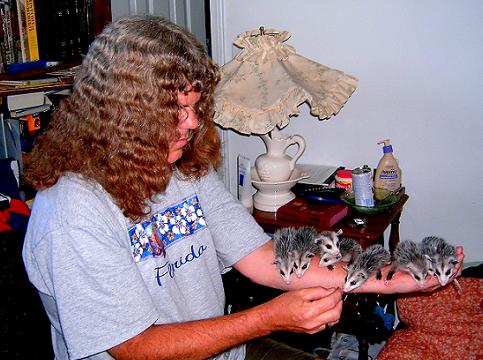 The best "house" for them is a plain and simple cardboard box! This avoids drafts (like a cage), and I give them a new box every several days, and I use a box for them until they reach the body length (not including the tail) of about 6 inches, which takes about 4 weeks, then they "graduate" to a small cage. By this time they are less affected by chill, just make sure they don't get wet! If they do get wet, be sure to keep them from cool, drafty winds till they have a chance to dry off.