
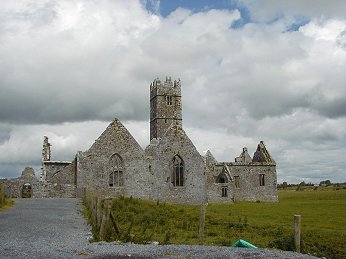
View From The South
There is a tall central tower, which has two storeys with crenellations above the apex of the church roof. The tower is vaulted at the level of a round arch leading from the nave to the chancel. Above this is another storey within the attic of the church and the free tower then rises above that. Throughout the church there are several large mausoleums. In the chancel there is a tomb niche in the north wall with finials and a few decorative rosettes. In the south wall there is a piscina. One of the basins has seven sides. The other has many sides but it is so shallow that the exact shape cannot be determined.
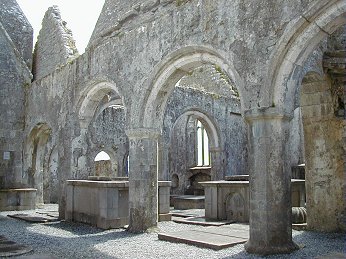
The Aisle Arcade And Transepts
There are several two-light windows in the south wall of the chancel. Some of them have cusped ogee heads. There is a good five-light traceried east window. The cloister to the north of the church has a ten bay arcade on each side except on the east where there are five bays separated by substantial masonry pillars and a small half bay. There are many two-storey buildings surrounding the cloister and to the north. Many of them have fireplaces but the upper floors are missing. One of these buildings has a large fireplace on the ground floor with a large oven behind it. Beside it is a deep circular stone pit, which was apparently a fish holding-tank.
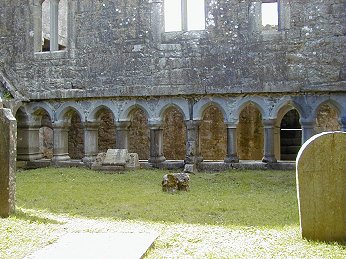
The Cloister
The friary was founded in 1351 by Sir Raymond de Burgo. After the Dissolution it was granted, with other monasteries, to the Earl of Clanrickarde.
