
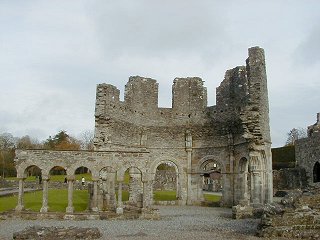
The Lavabo
By 1170 the monastery was said to contain a hundred monks and three hundred laybrothers. In the early 13th century it was the focus of a major breakdown in monastic discipline, a crisis known as 'the conspiracy of Mellifont', during which it resisted visitations from the General chapter and interference from the Anglo-Norman Cistercian houses. The crisis was resolved in 1228 by Stephen of Lexington and the number of monks was fixed at 50 with provision for 60 laybrothers. The monastery was burned early in the 14th century and much of the nave of the church was reconstructed in the 14th and 15th centuries.
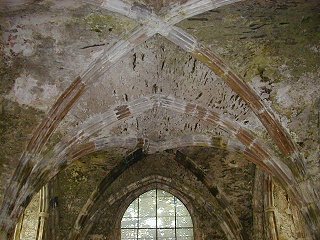
The Vaulting In The Chapter House
For the most part the church has been reduced to foundation level with only the east end standing to any height. Excavations revealed a crypt at the west end. The cloister lies to the south of the church and a small portion of the arcade has been reconstructed. The main feature of the cloister is the two-storey octagonal lavabo in the middle of the south side. Within this there was a fountain where the monks washed before going to eat in the refectory nearby. The most complete building is the fine vaulted chapter house on the east side of the cloister. This was built in the 14th century and now serves as a store for miscellaneous architectural fragments.
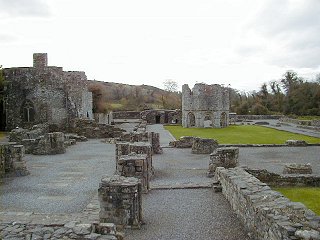
View From The North
Within a century of its foundation Mellifont became a parent or grandparent of more than 35 Cistercian monasteries throughout Ireland. At the approaches to the abbey is a late medieval gatehouse. The abbey was dissolved in 1539 when Richard Contour was abbot. The church was converted into a residence in 1556, but the monks remained associated with the site, for the death of the last abbot is recorded in 1743.
