

The Round Tower
The church to the north of the Round Tower is called the Cathedral. It had a lintelled west doorway, which is now blocked. It probably dates to the 11th or 12th century. This was surmounted by a three-light window. The nave of the church dates largely from about 1200. In the 15th century a south doorway was inserted and the transepts were probably built. There are many traceried windows throughout the church. In the south transept there is a three-light south window and a two-light east window. The chancel has a three-light east window and a two-light south window. There is a small north range of buildings. There is a very high plain chancel arch.
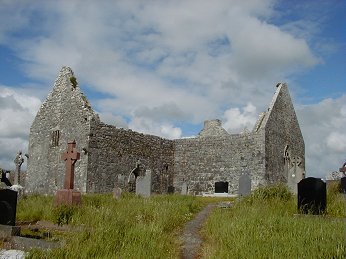
The Cathedral
To the north of the Cathedral is a small nave-and-chancel church called St John‘s Church. It is very ruinous and was not closely inspected. To the east is a rectangular church, which was also not closely inspected. This is St Mary’s Church. The building a short distance further north has been partly re-roofed and has crenellations. This is the Glebe House and was probably the Abbot’s dwelling. It was built in the 13th century. Several hundred metres to the northwest of this cluster of churches is another.
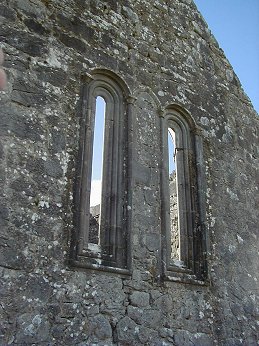
O'Heyne's Church
This is O’Heyne’s Church. It has two fine round-headed lancets in the east wall flanked by thin pilasters. The corners of the east gable also have pilasters. There is also a plain round-headed lancet in the south wall of the chancel. The south range of buildings also has some round-headed lancets. The building cannot be entered but it is possible to see that the capitals of the high chancel arch (arch missing) are richly decorated. The pillars are made from a central thick pilaster flanked by two narrow pilasters. After the Reformation the monastery passed to Richard, 2nd Earl of Clanrickarde.
