
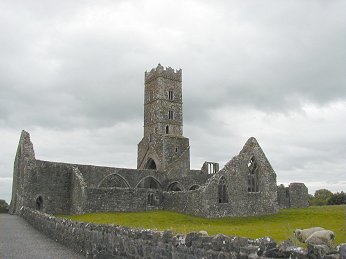
General View
The nave has a south aisle of two bays and there is a south transept, which has a west aisle also of two bays. The transept has an east chapel, which has a double piscina with round basins. The transept has a three-light traceried south window. There is also a double piscina with quatrefoil basins in the east wall. There is a tall central tower possibly five storeys high. It rises the full width of the church until the apex of the church roof where there is a fine vault. Above the vault are three more narrow storeys. There is a crenellated roof. A spiral stairway rises on the north side of the tower to above the vault but it is not now accessible. Underneath the vault is a carved owl.
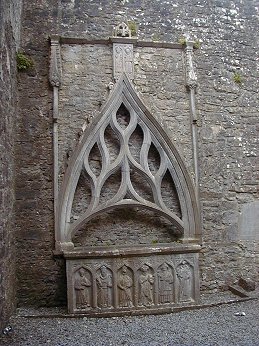
The Flamboyant Tomb
There is another fine traceried tomb in the north wall of the chancel but it has no weepers. This was erected by the O’Daly Family. Beside it is a plain tomb-niche with another opposite it in the south wall. There is a fairly simple four-light east window and a good memorial with raised lettering of 1674 in the north wall of the chancel. The cloister to the north of the church has the east arcade and part of the south arcade in place. Many of the stones in the arcade bear masons' marks including a fleur-de-lys, a letter L and a small leaf. The small room to the north of the chancel is called the guardian's room. Within it is a very fine memorial panel bearing a coat-of-arms and a raised-letter inscription. It is dedicated to the Trimbletown Family and is dated 1667.
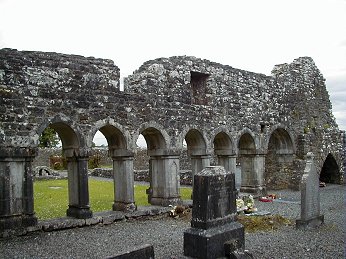
The Cloister Arcade
St Conall founded a monastery on this site in the 6th century. In 1353 William O’Kelly, Lord of Hy Many, founded a new friary for the Franciscans. The tower is a later addition which tradition says was built by the daughter of the founder. The friary was suppressed in 1541 but the church was repaired by the Catholics in 1604. It was besieged by Cromwell in 1650 but the friars were not expelled until only a few weeks before the Battle of Aughrim in 1691.
