
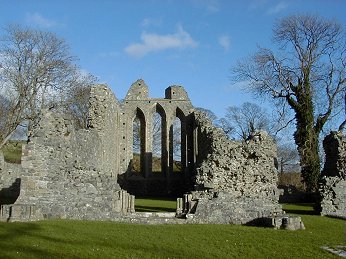
The Chancel From The West
The layout of the monastery followed the typical Cistercian pattern with a large cruciform church to the north of the cloister. Of the original buildings only the east end of the church survives to anything approaching its original height. The choir has three very fine east lancet windows and there are two similar windows in the north and south walls. There was a piscina in the south wall and beside it is the scar of a large triple sedilia. The transepts had twin east chapels and there are traces of the ribbed vaulting in these.
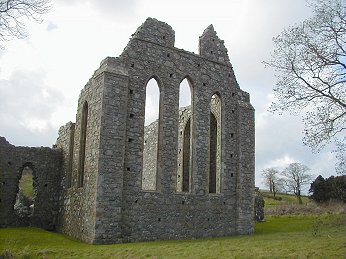
View From The East
Elswhere in the church the buildings have been reduced to foundation level but there are enough traces to show that the church had north and south aisles. In 1404 the abbey was burned. This caused the collapse of the central tower. It was decided at that time to build a new west wall to the church closer to the crossing and to shift the earlier west doorway to the new position. This doorway survives only in its lower courses. There are no remains of the cloister walk and the east range survives to only a few courses high.
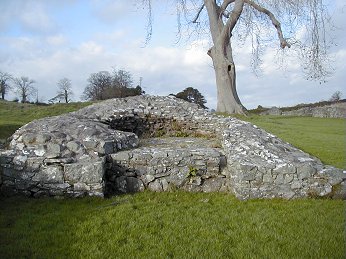
The Remains Of One Of The Bakehouse Ovens
At the SW is the ruin of a bakehouse with a large oven. A smaller isolated oven lies a little further south. To the SE is the foundation of a small rectangular building which may have been an infirmary. At some time an oven with a long flue was been inserted into this building. After the Dissolution the abbey was granted to Gerald, Earl of Kildare.
